
Know a few chords but can’t play one song all the way through?
Here’s how to fix it in 15 minutes a day and finally play songs people actually recognise — no lessons, no theory, and no new guitar needed.

- No music theory. You will never be asked to read a stave.
- Works with the guitar you already own — acoustic, electric, nylon, borrowed.
- 15 focused minutes a day. Miss a day and nothing resets.
G — then a long pause
Three seconds to reshape your hand. By the time you get there, the song has gone without you.
G → C, in time
The change lands on the beat. Your strumming hand never stops — and it finally sounds like the record.
The real problem
It was never your fingers. It was the loop.
You watch a lesson. You learn a shape. You go looking for a song, find the tab, and get four bars in before a chord arrives that your hand cannot reach in time. So you slow down. Then you stop. Then you play the one riff you can already play, because at least that sounds like music.
A week later the guitar is behind the door. A month later you open a new course, and it starts you on the C chord you already knew a year ago.
You are not bad at guitar. You have been practising the one thing that was never the bottleneck.
What waiting costs
Another year of “I’ll get back to it” is not neutral.
Guitar does not sit still while you are away from it. It decays — and it decays from the top, taking your best-earned progress first.
You start over, again
Every restart burns the calluses, the finger memory and the confidence you already paid for. Six months of stop-start work leaves you exactly where three weeks of steady work would have.
The guitar becomes furniture
It stops being an instrument and turns into an object you feel slightly guilty about. Most people never sell it. They just stop looking at it.
You stay a permanent beginner
Four years in, still on lesson one, still unable to sit down at a party and play something. Not because it is hard — because nobody ever aimed your practice at the part that was blocking you.
Let’s kill this first
Talent is the story people tell after they quit.
Nobody watching you struggle with an F chord is thinking about talent. They are watching a mechanical problem with a mechanical fix.
“I started too late.”
There is no too-late age for chord changes. What most people lack is patience with the boring middle — so they quit at the exact point the hand is about to click.
“I have no rhythm.”
You have rhythm. You lose it because your strumming hand pauses to wait for your fretting hand. Fix the hand-off and the rhythm was there all along.
“My hands are too small.”
Hand size changes which shapes are comfortable, not whether you can play. There is a workable version of every beginner chord for every hand — most courses only ever show you one.
The mechanism
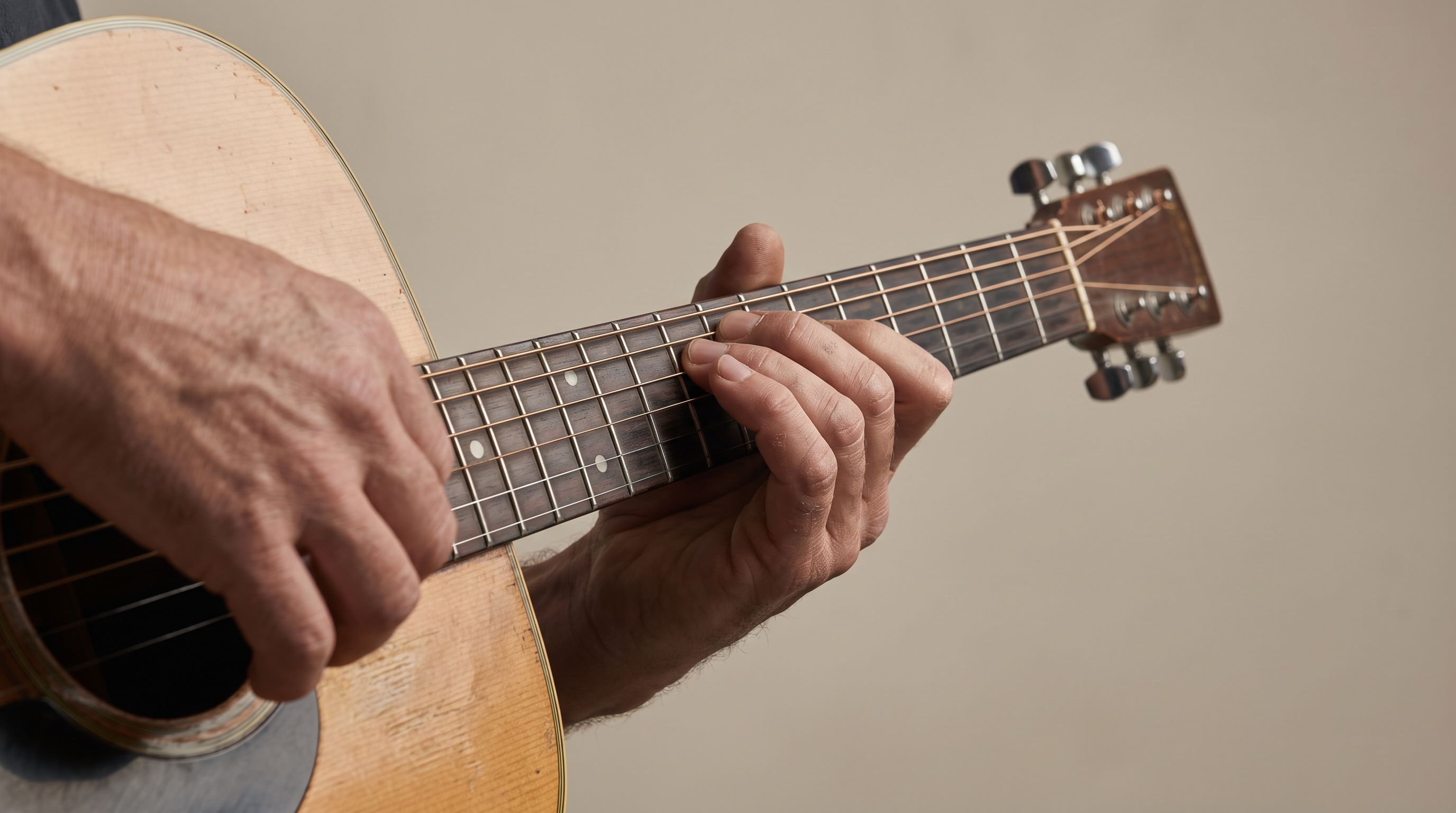
The switching gap: the half-second nobody teaches.
Every course on earth teaches guitar as a list of shapes. Here is C. Here is G. Here is F, good luck. You collect shapes the way you collect vocabulary in a language you cannot speak.
But a song is not made of shapes. A song is made of the movement between them — a half-second window where four fingers have to lift, travel and land together, in time, without you looking.
That window is the only thing standing between you and every song you want to play. It is also the one thing almost nobody practises directly, because it feels like practising nothing.
Where the difficulty sits
IllustrativeRoughly two thirds of the work that makes you sound like a player sits in the movement — and it is the slice your practice hour almost never touches.
The fix
GuitarLowKey trains the movement, not the shapes.
It is a practice app for people who want to play songs, not collect chord diagrams. Every session is fifteen minutes, aimed at one specific change your hands cannot make yet, and it ends with that change inside a real piece of music.
Lowkey is the point. No streak guilt, no leaderboard, no theory homework. Just the smallest useful thing you can do today, and a guitar that starts sounding like a guitar.
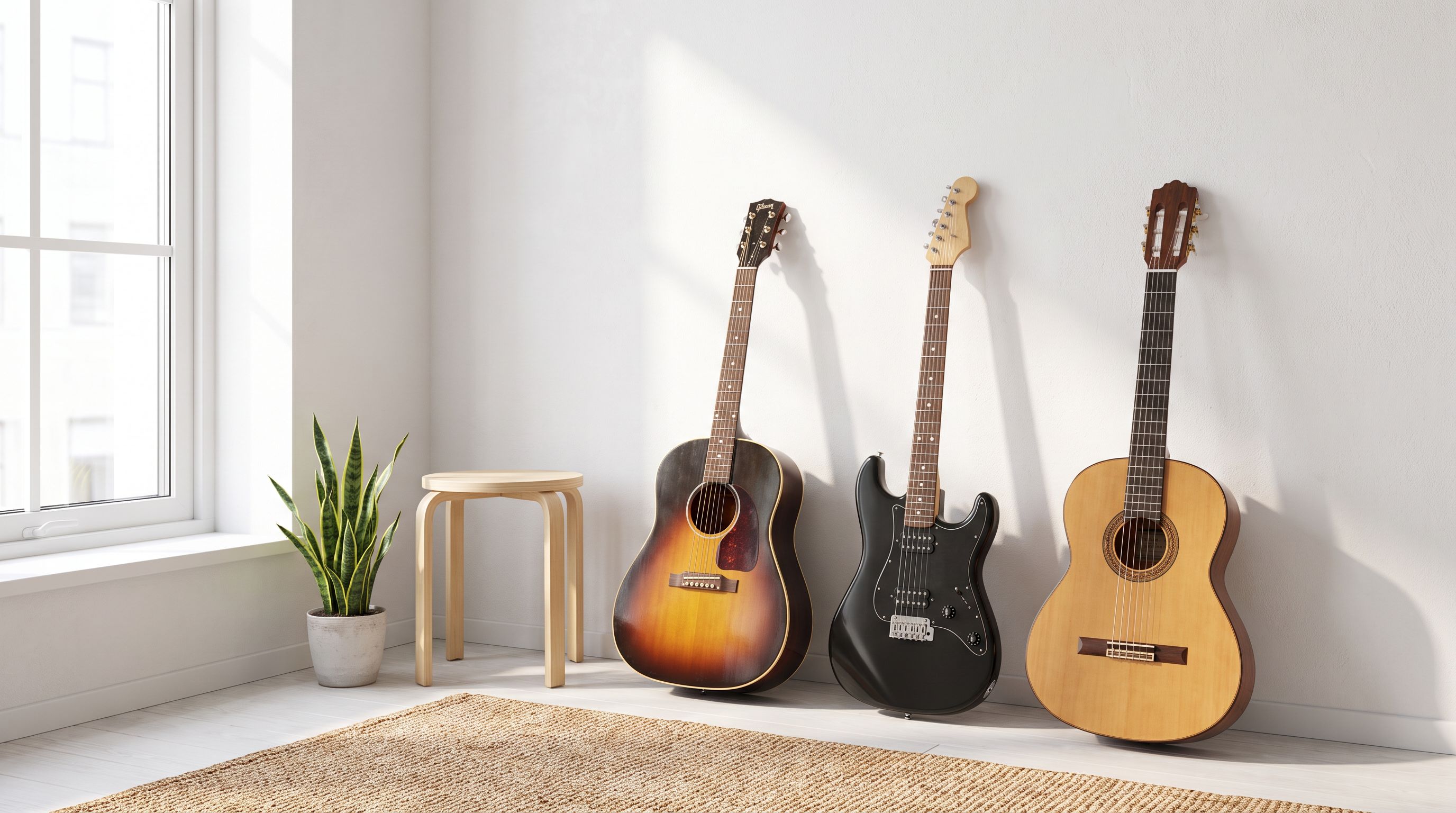
Any guitar
Acoustic, electric, classical, three-quarter size, the one in your parents’ loft. If it holds a tuning, it works.
Fifteen minutes
Short enough to do on a Tuesday you did not plan to practise. That is the whole trick.
Songs from day one
Every session ends on music, not on an exercise. You always put the guitar down having played something.
How it is different
The Loop: one change, ramped until it stops being hard.
Instead of a lesson, you get a loop. We isolate the single transition that is blocking the song you chose — say G to C — and you play only that, over a groove, for a few minutes.
The tempo does not sit still. It creeps up as you land the change cleanly and eases back the moment you start missing, so you spend your whole session at the edge of what you can do rather than comfortably below it or hopelessly above it.
Then, in the same fifteen minutes, that change goes straight into a section of the real song. Nothing you practise stays an exercise.
- One target per session, chosen from the song you want to play.
- Tempo that follows your hands instead of a fixed lesson plan.
- Every loop cashed out in music before you stop.
A session, end to end
- 0:00
Warm the change
G to C, slow, no strumming. Just the landing.
- 3:00
Add the groove
Four beats each. Tempo starts nudging upward.
- 9:00
Ramp to song speed
It backs off the moment the change gets scrappy.
- 12:00
Play the chorus
Same two chords, now inside the actual song.
How it works
Three steps, and none of them are homework.
Tell us where you are
Two minutes. What guitar you have, what you can already play, how much time you can realistically give it. No audition, no video upload.
Get today’s fifteen minutes
One change, one groove, one song section — already chosen for you. You never open the app wondering what to practise.
Finish on a song
Every session ends with you playing music, not drilling. That is what makes you come back tomorrow without needing discipline.
What to expect
An honest timeline.
Anyone promising you a song in seven days is selling you the seven days. This is what steady fifteen-minute sessions tend to build toward — assuming you show up most days, not every day.

- Day 1
One clean change
You will not sound like a different player. You will land one transition you could not land this morning — and you will hear it.
- Week 1
Your strumming hand stops waiting
The pauses shrink. The song starts holding together even when the change is not perfect, which is what playing actually is.
- Week 4
A song, start to finish
Not flawless. Recognisable, in time, all the way through — the thing you have been trying to do since you bought the guitar.
- Week 12
You stop thinking about chords
Your hands go where the song goes. New songs become an evening’s work instead of a new project.
The honest comparison
Everything else teaches guitar. We aim at the blockage.
All four of these can work. Only one of them decides, every single day, what the most useful fifteen minutes of your practice would be.
| GuitarLowKey | YouTube lessons | Tab sites | Weekly in-person lesson | |
|---|---|---|---|---|
| What you actually practise | The one change blocking your song | Whatever was recommended today | Nothing — it is a page of text | Whatever you got wrong last week |
| How long a session takes | 15 minutes, decided for you | 45 minutes, mostly watching | Open-ended | An hour, once a week |
| Tells you what to do next | Once a week | |||
| Adapts the moment you plateau | If you bring it up | |||
| If you miss a week | Picks up where you stopped | Feed has moved on | You are on your own | You miss a week of progress |
| Ends every session on music | Sometimes |
From people doing it
The wall.
Messages, clips and screenshots from people fifteen minutes deep into a Tuesday. No actors, no studio, no perfect takes.
@student-handle
Placeholder
Paste a real message from a student here — the shorter and more specific the better.
@student-handle
Placeholder
A screenshot of a real DM works better than a written quote. Keep the original wording, typos and all.
@student-handle
Placeholder
Ask permission, then use first name and initial. Anonymous walls read as invented — because usually they are.
@student-handle
Placeholder
One clip of someone playing a chorus badly-but-in-time beats ten polished quotes.
@student-handle
Placeholder
Keep the ones that name the specific change they got past. Specificity is the proof.
@student-handle
Placeholder
Leave this wall empty rather than filling it with fiction. An empty wall costs less than a refund and a reputation.
FAQ
Common questions
Simple answers about how the web app works — no jargon, no sales pitch.
GuitarLowKey is a web app that trains the chord changes that stop songs from holding together. You open it in your browser, pick a session, and practice for about fifteen minutes.
No. It runs in a modern browser on your phone, tablet, or computer. No app store download, no desktop installer.
Any guitar you already have — acoustic, electric, classical, or borrowed. If it stays in tune long enough to practice, it works.
No. It is for anyone who knows some chords but stalls when they have to move between them in time. Beginners, returners, and self-taught players all hit the same switching gap.
No. Sessions never ask you to read a stave or learn theory homework. You practice the movement between shapes, then put it back into a real song section.
About fifteen minutes. Short enough to fit on a normal day, long enough for one change to improve and end on actual music.
Nothing resets. The app picks up where you stopped. There is no streak punishment and no weekly lesson slot to lose.
You need an internet connection to load the web app and your sessions. Practice happens with your guitar in the real world — the browser is just the coach.
Fifteen minutes from now, one change lands clean.
Open the app, pick your guitar, and start the first session today. Do it again tomorrow and the week after, and the song you have been failing to finish finally holds together.
Works in your browser · No install required
- Works with the guitar already in your house.
- No theory, no notation, no exams.
- Fifteen minutes, chosen for you before you sit down.
- Miss a week and nothing you built is lost.