
Bass Guitar Scales: The Ones Worth Learning First
The major, minor, pentatonic and blues scales on bass guitar, exact fret patterns, fingerings, and how to move them to any key without relearning a thing.

The bass scales worth learning first are the major scale, the natural minor scale, the minor pentatonic scale, and the blues scale, all played as movable shapes with your fretting hand so the same finger pattern works in every key. Start with the minor pentatonic, since most basslines you already know lean on it, then add the major and natural minor scales to understand why those notes work. The shapes below use standard four-string tuning, low to high: E, A, D, G.
What a Bass Scale Actually Is
A scale is a set of notes played in order, one step at a time, that all belong to the same key. On a fretted instrument that set of notes becomes a shape: a repeatable pattern of frets and strings your hand can memorize once and then slide anywhere on the neck. Learn the shape in one key and you already know it in all twelve, because the distance between the notes never changes, only the starting fret does.
That is the whole reason scales matter on bass more than on almost any other instrument. A bass line is a sequence of single notes, not chords, so the notes you reach for while walking between chord changes, filling a gap, or building a groove come straight out of a scale shape you already have under your fingers. Guitarists can strum through a wrong note. A bass player who does not know the scale hits it alone, out loud, on beat one.
You do not need to know the name of every scale to be a good bass player, and plenty of working bassists could not tell you the interval formula for Mixolydian off the top of their head. What you do need is a small set of shapes reliable enough that your hand finds them without you thinking about it, so your attention stays on the groove, the drummer, and the song, not on where your fingers are supposed to go next. That is what this post is building toward.
Standard Bass Tuning, in Case You Are Still Getting It Under Your Fingers
Every shape in this post assumes a four-string bass in standard tuning. If your bass is in a different tuning, none of the fret numbers below will line up, so it is worth double-checking before you start.
| String | Note | Pitch |
|---|---|---|
| 4th (thickest) | E | Lowest |
| 3rd | A | |
| 2nd | D | |
| 1st (thinnest) | G | Highest |
That is E-A-D-G, low to high, the same order as the bottom four strings of a six-string guitar but pitched an octave lower. If you came to bass from guitar, the string names will feel familiar even though the neck is longer and the strings are heavier.
One more thing worth knowing before the shapes below: the interval between each of these four strings is identical, a perfect fourth, unlike a guitar, where the interval between the G and B strings breaks that pattern. That even spacing is exactly why the shapes in this post are so portable across strings, a fact this post comes back to more than once. Any pattern rooted on the E string will produce an identical result rooted on the A, D, or G string, just in a different key, because the distance to the next string never changes.
How a Scale Is Built: Steps and Half Steps
Every major scale in every key is built from the same formula, measured in whole steps (two frets) and half steps (one fret): whole, whole, half, whole, whole, whole, half. Starting from any root note and following that pattern up the neck produces a major scale in that key, note for note.
The natural minor scale uses a different formula: whole, half, whole, whole, half, whole, whole. Notice it shares five of its seven steps with the major scale, just rearranged, which is why a minor scale and its "relative major" scale contain exactly the same notes, only starting in a different place.
| Scale | Step pattern (W = whole step, H = half step) |
|---|---|
| Major | W-W-H-W-W-W-H |
| Natural minor | W-H-W-W-H-W-W |
Once that pattern is set, everything else in this post is just where to put your fingers to play it.
The Chromatic Scale: Every Note, No Skips
Before the major and minor scales, it helps to see the chromatic scale, the one scale that skips nothing. It is every note available on the neck, in order, one fret at a time, with no notes left out.
| Fret | 0 | 1 | 2 | 3 | 4 | 5 | 6 | 7 | 8 | 9 | 10 | 11 | 12 |
|---|---|---|---|---|---|---|---|---|---|---|---|---|---|
| E string | E | F | F# | G | G# | A | Bb | B | C | C# | D | D# | E |
The chromatic scale is not something you play inside a bassline very often, it is not built to sound like a key the way the major and minor scales are. What it is good for is warming up, since climbing one fret at a time forces every finger to move independently instead of leaning on the ones next to it, and for short chromatic passing runs, sliding by a fret or two to connect two notes that are a whole step apart in whatever scale you are actually playing. A four-fret chromatic run, one finger per fret starting with the index, is a common first exercise for exactly this reason: it teaches your hand the one-finger-per-fret discipline before you ask it to skip around inside an actual scale shape.
The Major Scale on Bass
The major scale is the one every other scale gets measured against, so it is worth knowing even though it shows up less often in basslines than the pentatonic and minor scales below. Here is a one-octave C major scale, root on the 3rd fret of the A string, using a common fingering that keeps your hand in one position across a four-fret span.
| String | Fret | Finger | Note |
|---|---|---|---|
| A | 3 | 2 (middle) | C (root) |
| A | 5 | 4 (pinky) | D |
| D | 2 | 1 (index) | E |
| D | 3 | 2 (middle) | F |
| D | 5 | 4 (pinky) | G |
| G | 2 | 1 (index) | A |
| G | 4 | 3 (ring) | B |
| G | 5 | 4 (pinky) | C (octave) |
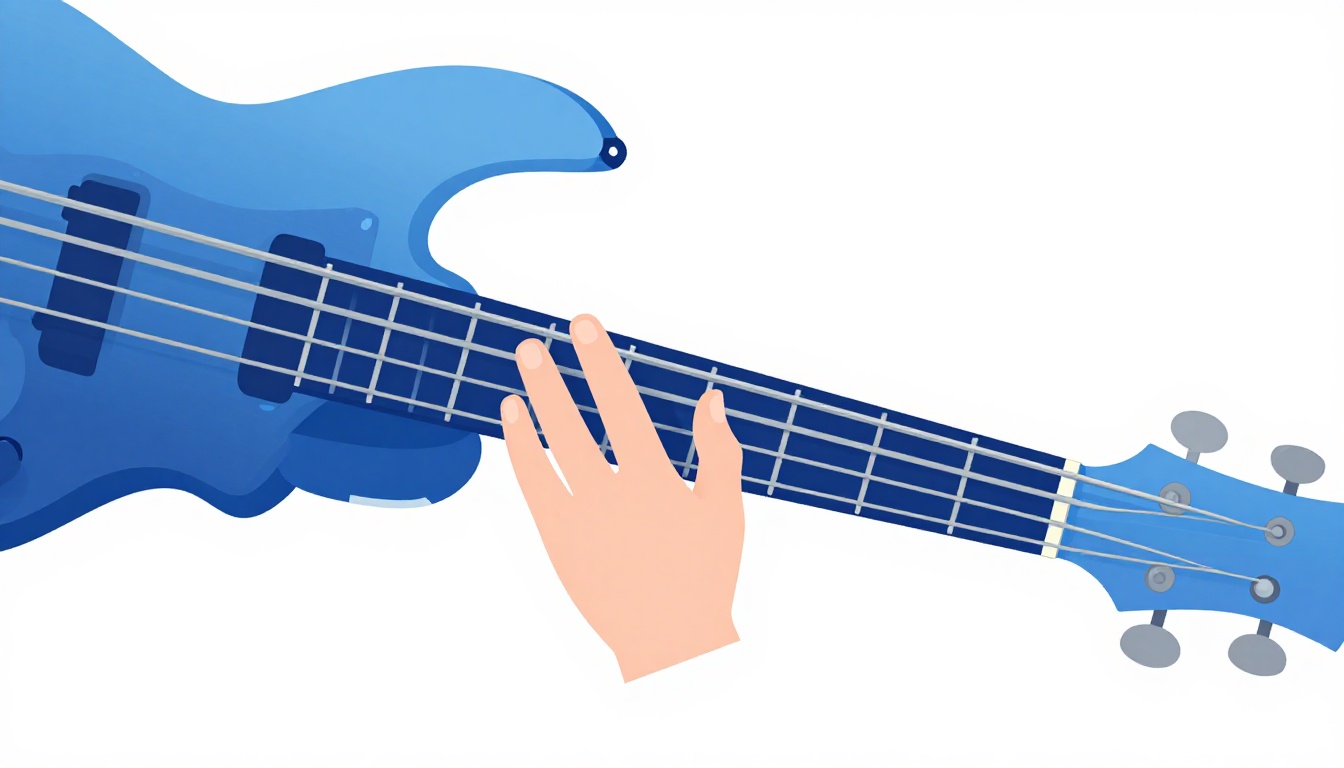
That fingering is a one-finger-per-fret approach, which keeps your hand still and lets your fingers do the moving rather than your whole arm. It is the same shape wherever you start it. Move the root from the 3rd fret of the A string to any other fret on the E or A string and you get the major scale for that new key, with the same finger pattern relative to the root.
The Same Shape, Root on the E String
Because the E, A, D and G strings are all tuned the same interval apart, a perfect fourth, the exact fret pattern above works unchanged one string lower, it just lands on a different key. Here is that identical shape played with the root on the E string instead of the A string, giving you a G major scale.
| String | Fret | Finger | Note |
|---|---|---|---|
| E | 3 | 2 (middle) | G (root) |
| E | 5 | 4 (pinky) | A |
| A | 2 | 1 (index) | B |
| A | 3 | 2 (middle) | C |
| A | 5 | 4 (pinky) | D |
| D | 2 | 1 (index) | E |
| D | 4 | 3 (ring) | F# |
| D | 5 | 4 (pinky) | G (octave) |
Same fret numbers relative to the root, same fingers, same shape, just shifted down one string. This is the payoff of a bass being tuned in even fourths: once your hand learns one major scale shape, it already knows the shape rooted on any of the four strings, not just the one you first practiced it on.
The Natural Minor Scale on Bass
The natural minor scale is the one behind most rock, blues and pop songs written in a minor key. Here is an A natural minor scale, root on the 5th fret of the E string.
| String | Fret | Finger | Note |
|---|---|---|---|
| E | 5 | 1 (index) | A (root) |
| E | 7 | 3 (ring) | B |
| E | 8 | 4 (pinky) | C |
| A | 5 | 1 (index) | D |
| A | 7 | 3 (ring) | E |
| A | 8 | 4 (pinky) | F |
| D | 5 | 1 (index) | G |
| D | 7 | 3 (ring) | A (octave) |
Compare it against the major scale shape above and the difference is three notes: the 3rd, 6th and 7th degrees each sit one fret lower. That is the entire distinction between a major and a minor scale on paper, and it is also the fastest way to memorize the minor shape once the major shape is already familiar, since you are only moving three fingers, not relearning the whole pattern.
The Minor Pentatonic Scale on Bass
If you only learn one scale on bass, make it this one. The minor pentatonic strips the natural minor scale down to five notes by removing the 2nd and 6th degrees, the two notes most likely to clash against a chord if you land on them for too long. What is left is a shape that is close to impossible to make sound wrong, which is exactly why it shows up under so many bass lines you already know by ear without realizing they are built on a scale at all.
Here is the A minor pentatonic scale, root on the 5th fret of the E string, played as a single-position box shape.
| String | Fret | Finger | Note |
|---|---|---|---|
| E | 5 | 1 (index) | A (root) |
| E | 8 | 4 (pinky) | C |
| A | 5 | 1 (index) | D |
| A | 7 | 3 (ring) | E |
| D | 5 | 1 (index) | G |
| D | 7 | 3 (ring) | A (octave) |
| G | 5 | 1 (index) | C |
| G | 7 | 3 (ring) | D |
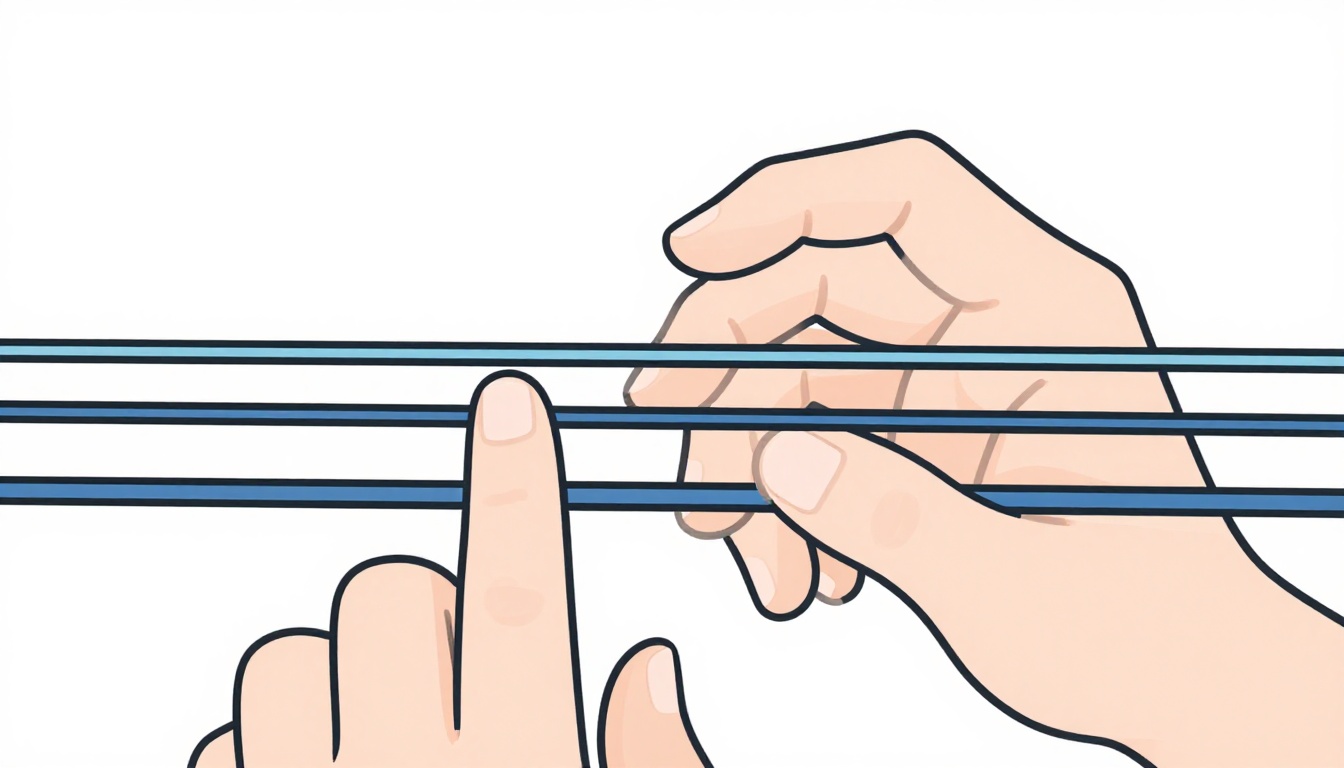
Notice the gap pattern: index finger, then a stretch to the ring finger, repeated across each string. Most players use only the index and ring fingers for this shape, occasionally reaching the pinky for the extra note on the low string. Once that two-fret stretch feels natural under your hand, you can play this shape starting on any fret of the E or A string and have the minor pentatonic scale for whatever key you need.
Part of why this shape is so forgiving is that it is missing the two notes most likely to create a half-step clash against whatever chord is playing underneath it. The full seven-note minor scale includes a 2nd and a 6th degree that, depending on the chord, can sit a half step away from a chord tone and sound like a wrong note if you land on it for too long. Strip those two out and almost every remaining note works as either a strong landing point or a safe passing tone, which is exactly why this shape holds up even when you are moving fast and do not have time to think about which note is coming next.
The Major Pentatonic Scale on Bass
The major pentatonic is the minor pentatonic's brighter cousin, built by removing the 4th and 7th degrees from the major scale instead. It has a lighter, more open sound, useful for basslines under happier or more upbeat major-key songs, funk grooves, and country and pop bass parts that want to avoid the darker pull of the minor pentatonic.
Here is a C major pentatonic scale, root on the 3rd fret of the A string.
| String | Fret | Finger | Note |
|---|---|---|---|
| A | 3 | 2 (middle) | C (root) |
| A | 5 | 4 (pinky) | D |
| D | 2 | 1 (index) | E |
| D | 5 | 4 (pinky) | G |
| G | 2 | 1 (index) | A |
| G | 5 | 4 (pinky) | C (octave) |
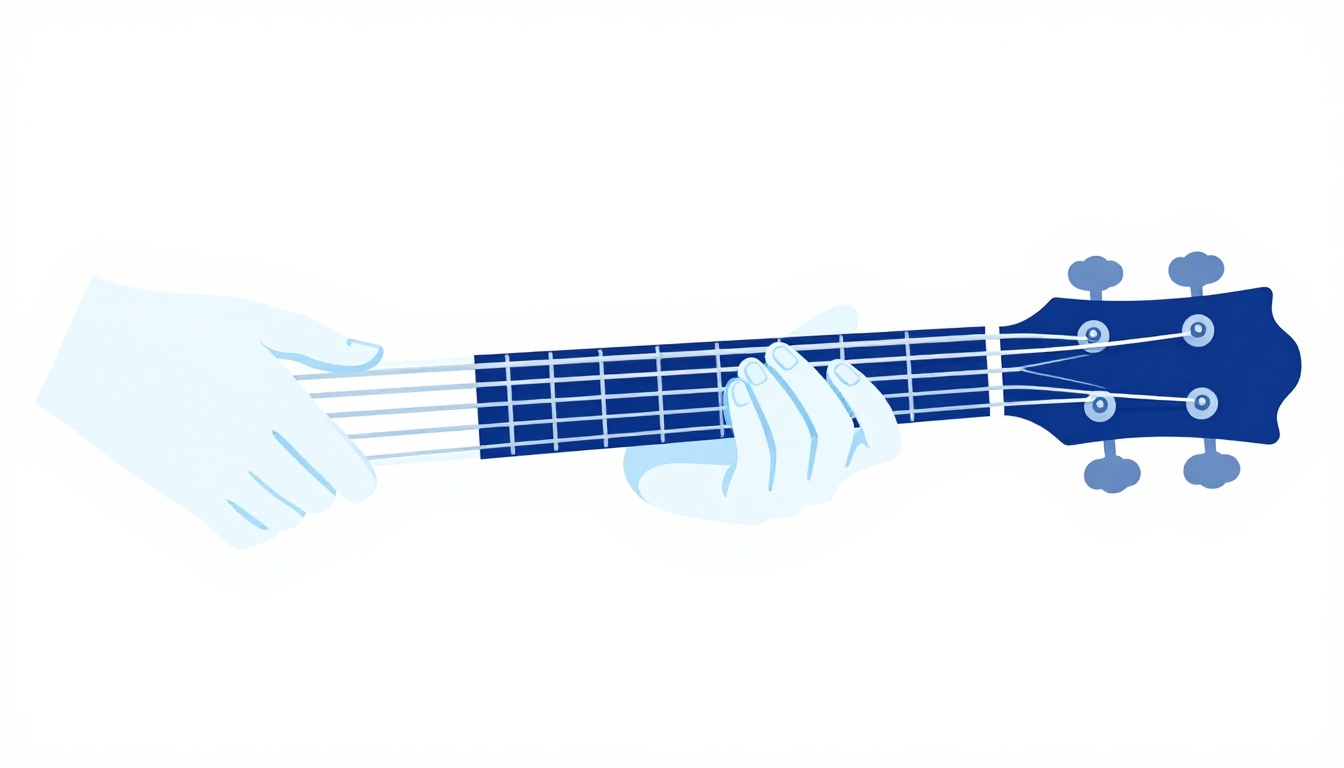
A useful trick: the major pentatonic scale and the minor pentatonic scale three frets down share the exact same shape, just anchored to a different root. C major pentatonic and A minor pentatonic, for example, use the same five notes. Learn one box shape and you effectively know both scales, you are just choosing which note to treat as home.
The Blues Scale on Bass
The blues scale takes the minor pentatonic and adds one note back in: a flattened 5th, sometimes called the "blue note," sitting right between the 4th and 5th degrees. That single added note is what gives the blues scale its bent, tension-and-release character, and it is the note most responsible for making a bassline sound like it is straining against the chord underneath it before settling back down.
Here is the A blues scale, root on the 5th fret of the E string.
| String | Fret | Finger | Note |
|---|---|---|---|
| E | 5 | 1 (index) | A (root) |
| E | 8 | 4 (pinky) | C |
| A | 5 | 1 (index) | D |
| A | 6 | 2 (middle) | Eb (blue note) |
| A | 7 | 3 (ring) | E |
| D | 5 | 1 (index) | G |
| D | 7 | 3 (ring) | A (octave) |
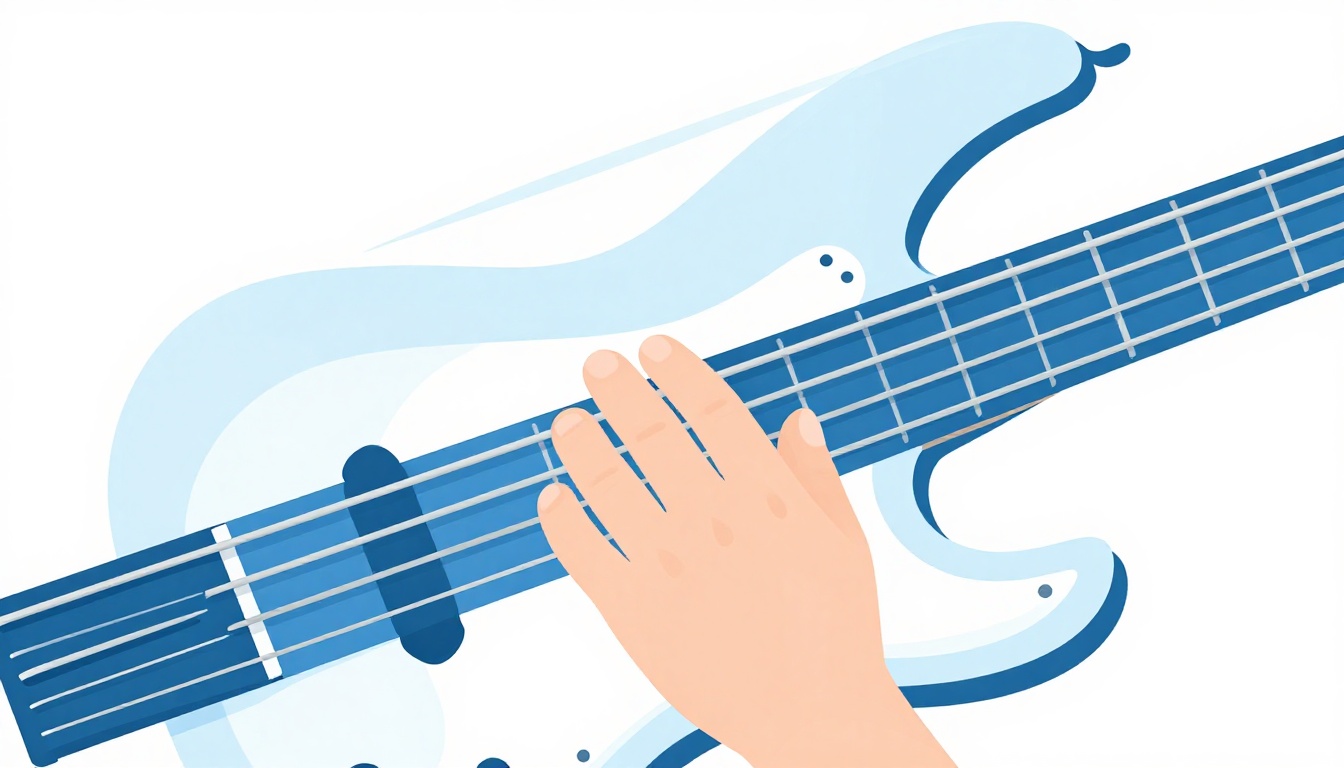
Treat the blue note as a passing tone rather than a note to land on and hold. It works best slid into and straight back out of, connecting the 4th and 5th degrees rather than sitting as a destination in its own right. Overusing it, or resting on it, is the fastest way to make the blues scale sound like a mistake instead of a style.
One-Finger-Per-Fret vs Box Shapes: Two Ways to Finger Every Scale
Every scale above can be played two different ways, and knowing both matters more than picking a favorite.
One-finger-per-fret assigns each finger to a single fret and keeps your hand still across a four-fret span, shifting your whole hand only when the scale needs a fret outside that span. This is how the major and natural minor scale shapes above are built. It keeps your fretting hand economical and is the standard approach for scales that cover more than five notes across two strings.
Box shapes are tighter, usually spanning two or three frets, and are how the pentatonic and blues scales above are laid out. Because pentatonic scales skip notes, the gaps between fretted notes on a single string are often wider (a two-fret stretch instead of one), so the box uses fewer fingers across a slightly wider reach rather than one finger per fret.
Neither is more correct. One-finger-per-fret keeps your hand from having to travel as the scale goes higher; box shapes keep your hand anchored in one spot for scales that do not span as many frets. Learn both approaches so you are not stuck when a bassline needs one and not the other.
You can also mix the two mid-scale, and most experienced players do without thinking about it. A common approach is to play the lower part of a scale as a tight box, then shift into a one-finger-per-fret stretch for the upper notes that fall outside a comfortable box reach, rather than forcing the whole scale into a single fixed hand position. There is no rule that says a scale has to be played with one fingering system from root to octave, only that whatever you choose stays clean and repeatable.
Left Hand Fingering and Why Bass Differs From Guitar
If you already play guitar, your fretting hand fingering habits will mostly transfer, but two things are different on bass and worth knowing before they trip you up.
The frets are wider apart, especially in the first five frets, because a bass string vibrates at a much lower pitch and needs a longer string length to do it in tune. That means the one-finger-per-fret stretch that feels comfortable on a guitar can feel like a genuine reach on a bass, particularly for players with smaller hands. It gets easier with time, but do not force a four-fret stretch on day one; play the same notes further up the neck, where the frets sit closer together, until your hand has built the flexibility.
The strings are heavier and sit under more tension, so you need slightly more pressure from your fretting fingers to get a clean, buzz-free note, especially on the thicker E and A strings. Keep your thumb behind the neck, roughly opposite your first or second finger, to give your fingers something to press against without collapsing your wrist.
Thumb position matters more on bass than most new players expect. Resting your thumb too high, curled over the top of the neck the way some guitarists play, robs your other fingers of leverage and makes the wider stretches in these scale shapes harder than they need to be. Keep it low, behind the neck, and let it travel with your hand as you shift position rather than anchoring it in one spot.
The other habit worth building early is muting with the same hand that is fretting the scale. As you play each note, let the pad of the fretting finger that just played rest lightly against the string below it, or let your unused fingers hover close to the strings rather than floating away from the neck. Bass strings ring for a long time and are physically close together, so a scale played without any muting tends to blur into a wash of overlapping notes even when every fret and finger is technically correct.
Where the Root Notes Live on Each String
Every shape in this post is anchored to a root note, and moving that root note is how you transpose a scale into any key without learning a new shape. The table below shows where the natural notes (no sharps or flats) sit on the E and A strings through the 12th fret, since most bass scales in this post are rooted on one of those two strings.
| Fret | Note on E string | Note on A string |
|---|---|---|
| Open | E | A |
| 1 | F | Bb |
| 3 | G | C |
| 5 | A | D |
| 7 | B | E |
| 8 | C | F |
| 10 | D | G |
| 12 | E (octave) | A (octave) |
To play any scale in this post in a different key, find the root note you want on the E or A string using this table, then rebuild the same fret-and-finger pattern starting from that fret instead. Everything else about the shape stays identical.
Moving Any Shape to Any Key
Because a bass has no capo and no open strings baked into most of these shapes, every pattern above is fully movable, which is actually an advantage over a lot of guitar scale work. There is no separate "open position" version to learn and no adjustment for open strings ringing where they should not.
Practice this directly: pick one shape from this post, play it rooted on the 5th fret, then slide the entire hand shape up two frets and play it again. You are now playing the same scale a whole step higher, in a different key, using an identical finger pattern. Do this chromatically, one fret at a time, up and back down the neck, and the shape stops being something you have to think about and becomes something your hand just knows.
This is also the reason it is worth resisting the temptation to memorize scales by key name instead of by shape. A player who has only ever thought of the minor pentatonic as "the A minor pentatonic scale" has to stop and consciously translate when a song calls for it rooted somewhere else. A player who thinks of it as "the shape with index and ring finger on two frets, moved to wherever the root needs to be" can play it in any key the moment they find the root note, because the thinking happens once, at the shape level, rather than being redone separately for every key.
Five-String and Six-String Bass: What Changes
If you play a five-string bass, you likely have a low B string below the E, or occasionally a high C string above the G on some six-string basses. None of the shapes in this post change because of that extra string, they simply gain an additional option for where to start them.
A low B string mostly matters for scales rooted a fourth below where you would normally reach for them on a four-string bass, since you no longer need to jump up an octave to stay in a comfortable playing range. A high C string extends the top of every box shape by a few extra notes before you run out of fretboard. In both cases, the fret patterns, finger numbers, and interval formulas in this post stay exactly the same, you are only changing which string you choose to anchor the root on.
Some four-string players also tune the whole instrument down, most commonly dropping the E string to D (drop D), which is common in heavier styles that want a lower root available without switching to a five-string instrument. Drop D only changes the lowest string, so any shape rooted on the A, D or G string in this post is unaffected, and any shape you were playing rooted on the E string simply lands a whole step lower than before.
Why Scales Sound Like Homework Until You Do This
Running a scale straight up and down, over and over, is how most players first meet it, and it is also why scales get a reputation for being dry, mechanical practice disconnected from actually playing music. The fix is not more repetition, it is changing what you do with the notes.
Take any scale shape from this post and instead of playing it in order, pick four or five notes from it and repeat them in a short rhythmic pattern, the way an actual bassline would. A minor pentatonic scale played as root, root, fifth, root with a rest on beat four sounds like a real groove within seconds, not an exercise. Once that clicks, go find a bassline in a song you already know and listen for which scale shape it is quietly built from. You will start recognizing the same five or six shapes underneath most of what you already listen to.
Repetition is doing more work here than it gets credit for. A note repeated with intention, in time, on a groove, is not the same thing as playing it once and moving on, and a lot of real basslines lean on exactly that: the same root hit two or three times before the line moves anywhere else. Practicing a scale as a straight, unbroken climb up and back down trains your fingers to find the notes, but it does not train the rhythmic sense that makes those same notes sound like a bassline instead of a drill. Both skills matter, and the second one only develops if you deliberately practice it, since a plain up-and-down scale will never ask you to repeat a note or leave a gap.
Connecting Scales to Chords
A scale on its own is just a list of available notes. What makes a bassline work is landing on the right one of those notes at the right moment, usually in step with the chord the rest of the band is playing.
The most reliable note to land on under any chord is the root, the note that shares its name with the chord itself. The next most reliable is the fifth, five scale degrees up from the root, which is why so many basslines lean on root-and-fifth patterns almost exclusively, especially in rock and pop. From there, the third degree of the scale tells you whether the chord is major or minor, and passing tones (notes from the scale that are not chord tones) are what connect one landing point to the next without the line sounding like it is just hopping between two notes.
| Scale degree | Role under the chord |
|---|---|
| 1st (root) | Home. Safe on any beat. |
| 5th | Second-safest landing note, very common on the "and" of a beat. |
| 3rd | Defines major or minor. Use with intention, not by accident. |
| Others | Passing tones. Best used briefly, connecting two landing notes. |
How a Scale Differs From Its Arpeggio
A scale and an arpeggio are related but not the same thing, and mixing them up is a common source of confusion for players just starting to connect scale shapes to actual chord changes. A scale is every note in the key, played in order. An arpeggio is just the chord tones from that key, the 1st, 3rd and 5th degrees, played one at a time instead of strummed together.
| Notes | Degrees used | |
|---|---|---|
| A natural minor scale | A, B, C, D, E, F, G | 1, 2, 3, 4, 5, 6, 7 |
| A minor arpeggio | A, C, E | 1, 3, 5 |
An arpeggio is the skeleton, the notes that spell out the chord itself and will never sound wrong against it. A scale is the full set of connective tissue around that skeleton, the notes you use to walk between arpeggio tones smoothly instead of jumping between them. A bassline that only ever plays arpeggio notes tends to sound correct but a little static, locked to the chord tones with nothing moving it forward. A bassline that leans on the scale's passing tones between those arpeggio notes is what turns a technically correct line into one that actually grooves.
Building a Simple Walking Bassline From a Scale
A walking bassline is one of the most direct, practical uses for a scale shape, common in blues, jazz, and plenty of rock and country besides. The idea is simple even when the sound is not: play four notes per chord, one per beat, that start on the root and end up landing on the root of the next chord, using the scale to fill the space in between.
The most common four-beat pattern is root, then a scale tone that leads smoothly upward or downward, then either the 5th or another scale tone, then a note a half step or whole step below the next chord's root, so beat four pulls your ear toward wherever the bassline is about to land. That last note does not have to belong to the current chord's scale at all, a chromatic passing tone a single fret below the next root is common precisely because it creates forward motion into the next chord.
Try it over a simple two-chord vamp between A minor and D minor, both of which share the same natural minor scale shape from earlier in this post, just rooted on different frets. A common four-beat formula is root, 3rd, 5th, then a chromatic approach tone a half step below whatever root is coming next:
A minor:  A (root) -- C (3rd) -- E (5th) -- C# (approach tone)
D minor:  D (root) -- F (3rd) -- A (5th) -- G# (approach tone)
The C# closing out the A minor bar sits a half step below the D that starts the next bar, and the G# closing out the D minor bar sits a half step below the A root the pattern returns to. Neither approach tone belongs to the natural minor scale of the chord it is sitting under, they are borrowed on purpose, there to point your ear toward where the bassline is headed next. This is the difference between a scale played as an exercise and a scale used as raw material for an actual bassline: the exercise plays every note in order, the bassline picks the notes that move the song forward and leaves the rest out.
Common Mistakes When Practicing Bass Scales
Only playing the scale in one direction
Going up a scale is only half of it. Practicing the descent separately matters because a lot of basslines resolve downward into the root, and that motion needs to feel as automatic as climbing up to it.
Ignoring your right hand while focusing on the left
A scale practiced with sloppy plucking or picking technique teaches your hands two different bad habits at once. Keep your right hand's technique, whichever you use, as deliberate as your fretting hand while you are still building the shape into muscle memory.
Practicing faster than you can play cleanly
Speeding up before a shape is solid bakes in the exact mistakes you are trying to practice out. Set a metronome slower than feels necessary, get every note even and clean, and only then nudge the tempo up.
Never naming the notes out loud
Playing a shape correctly and knowing what note you are on are two different skills. If you can play the A minor pentatonic scale perfectly but could not tell someone which fret has the C on it, you know a shape, not the fretboard. Say the note names as you play, at least occasionally, until they stick.
Tensing the fretting hand between notes
A common habit under time pressure is gripping the neck the whole way through a scale instead of relaxing between notes. Over a full song this fatigues your hand fast and makes fast passages harder to play cleanly. Press only as hard as needed to sound the note, then ease off.
Treating scales as separate from the songs you are learning
A scale practiced in isolation and never connected to an actual bassline stays an abstract exercise. Every time you learn a new shape, go find one real bassline that uses it, even loosely, so your hands connect the shape to music instead of just to a drill.
Practicing without a metronome or backing track
A scale practiced entirely alone, with no steady pulse underneath it, teaches your hand a fingering pattern but not the timing that makes it useful. Even a plain metronome click is enough to force your notes into even, predictable rhythm instead of the slight speeding up and slowing down that creeps in when nothing is holding you to a tempo.
Reading Bass Tab for Scales
Bass tab uses four horizontal lines, one per string, with the top line usually representing the G string and the bottom line the E string. Numbers on each line tell you which fret to play. Here is the A minor pentatonic scale from earlier written out in tab.
G|--------------5--7--
D|-----5--7-----------
A|-5--7----------------
E|5--8------------------
Read left to right, and read the numbers on each line as fret numbers on that string, not finger numbers. A "0" means play the string open. Tab tells you where to put your fingers but nothing about rhythm or timing, so it is usually paired with either standard notation or a recording to fill in when each note falls.
A Practice Routine You Can Start Today
Fifteen minutes is enough if it is focused. Here is a session built around what is in this post.
- Two minutes: play the A minor pentatonic box shape slowly, ascending and descending, naming each note out loud.
- Three minutes: slide that same shape up one fret at a time, chromatically, up to the 12th fret and back, keeping the tempo steady with a metronome.
- Five minutes: pick four notes from the shape and build a short rhythmic pattern out of them, repeating it until it feels like a bassline rather than an exercise.
- Three minutes: play the A major scale from earlier in this post, slowly, focused on evenness rather than speed.
- Two minutes: pick one bassline from a song you know and try to identify which scale shape it is built from, then play along.
Repeat daily and rotate which scale gets the two-minute warmup slot each week, cycling through the ones in this post so none of them go stale. In the second and third weeks, once the A minor pentatonic shape stops needing conscious thought, swap it for the C major pentatonic or the A blues scale in that same warmup slot, so you are always spending your most focused two minutes on whichever shape is currently the least automatic.
Scales, Modes, and How Far to Take This
Everything covered so far, the major scale, the natural minor scale, and their pentatonic and blues derivatives, is enough scale vocabulary to play the overwhelming majority of basslines in rock, pop, blues, funk, and country. Modes are the next layer, and they are less mysterious than they sound: a mode is what you get by taking the same seven notes as a major scale and starting and resolving on a different one of them. The notes do not change, only which note feels like home changes, and that shift in "home" is what gives each mode its own character.
| Mode | Starts on major scale degree | Step pattern | General character |
|---|---|---|---|
| Ionian | 1st | W-W-H-W-W-W-H | This is the major scale itself. Bright, resolved. |
| Dorian | 2nd | W-H-W-W-W-H-W | Minor, but with a brighter 6th than natural minor. Common in funk and jazz basslines. |
| Phrygian | 3rd | H-W-W-W-H-W-W | Minor with a dark, tense half step right above the root. |
| Lydian | 4th | W-W-W-H-W-W-H | Major with a raised 4th, a floating, unresolved brightness. |
| Mixolydian | 5th | W-W-H-W-W-H-W | Major with a flattened 7th. Common under dominant, bluesy chords. |
| Aeolian | 6th | W-H-W-W-H-W-W | This is the natural minor scale itself. |
| Locrian | 7th | H-W-W-H-W-W-W | Minor with a flattened 5th, unstable, rarely used as a home key. |
Of these, Dorian and Mixolydian show up most often in bass-specific playing, since funk and dominant-chord grooves reach for them regularly, while Phrygian, Lydian and Locrian are more common in jazz improvisation than in the basslines under a typical song. You do not need all seven memorized to start using this table, notice that Ionian and Aeolian are just the major and natural minor scales from earlier in this post by another name, so you already know two of the seven.
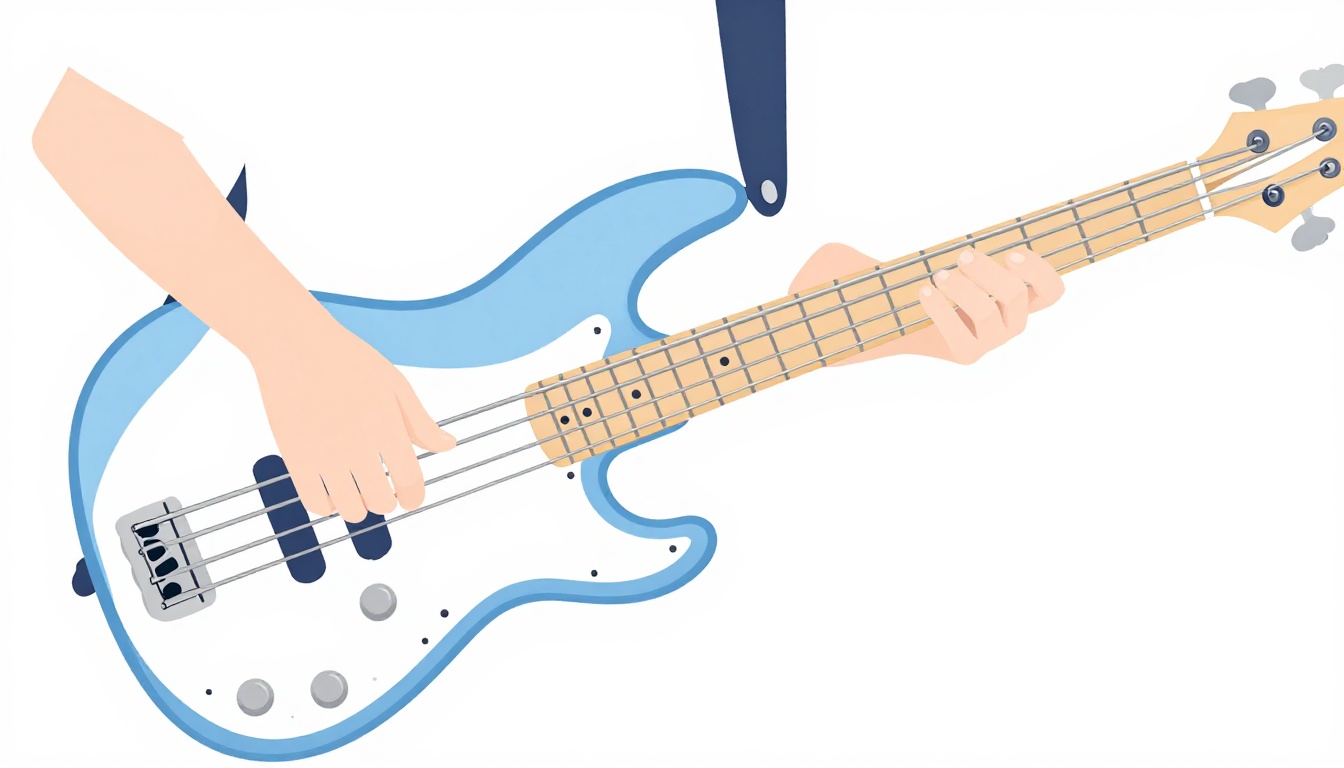
If you are still early in learning the instrument, there is no rush to get through this table. Solidifying the major scale, the minor scale, and the minor pentatonic until they are automatic under your hands will do more for how you actually play than adding a fourth or fifth scale to a list you have not fully absorbed yet. Modes are worth returning to once those three feel like home.
FAQ
Do I need to learn scales to play bass, or can I just learn songs?
You can get a long way learning songs by ear or from tab without naming a single scale. But every song you learn that way is quietly built on the same handful of scale shapes, and learning the shapes directly means the next song comes faster, because you already recognize the pattern instead of learning it from scratch each time.
What is the difference between a scale and a mode?
A mode is a scale that starts on a different note of an existing scale's note collection. D Dorian, for example, uses the exact same seven notes as C major, just starting and resolving on D instead of C. The notes do not change, only which one feels like home.
Why does the minor pentatonic scale come up so much more than the major pentatonic in bass lessons?
Rock, blues and a large share of pop and funk lean toward minor-key or minor-leaning basslines, and the minor pentatonic is the scale that sits most naturally under that harmony. The major pentatonic is just as useful, it simply gets less airtime because fewer of the songs most beginners start on call for it.
Do scale shapes change on a fretless bass?
No. The fret numbers in this post describe finger positions relative to the nut and to each other, and those positions exist on a fretless neck too, just without the metal fret wire to mark them. The shapes and the finger patterns are identical, the main added difficulty is intonation, since there is nothing physically stopping your finger from landing slightly sharp or flat.
How long does it take to actually know a scale, not just play it slowly?
There is no fixed timeline, but a shape usually stops requiring conscious thought somewhere after several weeks of short, daily, focused practice, not one long session. Practicing a shape for fifteen minutes a day for two weeks will get you further than one two-hour session.
Can I use guitar scale patterns on bass?
The interval formulas are identical, since a scale is defined by the distances between its notes, not the instrument playing it. But the exact fret patterns from a six-string guitar will not map directly, because bass strings are tuned differently and spaced further apart, so you need to work out the shape fresh on the bass neck rather than copying a guitar diagram fret for fret.
Should I learn scales with a pick or with my fingers?
Either is fine for scale practice, and most bass players end up developing at least some comfort with both over time. What matters more for the scale itself is that your fretting hand stays clean and your notes ring evenly, not which technique your plucking or picking hand uses to sound them.
What key should I start practicing scales in?
Start with a scale rooted on the open E or A string, since those give you the most familiar starting point and the fewest additional things to think about while your hand is still learning the shape. A minor pentatonic, rooted on the 5th fret of the E string, is a common first choice for exactly that reason.
Is it better to practice scales high on the neck or low on the neck?
Both, eventually, but if your hand is still building strength and stretch, practice further up the neck first. Frets sit closer together as you move up, so the same finger pattern requires a smaller stretch there than it does down near the nut, which makes it a gentler place to learn a new shape before you take it down to the wider frets.
Do I need to learn scales in every key, or just a few?
Because every shape in this post is movable, you technically already know every key once you know one shape and the note names on the E and A strings. In practice, most players end up with a handful of keys, often ones tied to songs they actually play, that feel instant, while the rest still require a half second of conscious thought to find the root. That gap closes with repetition, not with separately memorizing each key from scratch.
Why do some of these scales use flats (like Eb) instead of sharps (like D#)?
Both names describe the exact same fret and the exact same pitch. Which spelling gets used depends on the key and the scale being described, since scales are traditionally spelled so each letter name (A, B, C, and so on) appears exactly once, without skipping a letter or repeating one. The blues scale and minor pentatonic in this post are spelled with flats because that matches how they are conventionally written, but your fretting hand does not need to care which spelling you use, the fret is the same either way.
GuitarLowKey
Ready for fifteen focused minutes?
Open the web app and train the change that is blocking your song.