
Johnny Cash 'Hurt' Guitar Chords (Easy and Record-Accurate)
The Am, C, D and G chords for Johnny Cash's 'Hurt,' the easy chorus and the piano-style version, no capo needed, with tables for every shape.

No capo. The verse of Johnny Cash's "Hurt" runs on Am, C, and D (some tabs write the D as Dsus2), and the chorus moves through Am, F, and G, either as plain open chords or as the piano-style Am7, Fadd9, C, G voicing that gets you closer to the record. The whole song sits in A minor at a slow, steady tempo, and every chord in it is one most beginners already half know.
That simplicity is deceptive. "Hurt" is not hard to finger, but it is easy to play badly, because the entire arrangement depends on restraint, on space between the chords, and on a specific quiet-to-loud shape that most guitarists rush past on their first few attempts. This post covers both the easy version and the closer-to-record version, every chord shape in a table, and the dynamics that actually make the song sound like the recording rather than a strummed exercise.
Song Basics at a Glance
| Detail | Value |
|---|---|
| Key | A minor |
| Tempo | Around 90 to 92 BPM |
| Capo | None |
| Time signature | 4/4 |
| Verse chords | Am, C, D (or Dsus2) |
| Chorus chords (easy) | Am, F, C, G |
| Chorus chords (record-style) | Am7, Fadd9, C, G |
| Bridge chords | Am, F, G |
Two things stand out before you touch the guitar. First, there is no capo on any credible transcription of this version, which is unusual for a Johnny Cash recording and makes the song more approachable than it sounds. Second, the chorus has two commonly taught voicings, a simple one built from chords you already know, and a fuller one that mimics the piano line running underneath Cash's vocal. Neither is wrong. They are covered separately below so you can start with the easy version and move to the fuller one once the changes feel automatic.
Where This Version Came From
"Hurt" was written by Trent Reznor and originally recorded by Nine Inch Nails for the 1994 album The Downward Spiral, a much louder, more distorted song than the version most guitarists are learning here. Johnny Cash recorded his cover for American IV: The Man Comes Around, released in 2002, produced by Rick Rubin as part of the American Recordings sessions that revived Cash's career in the final years of his life.
Rubin has described choosing "Hurt" specifically because its lyrics, about regret and looking back on a life, fit what he saw as Cash's mythic "Man in Black" persona. Reznor was initially unsure about another artist covering the song, worried it might come across as a stunt, but after hearing Cash's recording and seeing the accompanying music video, he said publicly that the song no longer felt like his. Cash died the following year, and this recording is widely treated as one of the last major statements of his career.
None of that history changes a single chord shape, but it explains why the arrangement is so sparse. The recording features Mike Campbell on acoustic guitar and Benmont Tench on piano and organ, alongside Cash's vocal, and that small, careful lineup is exactly why the guitar part covered in this post stays out of the way rather than filling every bar. This was never meant to sound like a full band performance. It is one voice and one guitar, built entirely around the space between the notes, and that is the standard you are playing toward here, not a wall of strumming.
The accompanying music video, directed by Mark Romanek and filmed when Cash was 71, is part of why this recording is so widely known beyond guitar forums. It won a Grammy and a CMA award and has been named one of the greatest music videos ever made by multiple outlets. None of that affects how you play the song, but it is worth knowing why "Hurt" carries more weight for most listeners than a typical cover.
Comparing to the Nine Inch Nails Original
Guitarists who know the Nine Inch Nails original sometimes expect the guitar part to be more aggressive than it actually is. It is worth knowing what changed between the two versions and what did not before you start comparing your playing against the wrong recording in your head.
The Original Is Also Fingerpicked, and Also in Standard Tuning
Trent Reznor's original 1994 recording, the closing track on The Downward Spiral, is not a wall of noise from the first note. It opens with a fingerpicked acoustic guitar part in standard tuning, layered with piano, and only builds into distorted guitar and heavy sampled noise in its final section. The industrial reputation the song carries comes almost entirely from that ending, not from the verses.
Where the Two Versions Actually Diverge
The real difference is not the tuning or the picking style, both of which the two versions share. It is the arc. The Nine Inch Nails original builds from a quiet fingerpicked verse into a genuinely loud, distorted, almost overwhelming climax before pulling back again at the very end. Cash's version keeps that same quiet-to-loud shape but never goes nearly as far into distortion or noise, staying within the range of a strummed acoustic chorus rather than an industrial rock outro. If you are chasing the exact dynamic range of the original recording on a single acoustic guitar, you are chasing something the Cash arrangement deliberately does not attempt. Match the dynamics of the version you are actually learning, not the one you remember from the other recording.
Why This Song Sits in A Minor
A minor is the relative minor of C major, meaning the two keys share the same key signature, no sharps or flats in their most basic form, which is part of why the chords in this song (Am, C, D, F, G) all fall so comfortably under a guitarist's fingers using entirely open shapes.
Four of those five chords come directly from that shared key: Am is the i chord (the tonic), C is the III chord, F is the VI chord, and G is the VII chord, all naturally minor-key chords built from the A natural minor scale. The D chord is the outlier. A natural minor would predict a D minor chord in that spot, not D major. The major D you are actually playing borrows its F# from A Dorian, a closely related mode that raises the 6th degree of the scale, a common substitution in folk and rock songwriting that brightens an otherwise minor progression without ever leaving the key. It is the same kind of major-over-minor color you hear in a lot of traditional folk melodies, and it is a large part of why this song's verse feels unsettled rather than flatly sad.
The Song's Structure, Start to Finish
Seeing the whole arrangement laid out before you try to play start to finish makes the transitions easier to anticipate.
| Order | Section | Chords |
|---|---|---|
| 1 | Intro | Am - C - D (fingerpicked) |
| 2 | Verse 1 | Am - C - D (repeated) |
| 3 | Chorus 1 | Am - F - C - G (or the piano-style Am7-Fadd9-C-G) |
| 4 | Verse 2 | Am - C - D (repeated) |
| 5 | Chorus 2 | Am - F - C - G (or Am7-Fadd9-C-G) |
| 6 | Bridge | Am - F - G, played sparse and quiet |
| 7 | Final chorus | Am - F - C - G (or Am7-Fadd9-C-G), fuller and louder |
| 8 | Outro | Fades on Am |
Not every performance or transcription follows this exactly, some live versions add an extra pass through the chorus or hold the bridge longer, but this is the shape most guitar transcriptions of this recording agree on.
The Verse Chords
The verse cycles through three chords, played slowly with space between each change.
| Section | Chord 1 | Chord 2 | Chord 3 |
|---|---|---|---|
| Verse (repeated) | Am | C | D (or Dsus2) |
That three-chord loop repeats under both verses and carries almost the entire first half of the song. The pacing is what matters here more than the shapes themselves: this is not a strum-through-it song. Let each chord ring, keep your strumming hand light, and resist the pull to fill every beat with movement. A quiet, half-picked, half-strummed touch fits the recording far better than a full down-up strum pattern.
A Note for Left-Handed Players
Every string and fret reference in this post assumes a right-handed guitar, fretting hand on the neck, strumming hand over the sound hole. If you play a left-handed, reverse-strung guitar, mirror the string numbers in every table here (string 6 becomes string 1, and so on). The fret numbers themselves do not change.
The Am Chord
Am is the chord the whole song orbits, opening the verse, closing the chorus, and anchoring the bridge.
| String | Fret | Finger |
|---|---|---|
| 6 (low E) | Muted | - |
| 5 (A) | Open | - |
| 4 (D) | 2 | 2 |
| 3 (G) | 2 | 3 |
| 2 (B) | 1 | 1 |
| 1 (high E) | Open | - |
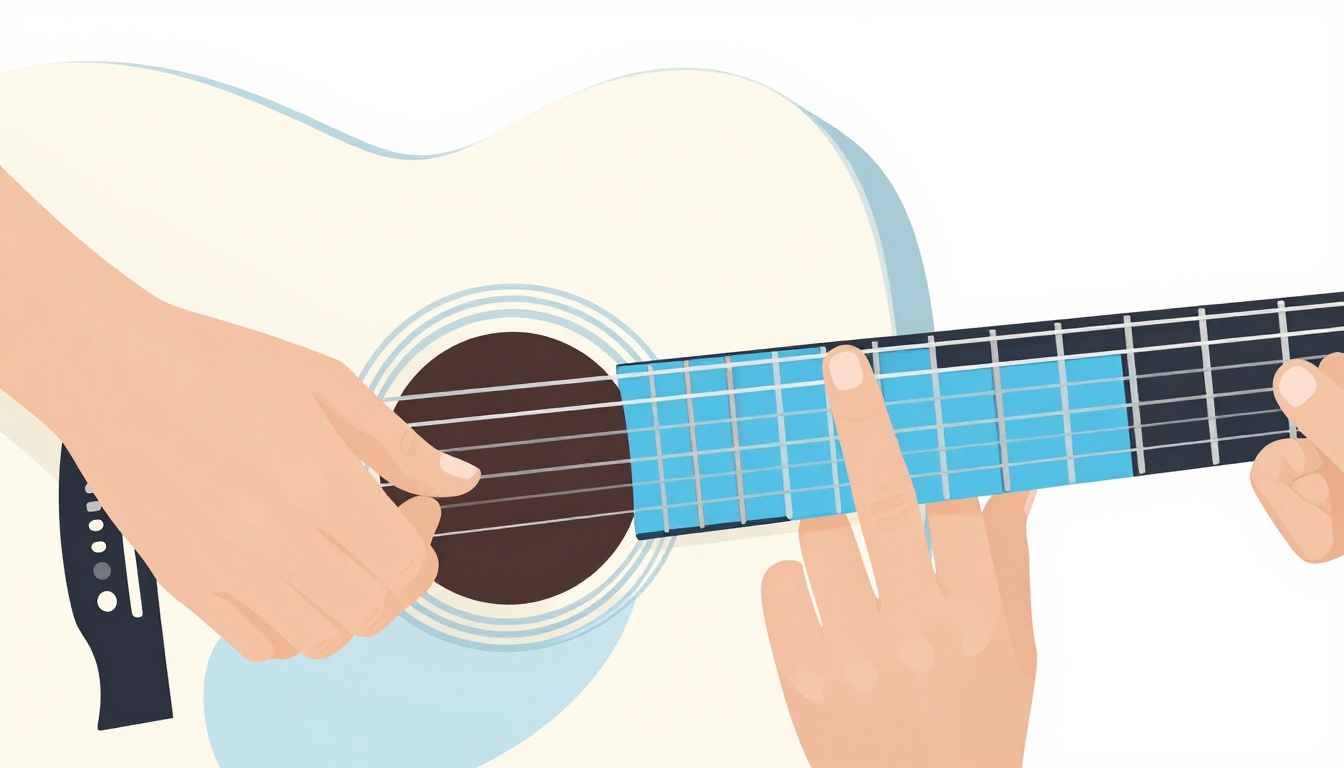
Strum from the 5th string down, leaving the 6th string out of the chord entirely. If the 6th string rings, angle the side of your fretting hand slightly so it brushes against that string without you having to think about it.
The C Chord
C follows Am in the verse and reappears in both chorus versions.
| String | Fret | Finger |
|---|---|---|
| 6 (low E) | Muted | - |
| 5 (A) | 3 | 3 |
| 4 (D) | 2 | 2 |
| 3 (G) | Open | - |
| 2 (B) | 1 | 1 |
| 1 (high E) | Open | - |
The Am to C change moves your middle and ring fingers by one string each while your index finger stays close to the same area of the neck, which is why this pair of chords is one of the more forgiving changes for a newer player once you have practiced it a handful of times.
The D Chord (and Why Some Tabs Write Dsus2 Instead)
The third verse chord is where sources genuinely differ, and it is worth understanding why rather than picking one version at random.
| String | Fret | Finger |
|---|---|---|
| 6 (low E) | Muted | - |
| 5 (A) | Muted | - |
| 4 (D) | Open | - |
| 3 (G) | 2 | 1 |
| 2 (B) | 3 | 3 |
| 1 (high E) | 2 | 2 |
That is a standard open D major. Several transcriptions instead call for Dsus2, which lifts your middle finger off the 1st string and lets it ring open instead of fretted at the 2nd fret.
| String | Fret | Finger |
|---|---|---|
| 6 (low E) | Muted | - |
| 5 (A) | Muted | - |
| 4 (D) | Open | - |
| 3 (G) | 2 | 1 |
| 2 (B) | 3 | 2 |
| 1 (high E) | Open | - |
The difference is one note. D major includes an F# on the 1st string, giving the chord a clear major third. Dsus2 replaces that F# with an open E, removing the third entirely and leaving a more open, ambiguous sound, the same kind of substitution that shows up in a lot of subdued acoustic arrangements. For this song, either is a reasonable choice. Dsus2 is arguably closer to the hushed character of the recording, and it is also slightly easier to finger since it uses one fewer fretted note. Start with whichever your hand finds more natural, and try swapping in the other once the verse feels solid.
The Easy Chorus: Am, F, C, G
The most beginner-friendly way into the chorus swaps the piano-style voicings for four chords most guitarists already have under their fingers.
| Section | Chord 1 | Chord 2 | Chord 3 | Chord 4 |
|---|---|---|---|---|
| Chorus (easy version) | Am | F | C | G |
If you already know open Am, C, and G, the only new shape here is F, and even that has a simplified version covered below. This progression captures the chord movement of the chorus accurately, it just skips the piano-mimicking detail covered next. For a first pass at singing along with the song, this is the version to start with.
The Record-Accurate Chorus: Am7, Fadd9, C, G
Listen closely to the recording and you will notice a single high note ringing steadily underneath the chorus chords, carried over from the piano part in the original arrangement. Guitarists reproduce that by anchoring one finger, usually the pinky, on the 3rd fret of the 1st string (high E) and keeping it there while the rest of the chord changes underneath it.
| Section | Chord 1 | Chord 2 | Chord 3 | Chord 4 |
|---|---|---|---|---|
| Chorus (record-style) | Am7 | Fadd9 | C | G |
The Pinky-Anchor Trick
The 3rd fret of the high E string is a G note. Holding it steady across Am7, Fadd9, C, and G recreates the sustained top note you hear on the piano, and it is the single detail that makes this version sound noticeably closer to Cash's recording than the plain open-chord chorus above.
| String | Am7 | Fadd9 | C | G |
|---|---|---|---|---|
| 6 (low E) | Muted | 1 | Muted | 3 |
| 5 (A) | Open | Muted | 3 | 2 |
| 4 (D) | 2 | 3 | 2 | Open |
| 3 (G) | Open | 2 | Open | Open |
| 2 (B) | 1 | 1 | 1 | Open |
| 1 (high E) | 3 | 3 | 3 | 3 |
Notice the 1st string stays fretted at the 3rd fret across all four chords, which is exactly the point. Everything else moves around that anchor. The G chord in this table is the common four-finger open G voicing, which already lands its top note on the 3rd fret of the 1st string, so it slots into the pattern without any change.
The Fadd9 Chord, Two Ways
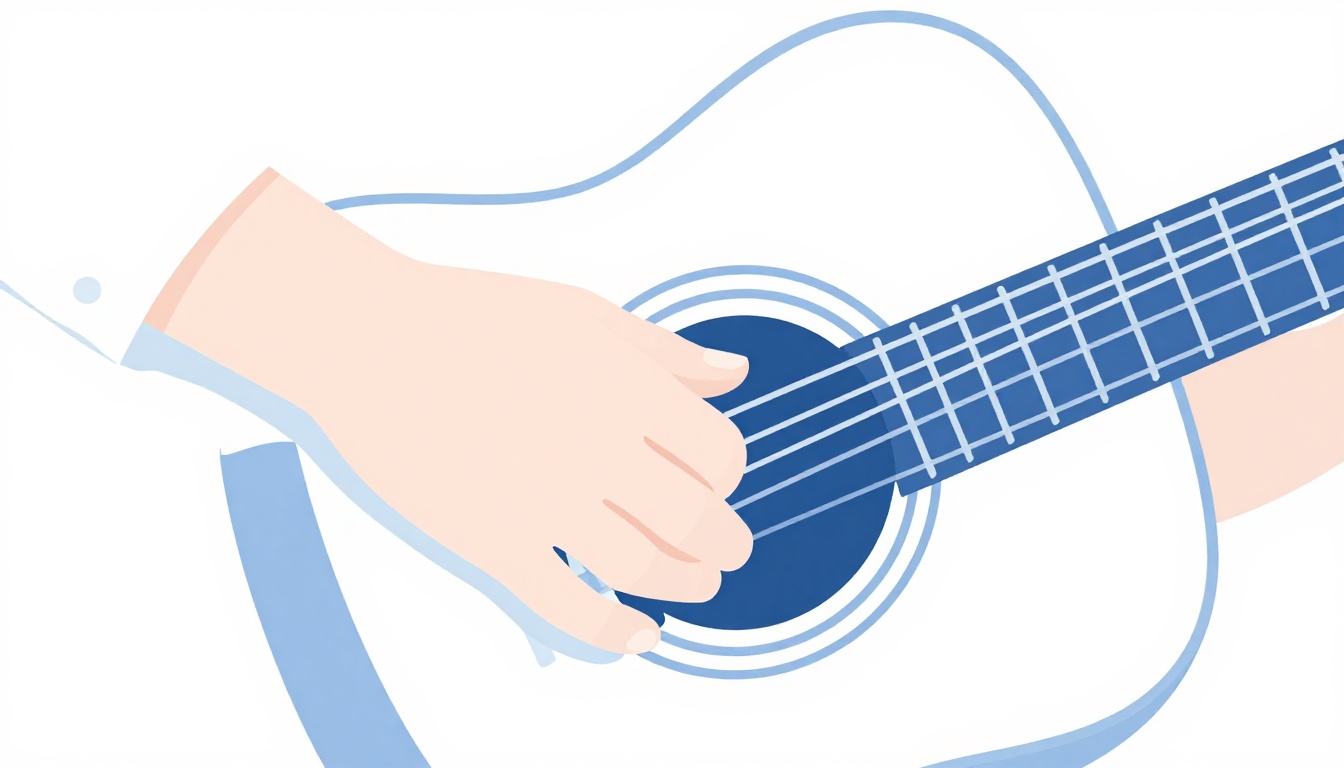
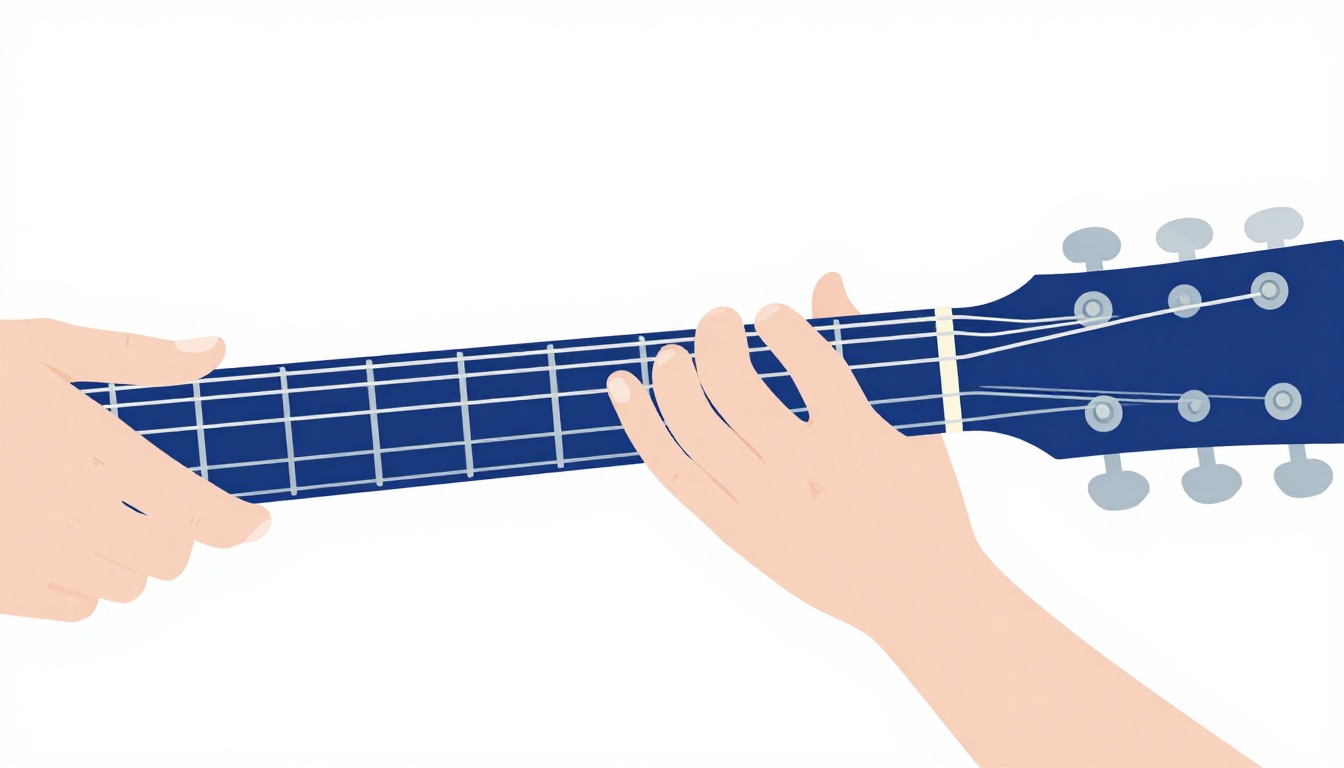
Fadd9 is the one shape in the record-accurate chorus that trips people up, because the full voicing asks your thumb to wrap over the top of the neck and fret the low E string, a technique some guitarists never use elsewhere.
The Full Voicing (Thumb Wrap)
| String | Fret | Finger |
|---|---|---|
| 6 (low E) | 1 | Thumb |
| 5 (A) | Muted | - |
| 4 (D) | 3 | 2 |
| 3 (G) | 2 | 3 |
| 2 (B) | 1 | 1 |
| 1 (high E) | 3 | 4 |
This is sometimes called a "Hendrix-style" voicing because of how common thumb-over-the-neck fretting was in his playing. It takes practice if you have never used your thumb this way, since it asks your hand to open wider than a standard chord grip. Do not force it early. Curl your thumb over gradually, fret lightly at first, and expect a buzz or two while your hand learns the stretch.
The Easier Substitute (No Thumb Wrap)
If the thumb-wrap version is not happening yet, drop the low E string from the chord entirely and mute it instead of fretting it.
| String | Fret | Finger |
|---|---|---|
| 6 (low E) | Muted | - |
| 5 (A) | Muted | - |
| 4 (D) | 3 | 2 |
| 3 (G) | 2 | 3 |
| 2 (B) | 1 | 1 |
| 1 (high E) | 3 | 4 |
This keeps the pinky-anchor trick intact and still spells out F, A, C, and G, the notes that make it an Fadd9, just without the low root doubling underneath. It is a completely legitimate substitute, not a lesser version, and plenty of recordings of this song on guitar alone skip the thumb wrap entirely.
The Capo 5 Version, and Why It Exists
A handful of chord charts for this song list a capo at the 5th fret instead of no capo at all. This is not a different arrangement or a different set of chords, it is the exact same Am, C, D, F, and G shapes covered throughout this post, just played higher up the neck with a capo clamped down.
A capo shortens the vibrating length of every string equally, raising the pitch of the whole guitar without changing which frets you press relative to the capo. Playing an open Am shape behind a capo on the 5th fret sounds higher than playing that same shape with no capo, even though your fretting hand is doing nothing differently. Guitarists reach for this mainly to match a different vocal range, useful if you are singing the song yourself and Cash's original key sits outside what is comfortable for your voice, higher or lower depending on where you place the capo. If you are playing along with the original recording, skip the capo. If you are singing it yourself and the no-capo version sits awkwardly in your range, experimenting with a capo further up the neck, using the identical shapes from this post, is a legitimate way to find a key that fits your voice.
The Bridge Chords
The bridge, the section beginning "If I could start again," shifts to a shorter three-chord movement before the song builds back into its final chorus.
| Section | Chord 1 | Chord 2 | Chord 3 |
|---|---|---|---|
| Bridge | Am | F | G |
Play this section even sparser than the verse. It is the quietest point in the song structurally, right before the arrangement opens back up, and rushing through it or strumming it at full volume undercuts the build that follows. Let the chords ring longer here than anywhere else in the song.
The F Chord, Simplified
F is the one shape in this song that beginners commonly avoid because of the full barre version. You do not need the full barre here.
| String | Fret | Finger |
|---|---|---|
| 6 (low E) | Muted | - |
| 5 (A) | Muted | - |
| 4 (D) | 3 | 3 |
| 3 (G) | 2 | 2 |
| 2 (B) | 1 | 1 |
| 1 (high E) | Muted or 1 (barred with finger 1) | 1 |
This four-string version drops the low E and A strings out of the chord entirely, so you are only fretting three notes across the middle strings. It is a widely used substitute for full F in slower acoustic songs specifically because it still carries the harmony without the strength and stretch a full six-string barre demands. If your index finger is only strong enough to fret the 2nd string cleanly for now, mute the 1st string with the edge of that same finger rather than trying to barre both strings at once.
Why It Is Not Sounding Right
If the chords are correct but the song still sounds off compared to the recording, the cause is almost always one of these, not a wrong shape.
You Are Strumming Too Hard
This is the single most common issue with this song specifically. "Hurt" is quiet by design, and a full, aggressive strum pattern fights against the entire arrangement. Pull your strumming hand back, use less wrist motion, and let the pick barely graze the strings on the softer sections.
The Am to C Change Is Muffling a String
If your C sounds thin or partially muted right after switching from Am, check that your ring finger has fully released the 3rd fret of the G string from the Am shape before it presses the 5th string for C. A finger that lifts only halfway will rest against the string beneath it and deaden the note.
The D or Dsus2 Chord Is Buzzing on the High String
Both shapes ask your ring finger to reach across to the 2nd or 3rd fret of the B string while your other fingers hold the rest of the chord. If that finger presses at an angle instead of straight down, the string buzzes against the fret next to it. Check that you are pressing just behind the fret wire, not in the middle of the fret space.
The Pinky-Anchor Chorus Sounds Muted on Top
If the high E note is not ringing clearly through the Am7-Fadd9-C-G sequence, your pinky is likely not pressing with even pressure as your hand reshapes around it. Practice the anchor alone first: hold the 3rd fret of the 1st string with your pinky only, then build the rest of each chord around it one at a time, checking that the top note stays clean through every shift.
You Are Rushing the Quiet Sections
Verses and the bridge in this song are meant to feel unhurried, almost held back. A common mistake is speeding up slightly during the quiet parts out of a sense that nothing is "happening" musically. Keep a steady internal pulse through the quiet sections just as much as the louder ones, even if it means counting beats in your head.
Getting the Dynamics Right
More than most songs, "Hurt" lives or dies on the contrast between quiet and loud. The verses and bridge sit low, picked or lightly strummed, while the chorus opens up into a fuller strum and a rounder tone. If every section is played at the same volume and intensity, the song loses the shape that makes it work, no matter how accurate your chord shapes are.
Decide on that contrast before you try to play the whole song start to finish, not after. A useful way to practice it: play the verse as quietly as you can while still hearing every note clearly, then let the chorus come in noticeably louder, even if it feels like an exaggeration at first. What feels like too much contrast in a quiet room usually sounds just right once there is a vocal or a recording playing alongside it.
Fingerpicking the Verse Instead of Strumming
Many recordings and live versions of this song use a fingerpicked or hybrid picked-and-strummed pattern for the verse rather than a full strum, which suits the song's restraint better than a strumming pattern does.
A simple starting pattern: thumb on the lowest note of the chord (the 5th string for Am and C, the 4th string for D or Dsus2), followed by your index, middle, and ring fingers picking the remaining strings in sequence, low to high. Played slowly and evenly, this rolling motion creates movement without raising the volume, which is exactly what the verse calls for.
Written out over an Am chord, one bar of that pattern looks like this, thumb on the open A string, then working up through the fretted notes and letting the open high E ring at the end:
e|---------------0---|
B|-------------1------|
G|-----------2--------|
D|---------2-----------|
A|-----0----------------|
E|-----------------------|
Treat that as a starting shape, not a fixed rule. Once it feels natural on Am, apply the same low-to-high motion to C and D, adjusting which string your thumb starts on to match each chord's lowest note.
If fingerpicking is new to you, do not attempt it at full song tempo right away. Practice the pattern on a single chord, Am alone, until your thumb and fingers move independently without you having to think about which finger is next. Only then layer it under the full Am-C-D progression.
Pick, Fingers, or Both?
Which technique fits this song best depends on which section you are in, and switching between them mid-song is normal rather than a sign you have not settled on a technique.
Fingerpicking suits the verse and bridge well, since it naturally keeps the volume down and gives you control over which strings ring and which stay quiet, something a pick makes harder at low volume. The chorus, especially the easy Am-F-C-G version, works fine with a pick and a fuller strum, since that section is meant to open up and a pick makes it easier to project that lift in energy.
A hybrid approach, holding a pick between your thumb and index finger while your middle and ring fingers pick the higher strings, is a common middle ground if switching techniques mid-song feels clumsy. It lets you strum the chorus with the pick and pluck individual notes in the verse without physically swapping anything in your hand. This takes its own practice to feel natural, so do not expect it to click immediately if you have not used a hybrid grip before.
Singing While You Play
This song was written to be sung, and if you plan to sing along while you play, the guitar part needs to stay simple enough that it does not compete with your voice for attention. That is one more reason the fingerpicked verse and the restrained bridge matter here more than they would in a purely instrumental song: a busy guitar part under a vocal melody this exposed pulls a listener's ear away from the words.
Practice the chord changes completely on their own first, with no singing, until they no longer require conscious thought. Only then add the vocal melody on top. Trying to learn new chord shapes and new lyrics at the same time usually means both suffer, and it is far more efficient to separate the two skills before combining them.
Pay attention to where your breath naturally falls at the end of each line, and notice whether that lines up with a chord change. If it does not, you may need to let a chord ring slightly longer or shift your strum to accommodate the phrasing rather than rigidly keeping to a fixed pattern. Cash's phrasing across this song is loose and speech-like rather than metronomic, and a guitar part that breathes with the vocal, rather than marching through it on a strict pattern, is closer to what the recording actually does.
Easier Versions for Beginners
If any part of this song is still out of reach, several substitutions keep the song recognizable while reducing the difficulty.
Swap the full Fadd9 thumb-wrap voicing for the simplified, thumb-free version covered earlier. It keeps the pinky-anchor detail that makes the chorus sound close to the record without the added stretch of fretting the low E string with your thumb.
If the D chord's stretch across three strings at the top of the neck feels awkward, Dsus2 is not just an alternate voicing here, it is genuinely easier to finger, since it removes one fretted note compared to full D.
If F is still difficult even in its simplified four-string form, substitute a full Am7 or plain Am wherever F appears in the easy chorus and bridge. It is not the exact chord the song uses, but it keeps the progression moving while your hand builds the strength for F, and you can swap the correct chord back in once it feels comfortable.
None of these substitutions are permanent compromises. They are a way to keep playing the whole song while your hand develops the strength and independence that the fuller voicings ask for.
Full Chord Shape Reference
Every chord this song uses, gathered in one place. Strings are numbered 1 to 6, thinnest to thickest, and fingers are numbered 1 to 4, index to pinky.
| Chord | 6 (low E) | 5 (A) | 4 (D) | 3 (G) | 2 (B) | 1 (high E) |
|---|---|---|---|---|---|---|
| Am | Muted | Open | 2 (finger 2) | 2 (finger 3) | 1 (finger 1) | Open |
| C | Muted | 3 (finger 3) | 2 (finger 2) | Open | 1 (finger 1) | Open |
| D | Muted | Muted | Open | 2 (finger 1) | 3 (finger 3) | 2 (finger 2) |
| Dsus2 | Muted | Muted | Open | 2 (finger 1) | 3 (finger 2) | Open |
| G (4-finger) | 3 (finger 2 or 3) | 2 (finger 1) | Open | Open | Open | 3 (finger 4) |
| F (easy, 4-string) | Muted | Muted | 3 (finger 3) | 2 (finger 2) | 1 (finger 1) | Muted or 1 |
| Am7 (pinky-anchor) | Muted | Open | 2 (finger 2) | Open | 1 (finger 1) | 3 (finger 4) |
| Fadd9 (easy, no thumb) | Muted | Muted | 3 (finger 2) | 2 (finger 3) | 1 (finger 1) | 3 (finger 4) |
| Fadd9 (thumb wrap) | 1 (thumb) | Muted | 3 (finger 2) | 2 (finger 3) | 1 (finger 1) | 3 (finger 4) |
Keep this table open on a second screen the first few times you run through the song. It is faster to glance at than scrolling back through each individual section once you already know which version of the chorus you are playing.
Changing Between Chords Without Losing the Feel
The chords in this song are individually simple. What actually makes "Hurt" feel hard the first several times through is keeping the quiet, unhurried feel while your fretting hand moves between shapes, especially in the pinky-anchor chorus where one finger has to stay still while the rest of your hand reshapes around it.
Two habits help more than anything else:
- Practice each change in isolation, just two chords back and forth, at a slow, even tempo, before attempting the full progression.
- Look for the fingers that barely move between chords rather than resetting your whole hand on every change. In the Am to C change, your index finger travels only a short distance from the 2nd string to the 5th string area. In the record-style chorus, your pinky does not move at all.
Once you notice these small anchor points, the progressions stop feeling like a series of separate hand positions and start feeling like one shape shifting slightly, which is also what keeps the strumming or picking hand relaxed enough to stay quiet when the song calls for it.
A Practice Routine for This Song
A realistic first week spent on this song, assuming you already know basic open chords, looks like this.
| Days | Focus |
|---|---|
| 1 to 2 | Am-C-D verse progression alone, slow tempo, strummed lightly |
| 3 | Add fingerpicking to the verse in place of strumming |
| 4 | The easy chorus (Am-F-C-G), focusing on the F chord |
| 5 | The record-style chorus (Am7-Fadd9-C-G) with the pinky-anchor trick |
| 6 | The bridge (Am-F-G), played even softer than the verse |
| 7 | Full song at a slow, steady tempo, focusing on the quiet-to-loud dynamic |
Do not treat the seventh day as a finish line. It is the first time you are allowed to play the song slowly and imperfectly from start to finish, not the point where the dynamics should already sound like the recording. Those come with repetition, once the chord changes stop taking up your attention.
If you are building this into a short daily habit rather than one long session, the homepage has more on structuring focused fifteen-minute practice blocks that actually stick over time.
Common Mistakes With This Song
A few habits show up repeatedly with this particular song, separate from the buzzing and muted-string issues covered earlier, mostly because the chords are so approachable that players rush past the details that actually make it sound right.
Adding Embellishments That Are Not There
Because the chord shapes are so simple, it is tempting to fill the space with extra flourishes, hammer-ons, slides, or a busier strumming pattern than the song calls for. The original arrangement, and Cash's version of it, both rely on restraint rather than embellishment. If you find yourself adding movement the recording does not have, it is worth asking whether you are filling space out of habit rather than because the song needs it.
Rushing Because the Chords Feel Easy
Familiar open chords can create a false sense that a song is easy to finish learning, when in this case the chord shapes are the least of what makes the song work. Treat the dynamics, the phrasing, and the pinky-anchor detail in the chorus as being just as much a part of "knowing" this song as the chord names are.
Cutting the Ending Short
The song fades out on a sustained Am chord rather than ending on a strummed final chord with a clean cutoff. Playing a hard, deliberate final strum and immediately muting the strings undercuts that quality. Let the last Am ring out and decay naturally, or fingerpick it softly and let it trail off, rather than treating the ending like the last beat of an up-tempo song.
Ending the Song
The outro repeats the chorus progression, or the bridge chords in some transcriptions, before settling on a final Am that is allowed to ring rather than cut off. There is no dramatic final chord change here, no big strummed flourish to signal the end. The song simply runs out of energy and stops, which is very much in keeping with its subject matter.
Practicing the ending on its own is worth doing separately from the rest of the song. Play the final Am, then consciously do nothing for several seconds, letting the string vibration die down naturally rather than muting it with your palm. That small choice, resisting the urge to add a tidy final gesture, is a large part of what makes a solo performance of this song land the way the recording does.
Playing It as a Solo Voice-and-Guitar Song
Unlike songs built around a full band arrangement, "Hurt" was recorded with almost nothing behind the vocal beyond the guitar and a few sparse additional layers. That makes it one of the more forgiving songs to play solo, since you are not trying to approximate multiple interlocking guitar parts the way you would with a dense rock arrangement. What you play on one guitar is close to what carries the entire recording.
That also raises the stakes on dynamics and timing, since there is nowhere for a stray strum or a rushed change to hide behind a full band. Playing it well solo comes down to exactly the two things covered throughout this post: clean, unhurried chord changes, and real contrast between the quiet sections and the chorus.
Frequently Asked Questions
Do I need a capo for Johnny Cash's version of "Hurt"?
No. Every credible transcription of this recording plays it in standard tuning with no capo.
Is "Hurt" a good song for a beginner guitarist?
The chord shapes themselves are approachable, especially the easy chorus version, which uses chords most beginners already know. The harder part is the restraint the song asks for, playing quietly and with space, which is more about control than finger strength.
What is the difference between the easy chorus and the piano-style chorus?
The easy version (Am, F, C, G) uses plain open chords and gets the progression right. The piano-style version (Am7, Fadd9, C, G) adds a pinky held on the 3rd fret of the high E string throughout, reproducing a sustained note from the original piano part. Both are correct, one is just closer to the recording.
Why do some tabs write the verse chord as D and others as Dsus2?
The two shapes differ by a single note. Dsus2 removes the major third that D includes, giving a more open, ambiguous sound that many guitarists feel matches the hushed character of this recording more closely. Either is a reasonable choice.
Do I need to learn the thumb-wrap Fadd9 chord?
No. A simplified version that drops the low E string and mutes it instead gets you the same core notes without the stretch. The thumb-wrap version is worth learning eventually if you want the exact recorded voicing, but it is not required to play the song correctly.
Is this the same song as the Nine Inch Nails original?
Musically, yes, it is the same song written by Trent Reznor. Johnny Cash's 2002 recording is a cover, produced by Rick Rubin, and it strips the arrangement down to a much sparser, guitar-and-voice setting than the original industrial rock recording.
What tempo should I practice at first?
The song sits around 90 to 92 BPM, but for the first few run-throughs, focus on evenness rather than matching that exact tempo. A slower, steady pace that keeps every chord change clean is more useful early on than pushing to full speed.
Why does my chorus sound thin compared to the recording?
Most likely because you are playing the easy Am-F-C-G version rather than the piano-style Am7-Fadd9-C-G version with the pinky anchored on the high E string. That sustained top note is a big part of what gives the recorded chorus its fuller, more piano-like character.
How long does it take to learn this song?
If you already know open Am, C, D, and G, the easy version is realistic within a few days of short practice sessions. Adding the piano-style chorus and the fingerpicked verse pattern usually takes another week, since both depend on finger independence rather than new chord knowledge.
Should I strum or fingerpick the verse?
Either works, but fingerpicking or a light hybrid pick-and-strum matches the recording's restraint more closely than a full strum pattern does. Start with strumming if fingerpicking is new to you, and move to picking once the chord changes themselves feel comfortable.
Who actually played guitar on Johnny Cash's recording?
Mike Campbell played acoustic guitar on the track, with Benmont Tench on piano and organ. The chord shapes covered in this post reconstruct that guitar part for a solo player, not a note-for-note transcription of a specific isolated recording.
Does the "piano-style" chorus actually copy a real piano part?
Yes. The sustained top note the pinky-anchor trick reproduces comes from the piano and organ part played by Benmont Tench underneath Cash's vocal, not from anything the guitar was originally doing. Holding that note on guitar is a guitarist's way of filling in a detail the piano is responsible for on the actual recording.
Should I use a capo to sing this in a different key?
If the no-capo version sits outside your comfortable vocal range, moving a capo up the neck raises the pitch of every chord while leaving the shapes themselves unchanged. There is no single correct capo position for this, it depends entirely on your own voice, so try a few positions and sing along to find where the melody sits comfortably without straining.
Can I play this on a nylon-string or classical guitar?
Yes, and the fingerpicked verse and bridge in particular suit a nylon-string guitar's warmer, softer tone well. The chorus loses a little brightness compared to steel strings if you switch to a pick, so leaning on fingerstyle throughout, rather than switching to a pick for the chorus, tends to sound more natural on a nylon-string instrument.
Is the Johnny Cash version harder or easier than the Nine Inch Nails original?
Easier to approximate on a single acoustic guitar. The original builds into a genuinely loud, distorted, multi-layered climax that is difficult to recreate solo, while Cash's version stays within the range of a strummed acoustic chorus throughout, which is much more achievable for one guitarist to reproduce faithfully.
GuitarLowKey
Ready for fifteen focused minutes?
Open the web app and train the change that is blocking your song.