
Picasso's Last Words Guitar Chords (Wings, Band on the Run)
Every chord for Wings' Picasso's Last Words in the key of G, the F and Bm shapes that trip people up, and how the song moves into its Jet interlude.

No capo. "Picasso's Last Words (Drink to Me)" by Wings sits in the key of G, and the verses and chorus run on G, D, F, Am, Bm, Em, Am7 and C, all open or first-position shapes. The one section that pushes past beginner chords is the instrumental interlude that quotes "Jet," which walks through Eb7, Ab, F7, Bb and G7 before landing back in G. You can play the whole song on the chords in the first table below and skip the interlude section entirely if you are not ready for it yet.
That is the short version. The longer version is that this is one of the stranger songs in the Wings catalog to learn on guitar, not because any single chord is hard, but because it does not behave like a normal verse-chorus song. It quotes two other songs from the same album inside itself, changes key more than once, and was largely written on the spot. This post covers every chord shape you need in a table, the two chords beginners usually get wrong (F and Bm), the song's odd structure section by section, and a practice plan that gets you through it without pretending it is a three-chord song, because it is not.
Song Basics at a Glance
| Detail | Value |
|---|---|
| Key | G major (modulates during the interlude) |
| Tempo | Loose, rubato in places, roughly 80 to 90 BPM where it settles into a groove |
| Capo | None |
| Time signature | 4/4, with some free-time passages |
| Core chords | G, D, F, Am, Bm, Em, Am7, C |
| Interlude chords | Eb7, Ab, F7, Bb, G7 |
| Album | Band on the Run (1973) |
| Track length | 5 minutes 49 seconds |
The core chord set is short enough to learn in one sitting. What makes the song feel advanced is the order those chords arrive in and the fact that, unlike almost everything else in the Wings catalog, it does not repeat a single verse-chorus loop for five minutes. It moves through a sparse acoustic opening, a fuller chorus, a spoken-word style bridge, an instrumental section that borrows the riff from "Jet," another that echoes "Mrs. Vandebilt," and a fading outro. You do not need all of that to strum along with the record. You need the chord table below and the section guide further down to know where you are in the song.
Where This Song Came From
Paul and Linda McCartney wrote "Picasso's Last Words" during a Wings trip to Jamaica in 1973, and the story behind it is one of the more specific songwriting origin stories in McCartney's catalog. Dustin Hoffman, who was there filming Papillon, challenged McCartney to write a song about anything, on the spot, to prove he really could write a song out of nothing. Hoffman handed him a magazine article about the death of Pablo Picasso, who had died that April, and pointed to a quote: Picasso's last words to his dinner guests, reportedly something close to "Drink to me, drink to my health, you know I can't drink any more." McCartney worked out a melody around that line right there, apparently impressing Hoffman enough that the moment became part of Wings folklore.
The song ended up as the eighth track on Band on the Run, released in December 1973, and at nearly six minutes it is the longest track on the album, though it was never released as a single. It was recorded in September and October 1973 at EMI Studios in Lagos, Nigeria, during the same sessions that produced the rest of the album under famously difficult circumstances (the band had already been robbed at knifepoint earlier in the trip, losing demo tapes and gear). One session took place away from EMI entirely: former Cream drummer Ginger Baker, who was running his own ARC Studios in Lagos, invited Wings to record there. McCartney agreed to spend a single day at Baker's studio, and "Picasso's Last Words" is the song that came out of it, with Baker contributing percussion by shaking a tin can filled with gravel.
None of that history changes a single chord shape, but it explains why the song sounds the way it does: sparse and conversational in the verses, because it started as one person proving he could write a song from a magazine clipping, not as a planned arrangement.
Why the Band Was Even in Lagos
The Lagos sessions were not an easy trip. Wings had traveled to Nigeria in 1973 partly because EMI had a studio there and partly because McCartney wanted the album made somewhere unfamiliar, away from the routine of a London studio. Early in the visit, Paul and Linda McCartney were robbed at knifepoint while walking at night, and the demo tapes and notebooks they were carrying were taken along with other belongings, meaning some of the album's songs had to be reconstructed from memory once recording started. The band was also working with a smaller lineup than usual; guitarist Henry McCullough and drummer Denny Seiwell had both left Wings shortly before the trip, so Band on the Run was recorded largely with McCartney, Linda McCartney and Denny Laine covering most of the instrumental parts themselves.
Ginger Baker's involvement adds a strange footnote to that already difficult trip. Baker, best known as Cream's drummer, had moved to Lagos and built his own studio, ARC, hoping to record the whole of Band on the Run there. McCartney was reportedly unconvinced by the room's sound and only agreed to one day of recording as a courtesy, which is the session that produced "Picasso's Last Words." The tin-can percussion Baker played on the track, gravel shaken inside a tin can rather than a conventional shaker, is a small detail, but it is a fair snapshot of the whole trip: resourceful, improvised, and a long way from a controlled studio session.
The Live Medley With Richard Cory
Wings revisited the song two years later on the 1975 to 1976 Wings Over the World tour, performing it as an acoustic medley paired with "Richard Cory," a cover of the Paul Simon song. That live pairing, McCartney alone or nearly alone on acoustic guitar, appears on the 1976 live album Wings Over America. It is worth hearing if you are learning this song, because it strips the arrangement down to close to just voice and guitar, which is a clearer reference for a solo acoustic cover than the fuller studio recording with its orchestral overdubs.
Why the Song Sits in the Key of G
The verse and chorus chords, G, D, Am, Bm, Em and C, all belong naturally to the key of G major. G is the I chord (the tonic), C is the IV, D is the V, Em is the vi, Am is the ii and Bm is the iii, so every one of those is a diatonic chord you would predict from the G major scale without needing to borrow anything.
F is the outlier. A straight G major scale does not contain an F major chord; the vii chord built on the seventh degree would be F# diminished, not F major. The F you are actually playing is a borrowed chord, sometimes called a flat-VII, pulled in from G Mixolydian (the G major scale with a flattened seventh degree). That borrowed F is common in rock and folk songwriting because it has a lifted, slightly bluesy pull back to G that a "correct" F# diminished chord could never give you, and it is a large part of why the verse feels a little unsettled rather than politely diatonic. You will recognize the same move from plenty of other rock songs in G that reach for an F chord instead of staying strictly inside the key.
The Core Chord Shapes
These eight chords cover the verse, chorus and bridge. Learn these first and you can play most of the song.
G Major
| String | Fret | Finger |
|---|---|---|
| 6 (low E) | 3 | 3 |
| 5 (A) | 2 | 2 |
| 4 (D) | Open | - |
| 3 (G) | Open | - |
| 2 (B) | Open | - |
| 1 (high E) | 3 | 4 |
This is the standard three-finger open G, using your ring finger on the low E string, middle finger on the A string, and pinky stretched to the high E string. Some players use index and middle for the low two strings and leave the pinky off the high E string entirely, playing it open with just two fretted notes; both are correct, and the second is easier if your pinky is not cooperating yet.
D Major
| String | Fret | Finger |
|---|---|---|
| 6 (low E) | Muted | - |
| 5 (A) | Open | - |
| 4 (D) | Open | - |
| 3 (G) | 2 | 1 |
| 2 (B) | 3 | 3 |
| 1 (high E) | 2 | 2 |
Strum from the open A string down, or the open D string if you want to keep it simpler. The low E string is muted, either by not strumming that far, or by letting the side of your fretting thumb rest against it lightly.
F Major (Easy Version)
| String | Fret | Finger |
|---|---|---|
| 6 (low E) | Muted | - |
| 5 (A) | 3 | 3 |
| 4 (D) | 3 | 4 |
| 3 (G) | 2 | 2 |
| 2 (B) | 1 | 1 |
| 1 (high E) | Muted | - |
This four-string version leaves out the low E and high E strings entirely, so there is no barre and nothing to mute by accident. It is the version to learn first for this song, since the F arrives quickly in the verse and you do not want to stall the song on a barre chord you have not built up yet.
F Major (Full Barre Version)
| String | Fret | Finger |
|---|---|---|
| 6 (low E) | 1 | 1 (barre) |
| 5 (A) | 3 | 3 |
| 4 (D) | 3 | 4 |
| 3 (G) | 2 | 2 |
| 2 (B) | 1 | 1 (barre) |
| 1 (high E) | 1 | 1 (barre) |
The full version barres the first fret across all six strings with your index finger while your ring finger, pinky and middle finger fill in the rest. Move to this once the easy version feels automatic; it gives you a fuller sound for the chorus, where F sits under a stronger vocal line.
A Minor
| String | Fret | Finger |
|---|---|---|
| 6 (low E) | Muted | - |
| 5 (A) | Open | - |
| 4 (D) | 2 | 2 |
| 3 (G) | 2 | 3 |
| 2 (B) | 1 | 1 |
| 1 (high E) | Open | - |
Am shares two fretted strings with C major and one with D major, which is part of why the changes between them in this song feel natural once your hand knows the shape.
B Minor (Barre)
| String | Fret | Finger |
|---|---|---|
| 6 (low E) | Muted | - |
| 5 (A) | 2 | 1 (barre) |
| 4 (D) | 4 | 3 |
| 3 (G) | 4 | 4 |
| 2 (B) | 3 | 2 |
| 1 (high E) | 2 | 1 (barre) |
Bm is the chord most beginners stall on in this song. It is a five-string barre starting at the second fret, index finger flattened across strings 5 through 1, with your ring and pinky fingers stacking on the 4th fret and your middle finger filling the 3rd fret on the B string. There is no simple open-position substitute for Bm the way there is for F, so this is worth isolating and practicing on its own before you try to play it inside the song.
E Minor
| String | Fret | Finger |
|---|---|---|
| 6 (low E) | Open | - |
| 5 (A) | 2 | 2 |
| 4 (D) | 2 | 3 |
| 3 (G) | Open | - |
| 2 (B) | Open | - |
| 1 (high E) | Open | - |
Em is the easiest chord in the song, two fingers, both on the same fret, and it shows up right after Bm in the chorus, which is a small mercy for your hand.
A Minor 7
| String | Fret | Finger |
|---|---|---|
| 6 (low E) | Muted | - |
| 5 (A) | Open | - |
| 4 (D) | 2 | 1 |
| 3 (G) | Open | - |
| 2 (B) | Open | - |
| 1 (high E) | Open | - |
Am7 is Am with your ring and middle fingers lifted, leaving just one finger down on the D string. It is a one-finger chord that shares its bass note with Am and C, which is exactly why it shows up in the chorus as a quick passing chord between them.
C Major
| String | Fret | Finger |
|---|---|---|
| 6 (low E) | Muted | - |
| 5 (A) | 3 | 3 |
| 4 (D) | 2 | 2 |
| 3 (G) | Open | - |
| 2 (B) | 1 | 1 |
| 1 (high E) | Open | - |
C shows up mostly in the bridge and later verses. If you already play C, D and G comfortably from other songs, this is the one chord in the set that should need no new practice at all.
The Song's Structure, Section by Section
This is not a song where you can learn the chorus and infer everything else. Here is the order things actually happen in, keeping in mind that live and studio timings vary slightly by source.
Intro and First Verse
A sparse, largely acoustic opening built on G, D, F and Am, closer to a spoken performance than a sung one in places, matching the story of a song built around a single quoted line. Keep your strumming or picking quiet here; this section is doing narrative work, setting up the Picasso quote, not building energy yet.
Chorus
Moves through G, Bm, Em and Am7 before resolving back to G and D, the fullest and most "song-like" section, and the part most cover versions and tab sites treat as the core of the piece. If you only ever learn one section of this song well enough to sing along to at a party, this is it.
Bridge
Introduces C alongside the Em and Am chords already established, functioning as a short pivot before the interlude rather than a full second chorus. It is shorter than either the verse or the chorus and mostly exists to reset the listener's ear before the instrumental section arrives.
"Jet" Interlude
An instrumental passage that quotes the riff from "Jet," the second track on Band on the Run, and modulates through a chain of chords, commonly transcribed as Eb7, Ab, F7, Bb and G7, before the song finds its way back to G. This is the hardest section to play cleanly and the one most beginner arrangements simplify or drop. On the record it arrives with a noticeably different energy than anything before it, closer to a horn-band vamp than the sparse verse that opened the song.
"Mrs. Vandebilt" Echo
A second callback, this time to "Mrs. Vandebilt," the fourth track on the album, reinforcing that this song is less a single composition than a set of musical fragments from across Band on the Run, folded back into one another. Guitarists learning the song from a chord chart alone, without listening to the album as a whole, often miss that this section is a quotation at all, since "Mrs. Vandebilt" itself is rarely as well known as "Jet."
Outro
Fades out on vocal ad-libs and the chorus chords, without a hard ending. There is no final cadence to land on cleanly, which is normal for this song and not a sign you have missed something in the chart.
That quoting of "Jet" and "Mrs. Vandebilt" inside another song's arrangement is unusual for a Wings track, and it is why some writers describe "Picasso's Last Words" less as a conventional song and more as a set of connected movements, similar in spirit to how a classical suite reuses earlier themes rather than introducing entirely new material in every section. Knowing that going in changes how you should think about learning it: you are not memorizing one chord loop, you are learning three related but distinct sections and the transitions between them.
The Jet Interlude Chords
If you want to play the full arrangement rather than stopping at the chorus, here is the interlude progression that most transcriptions agree on.
| Chord | Root idea |
|---|---|
| Eb7 | Dominant seventh built on Eb |
| Ab | Major chord a fourth above Eb7 |
| F7 | Dominant seventh built on F |
| Bb | Major chord a fourth above F7 |
| G7 | Dominant seventh built on G, pulling back toward the home key |
Notice the pattern: each dominant seventh chord resolves up a fourth into a major chord, then the whole thing steps down and resolves again, a chain of little resolutions rather than one big one. That is a common device in horn-driven pop arrangements from this era, and it is part of why this section sounds more like a brass hit than a strummed verse even when you are playing it on an acoustic guitar. These are genuinely intermediate chords, most of them requiring a barre a few frets up the neck, and there is no shame in leaving this section out and playing the verse and chorus on a loop if you are learning the song to sing along with rather than to reproduce the record exactly.
Comparing the Studio Version to the Recording's Backstory
The record itself is a useful reference for how loose the timing is meant to feel. Because the song began as an improvised response to a challenge, the verse phrasing does not sit on a strict grid the way a normal Wings pop song does. If you are playing along and the chord changes feel like they arrive slightly early or late compared to a metronome, that is the recording, not your timing. Play along with the actual track before you assume you are making a mistake; a song built around spoken-word delivery over sparse chords is one of the few times "matching the record exactly" means learning to bend the beat rather than lock it down.
The orchestral flourishes layered over parts of the recording, arranged by Tony Visconti and recorded separately at AIR Studios in London, are not something a solo guitar arrangement needs to reproduce. Treat them as color you are not responsible for. Your job is the chord shapes and the changes between them, not the strings.
Listen Before You Play
Because this song does not follow a repeating pop structure, it rewards a full listen before you pick up the guitar, more than almost anything else in a typical beginner's songbook. Play the studio recording once through, following along with the chord table above and the section-by-section guide, and pay attention to three things.
First, notice how much quieter and more sparse the opening verse is than you would expect from an album track. There is no drum groove driving it forward the way there is on most of Band on the Run; it is closer to an accompanied vocal. Second, listen for the shift in energy when the "Jet" interlude arrives; the tempo and feel change enough that it should be obvious even before you can name the chords. Third, listen to how the song ends, drifting into ad-libbed vocals and a fade rather than a final chord, so you are not left waiting for a big finish that never comes when you play it yourself.
If you can, listen to the Wings Over America live version as well. Stripped down to largely voice and acoustic guitar, it is a more direct model for a solo cover than the studio version with its orchestral overdubs, and it makes the underlying chord changes easier to hear without the additional instrumentation around them.
Playing This on Electric Guitar
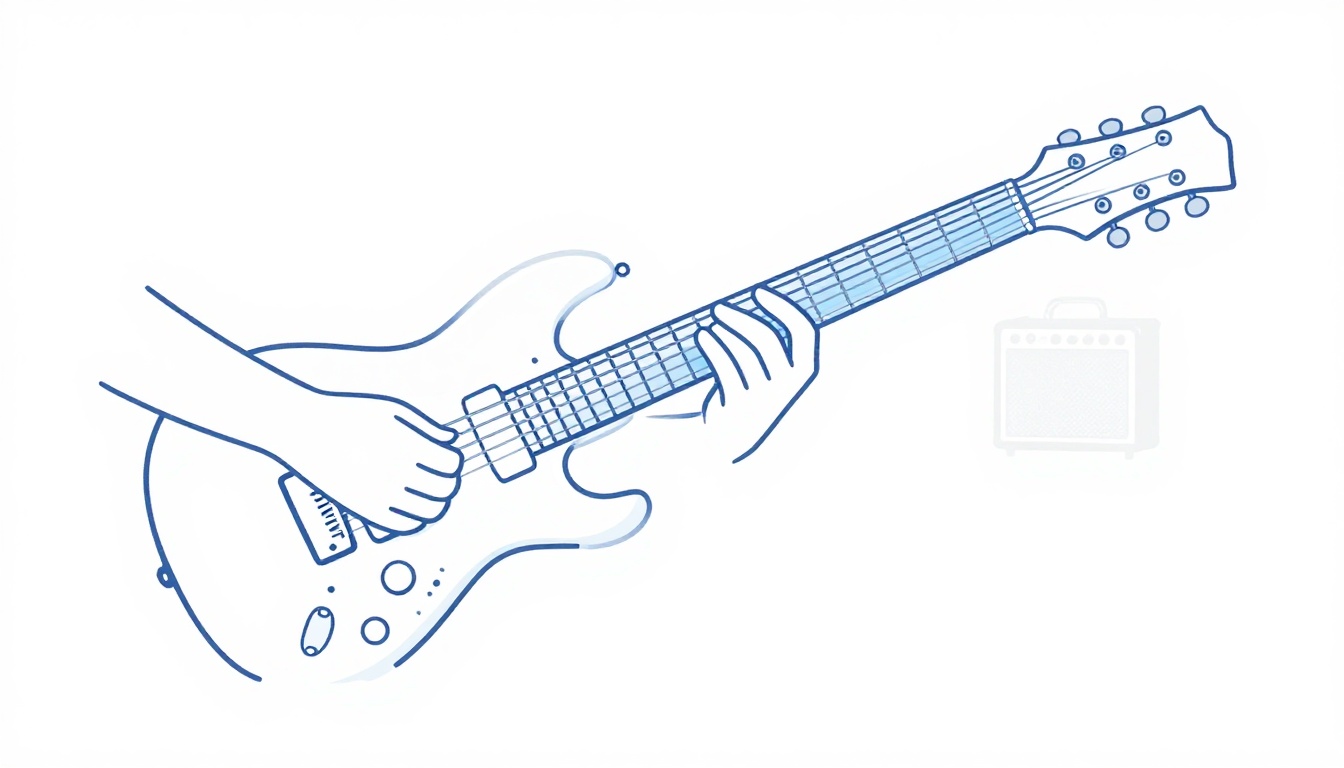
Nothing about the chord shapes above changes if you play this on an electric guitar instead of acoustic, but the character of the song does lean acoustic, closer to a singer-songwriter piece than a rock arrangement, at least until the "Jet" interlude arrives. If you are working this out on an electric, a clean or lightly overdriven tone with the neck pickup selected will sit closer to the recording's mood for the verse and chorus than a bright bridge-pickup tone would.
The interlude is the one section where an electric guitar can genuinely help rather than just substitute for an acoustic. The Eb7 to Ab to F7 to Bb to G7 chain reads more clearly with a bit of sustain behind it, closer to how a horn section would hold those chords, and a clean electric tone with a touch of reverb makes that chain easier to follow by ear than a dry acoustic strum does. Either instrument is a legitimate choice; pick whichever one you already play, since none of the chord shapes in this post require anything specific to acoustic construction.
Why Your Chords Are Not Ringing Out
Every chord in this song will buzz or mute for a specific, fixable reason. Work through these one at a time rather than assuming your hand is the whole problem.
G Sounds Muffled on the High E String
If you are using the three-finger G shape with your pinky reaching for the high E string, that string is the one most likely to go dead, because the pinky is your weakest finger and the least practiced at applying even pressure. Press from directly above the string rather than at an angle, and check that no other finger is leaning across and touching it by accident.
F Buzzes on the D or G String
On the easy, four-string F, the most common fault is the ring and pinky fingers landing on different parts of the 3rd fret, so one string presses cleanly while the other only half touches. Line your ring finger up on the A string and your pinky up on the D string so both land at the same distance from the fret wire, and arch your fingers so neither one flattens onto the string next to it.
The Full Barre F Only Rings on Some Strings
A barre chord fails almost every time the same way: uneven pressure along the index finger, usually because it is rolled flat instead of turned slightly onto its side. Roll your index finger toward its outer edge, where the bone is closer to the surface, rather than pressing with the soft, fleshy underside. Bring your fretting elbow in slightly toward your body, which gives the barre more leverage without needing more raw finger strength.
Bm Sounds Choked or Only Half There
Bm asks a beginner's hand to do two new things at once, barre with the index finger and stack three more fingers on top, and when it fails, it usually fails because the wrist is bent too far forward, which weakens the whole hand. Bring your fretting hand's palm more parallel to the back of the neck, thumb centered behind your middle finger, and the barre gets noticeably easier to hold down.
Am7 Sounds Like It Is Missing a Note
Because Am7 only fingers one string, it is easy to accidentally mute an open string with a finger that is still hovering from the previous chord. Check that your other fingers are lifted clear of the strings, not just off the fretboard but genuinely not touching, especially coming out of Am or C where three fingers were just doing work nearby.
The Low E String Rings When It Should Be Muted
D, F, Am, Bm and C in this song all either mute or skip the low E string, and a stray low E ringing under any of them will make the chord sound wrong even if every fretted note is correct. Rest the side of your fretting thumb lightly against the low E string when it is not part of the chord, or simply stop your strumming hand before it reaches that string.
Easier Versions for a First Pass
If the full chord set above is more than you want to take on right now, here is a version that keeps the song recognizable with a smaller vocabulary.
| Section | Full version | Simplified version |
|---|---|---|
| Verse | G, D, F, Am | G, D, Am (skip F, repeat G) |
| Chorus | G, Bm, Em, Am7 | G, Em, G, D (substitute Em for Bm) |
| Bridge | C, Em, Am | C, Em, Am (no change needed) |
| Interlude | Eb7, Ab, F7, Bb, G7 | Skip entirely, or substitute G, D, C, G |
Substituting Em for Bm loses some of the chorus's color, since Bm is what gives that section its slightly darker lift, but Em shares two of the same notes and keeps the chord progression moving without asking a new player to hold a barre chord in time. Treat this as a bridge to the real chords, not a permanent stand-in; once Bm feels comfortable on its own, put it back into the chorus and the song will sound noticeably closer to the record.
Changing Between the Chords
The shapes are rarely the hard part in a song like this. The transitions are, and a few of them are worth isolating on their own before you try to play through a whole verse.
G to D
Your ring finger stays roughly in the same area of the neck for both chords (3rd fret low E for G, 2nd fret high E for D is a different finger, but the general hand position is close), which makes this one of the more forgiving changes in the song once you have practiced it slowly a few dozen times.
D to F (Easy Version)
This is a bigger jump than it looks, moving your whole hand from the D shape near the nut into a four-string block shape a fret or two further in. Practice landing all four fingers of the F shape at once, rather than one at a time, since piecing it together finger by finger is what causes the hesitation that breaks the song's timing.
F to Am
Your ring finger moves from the 3rd fret A string (F) to open, and your other fingers reorganize onto the D and G strings. Keep your index finger anchored near the B string between the two chords; it is doing similar work in both shapes and does not need to fully leave the fretboard.
G to Bm
This change asks your hand to go from a wide, spread-out open shape straight into a barre, and it is one of the few places in the song where rushing genuinely makes things worse rather than just sloppier. Lift all three G fingers together rather than one at a time, and let your index finger land flat across the second fret before you try to add the other three fingers on top of it. Treating the barre as step one and the extra fingers as step two, rather than trying to place all four at once, is usually faster in practice even though it looks slower.
Em to Am7
Both chords use only one or two fingers, which makes this one of the lighter transitions in the chorus, but it is easy to rush precisely because it feels easy. Your ring and middle fingers lift off the low strings from Em, and a single finger lands on the D string for Am7. Keep the same light touch you used for Em; there is no reason to press harder for a one-finger chord.
Bm to Em
This is the easiest transition of the song's harder chords, because Em is simpler than almost anything else you are playing, and you get to release the barre entirely. Use it as a recovery point: if Bm has cost you timing, Em gives you a beat to reset before the next change.
Am to Am7 to C
These three chords in sequence share the same basic hand position, with only small finger adjustments between them, which is exactly why the songwriting uses Am7 as a passing chord rather than a full stop. Practice this three-chord run on its own in a loop until your fingers stop thinking about it as three separate decisions.
Strumming and Fingerpicking Feel
The recording is not a hard-strummed song. The verses lean toward a fingerpicked or lightly brushed acoustic guitar sitting under a near-spoken vocal, with the arrangement filling out gradually as the chorus and later sections arrive. If you strum this the way you would strum a straightforward up-tempo pop song, it will fight against the vocal delivery instead of supporting it.
A simple approach that works well for the verse: pick the bass note of each chord with your thumb, then brush the remaining strings softly with your fingers rather than a pick, keeping the dynamic quiet enough that a spoken vocal line would sit comfortably on top of it. Save a fuller strum, pick or fingers, for the chorus, where the song opens up and the chord changes come with more weight behind them. You do not need to fingerpick a fixed pattern here the way you would for a folk arrangement with a set right-hand pattern; matching the loose, conversational feel of the recording matters more than hitting a specific technique.
A Note on Tuning and Setup
Before you decide that Bm or the barre version of F is simply beyond you, rule out your instrument as the cause. Barre chords are the first place a poorly set up guitar shows itself: if the strings sit unusually high above the frets, known as high action, a barre that would be manageable on a well set up guitar can feel genuinely unplayable, no matter how good your technique is. If every barre chord you try feels like it takes far more effort than the chord shape should reasonably require, it is worth having the action checked rather than assuming the problem is entirely your hand strength.
Confirm your guitar is in standard tuning, low to high E-A-D-G-B-E, before you start. Nothing in this song uses an alternate tuning, and a guitar that is even slightly out of tune will make chords like Bm and Em, which share so many notes, sound noticeably worse than either chord actually is once you are in tune. A cheap clip-on tuner removes this as a variable entirely and is worth using every time you sit down to practice, not just when something sounds obviously wrong.

Practice Routine for Today
Do not try to play the whole song front to back on your first attempt. Work in this order instead:
- Isolate Bm. Fret it, strum once, release, and repeat for two minutes before you touch anything else. This is the chord most likely to slow the whole song down if you skip straight to playing it in context.
- Loop the chorus progression. G, Bm, Em, Am7, back to G, at a slow, even tempo, with a metronome if you have one, until the changes stop requiring you to look at your hand for every single chord.
- Add the verse. G, D, F, Am, at the same slow tempo, focusing on landing the F shape cleanly rather than quickly.
- Play verse into chorus without stopping. This is where most of the real difficulty in the song lives, not in any individual chord but in carrying momentum across the section change.
- Decide about the interlude. If you are learning this song to sing and play, the simplified table above is a legitimate stopping point. If you want the full arrangement, tackle Eb7, Ab, F7, Bb and G7 as their own separate practice block, away from the rest of the song, until that chain feels as automatic as the verse chords do.
Five focused minutes on Bm alone will do more for how this song sounds than twenty minutes of playing it start to finish with a chord that keeps buzzing.

Mistakes That Have Nothing to Do With Your Fingers
Once the chord shapes and transitions are solid, most of what still separates a beginner's version of this song from a convincing one is dynamics and pacing rather than accuracy. These are worth checking even after your hands already know the chart.
Playing the Verse and Chorus at the Same Volume
If every section of the song comes out at the same strumming intensity, the arrangement loses the thing that makes it interesting, the build from a near-spoken opening into a fuller chorus and then an even more energetic interlude. Deliberately play the verse quieter than you think you need to. It should feel almost too soft on its own, because it is meant to sit under a vocal, not stand alone.
Rushing the Loose Opening
Because the verse does not sit on a strict rhythmic grid, a beginner's instinct is often to straighten it out, to force the chord changes onto an even, metronomic pulse. Resist that. The looseness is part of the song, inherited from how it was written on the spot around a spoken quote, and flattening it into a strict tempo removes the exact quality that makes the opening sound intentional rather than just simple.
Stopping Dead at Section Changes
Beginners often pause slightly, sometimes without realizing it, at the boundary between verse and chorus, or chorus and bridge, while their hand resets for the next chord. Practicing the transition into each new section specifically, not just the chords within each section, is the fix; treat the last chord of one section and the first chord of the next as a pair you drill together, the same way you would drill any other two-chord change.
Skipping the Interlude Without Acknowledging It
If you are using the simplified version and leaving out the "Jet" interlude, that is a legitimate choice, but going straight from the bridge back into another chorus without any pause can feel abrupt to a listener who knows the record. A short instrumental gap, even just letting the last bridge chord ring out for an extra beat or two, signals that you are choosing to skip a section rather than that you forgot it existed.
How This Song Connects to Other Wings and Beatles Chord Vocabulary
If you already play a few other songs from this era, several of the chord relationships here will feel familiar. The borrowed F chord over a G major backdrop shows up across a lot of McCartney's writing from the same period, and the Am to Am7 to C movement is a common connective device in his songwriting more broadly, a way of keeping a chorus moving without introducing an entirely new chord. Practicing this song's chorus is, in a real sense, practicing a small piece of vocabulary that will make other songs from the same catalog easier the next time you meet it.
The interlude is a different kind of lesson. Chains of dominant seventh chords resolving up a fourth, the Eb7 to Ab to F7 to Bb to G7 movement, are far more common in jazz and horn-band writing than in typical rock rhythm guitar parts. If you have never played anything like it before, treat this section less as "part of a Wings song" and more as a short, self-contained introduction to a chord vocabulary you will meet again if you explore jazz standards or horn-heavy soul and funk rhythm parts later on.
Frequently Asked Questions
What key is "Picasso's Last Words" in? The verse, chorus and bridge sit in G major. The instrumental interlude modulates through a chain of chords built around Eb before resolving back to G, so the song is not in a single unchanging key for its full five and a half minutes.
Do I need a capo for this song? No. Every commonly published chord chart for this song plays it without a capo, using open and first-position shapes for the verse and chorus.
What were Picasso's actual last words? By most accounts, Pablo Picasso's last words to friends at a dinner shortly before his death in April 1973 were close to "Drink to me, drink to my health, you know I can't drink any more," which is the line McCartney was shown in a magazine article and built the song's melody around.
Why does the song reference "Jet" and "Mrs. Vandebilt"? Both are other tracks from Band on the Run, the second and fourth songs on the album respectively, and this song interpolates musical fragments from each inside its own arrangement, functioning more like connected movements than a single conventional song structure.
Is this an easy song for a beginner guitarist? The verse and chorus chords are all beginner-friendly except for the Bm barre chord, which is genuinely a step up in difficulty. The full interlude section is intermediate at best, built on chords most players do not encounter until well past their first few months. Learning the verse and chorus first, and treating the interlude as optional, is a realistic starting point.
Was this song ever released as a single? No. Despite being the longest track on Band on the Run at nearly six minutes, it was never issued as a single, unlike other tracks from the same album.
Is this song harder than a typical Wings or Beatles song to learn on guitar? The verse and chorus are comparable in difficulty to plenty of other songs from the same catalog, built on open chords with one barre chord thrown in. What makes the song unusual is not chord difficulty but structure: most Wings songs repeat a verse-chorus pattern, while this one moves through several distinct sections that each need to be learned somewhat separately, which makes it feel longer and more demanding to learn even though no single chord is harder than average.
What instrument carries the melody on the original recording? The recording centers on acoustic guitar and Paul McCartney's vocal, with a brief orchestral arrangement by Tony Visconti added separately at AIR Studios in London, and percussion from Ginger Baker recorded during the Lagos sessions.
Can I play this song by only learning the chorus? You can, and it is a reasonable way to learn to sing along with the song's most memorable section, but you would be skipping the verse's borrowed F chord, the bridge's introduction of C, and the interlude entirely, so you would only be learning roughly a third of the arrangement.
What is the "Richard Cory" version of this song? On the 1975 to 1976 Wings Over the World tour, Wings performed "Picasso's Last Words" as part of an acoustic medley with "Richard Cory," a cover of a Paul Simon song, and that live pairing was released on the 1976 live album Wings Over America. It is a useful reference recording for a solo acoustic cover, since it is stripped down closer to just voice and guitar.
Does this song work on electric guitar? Yes. None of the chord shapes change between acoustic and electric. The verse and chorus generally suit a cleaner tone closer to the recording's acoustic mood, while the interlude's chain of dominant seventh chords can sound clearer with a bit of sustain or light overdrive behind it.
Once the chorus and verse changes stop needing conscious thought, this song rewards patience more than most: it is one of the few in a typical beginner's songbook where playing it slower and more sparsely, closer to how it was actually written, sounds more correct than playing it fast.
GuitarLowKey
Ready for fifteen focused minutes?
Open the web app and train the change that is blocking your song.