
12-String Guitar Tuning: Every Note, Pair, and Order Explained
The exact notes for every octave and unison string pair on a 12-string guitar, the correct tuning order, string gauges, and why it slips out of tune fast.

Standard tuning for a 12-string guitar is E-A-D-G-B-E, the same six notes as a regular guitar, but each note is doubled into a pair. The bottom four pairs (low E, A, D, G) are tuned an octave apart, and the top two pairs (B and high E) are tuned in unison, so the full spread is E2E3, A2A3, D3D4, G3G4, B3B3, E4E4 from the thickest string to the thinnest. Get those twelve strings to that spread and you have a 12-string in tune. Everything else in this guide, the order you bring them up in, why the octave strings snap if you rush it, and what to do when it will not hold, is what makes that spread easy to reach and keep.
The Standard Tuning, String by String
A 12-string guitar has six courses, pairs of strings tuned to sound like one note, not twelve independent pitches. Standard tuning names the six notes E-A-D-G-B-E from the 6th course (thickest, lowest) to the 1st course (thinnest, highest), exactly like a six-string guitar. The difference is what happens inside each course.
| Course | Note | Main string | Octave/unison string | Relationship |
|---|---|---|---|---|
| 6th (low E) | E | E2 | E3 | Octave apart |
| 5th (A) | A | A2 | A3 | Octave apart |
| 4th (D) | D | D3 | D4 | Octave apart |
| 3rd (G) | G | G3 | G4 | Octave apart |
| 2nd (B) | B | B3 | B3 | Unison |
| 1st (high E) | E | E4 | E4 | Unison |
The bottom four courses each carry a thick, wound string at the standard pitch and a thin string an octave above it. Pluck the 6th course and you hear a low E and a higher E ringing together, not two identical notes. The top two courses drop the octave trick and just double the same pitch on two strings of matching gauge, which is why those two courses feel and sound the most like a regular guitar string, just fuller.
That combination, four octave courses under two unison courses, is what people mean when they say "standard 12-string tuning" without qualification. It is the tuning nearly every 12-string ships in, and the one every alternate tuning in this guide is a variation on.
12-String vs Six-String at a Glance
Before getting into the mechanics, it helps to see what actually changes between the two instruments, since it is less than most new 12-string owners expect.
| Six-string guitar | 12-string guitar | |
|---|---|---|
| Number of strings | 6 | 12 (six courses of two) |
| Named pitches | E-A-D-G-B-E | E-A-D-G-B-E, same six notes |
| Octave or unison pairing | None, one string per note | Bottom four courses octaves, top two unison |
| Chord shapes | Standard | Identical to six-string |
| Typical neck width at nut | Around 1.69 inches | Slightly wider, closer to a classical guitar |
| Fretting pressure needed | Baseline | Noticeably more, two strings per course |
| String bending and solos | Straightforward | Difficult, bends pull a course out of tune with itself |
| Tuning stability | Settles quickly | More sensitive to tension changes and takes longer to settle |
Nothing about how you read a chord chart or where your fingers go changes. What changes is what your fretting hand feels and what your ear hears ringing back at you.
Why Octaves on the Bottom and Unison on Top
This is not an arbitrary split. It comes from what each register does for the sound and what the strings can physically survive.
On the bottom four courses, an octave string adds a bright, chiming overtone above a low fundamental without turning the bass muddy. You still hear the low E as the bass note of the chord, but a thin string a fifth or more thinner is ringing an octave above it, adding shimmer without competing for the same frequency space. That is the core of the 12-string's signature sound, often described as jangly or bell-like: Pete Seeger called it "the clanging of bells," and the effect comes from two strings at slightly different pitches beating against each other in a way a single string cannot.
Unison pairs on the top two courses do something different. An octave above a high B or high E would be uncomfortably thin and hard to keep in tune reliably, so instead the pair reinforces the same pitch, adding volume and a slight chorus-like detune rather than a new overtone. It also means the two thinnest courses feel closer to fretting a regular guitar, since both strings in the pair are nearly the same gauge and same pitch.
Every 12-string in standard tuning follows this split for the same reason: it is the balance that gives you the shimmer where it works (low end) without asking impossibly thin high strings to hold an octave that would break or go flat within minutes.
Where This Tuning Came From
Doubled strings on a guitar are not a modern idea. The direct ancestor of today's 12-string is the double-strung Spanish guitar of the 1800s, itself a development of the Baroque guitar, which paired its courses centuries before anyone plugged one into an amplifier. The instrument stayed a novelty through most of the 1800s and into the early 1900s, and it was blues and folk musicians in the 1920s and 1930s, most notably Lead Belly and Blind Willie McTell, who turned it into a serious voice for accompanying singing, with Lead Belly reportedly favoring tunings well below standard, including low C and low B, on instruments built to take the extra slack. Mexican-American musician Lydia Mendoza brought the 12-string to wider prominence in the same era.
The instrument's biggest jump into the mainstream came through electric models in the 1960s. George Harrison's Rickenbacker 360/12, heard across A Hard Day's Night, and Roger McGuinn's use of a 12-string as The Byrds' defining sound, set the template for the jangling, chiming rock and folk-rock tone most people associate with a 12-string today. That sound is standard E-A-D-G-B-E tuning, the same octave-and-unison structure covered above, played through the specific attack a Rickenbacker's reversed string order gives it. Jimmy Page, Don Felder, Johnny Marr, Peter Buck, and Tom Petty all carried the instrument forward in rock through the following decades, almost always in standard tuning or a close variant of it.
The reason pre-1970s 12-strings were so often tuned down, sometimes a full step or more below standard, was structural rather than purely musical. Before truss rods became standard equipment on American-built guitars, a neck under the tension of twelve strings at standard pitch was prone to bowing and warping over time, so builders and players alike treated a lower tuning as the safe default rather than a stylistic choice. Once reinforced necks became common after the 1970s, standard pitch became practical for most instruments, and tuning down became optional again, kept alive today mostly for the tension relief and tonal thickness it still offers rather than out of structural necessity.
String Order: Which String Goes Where in Each Pair
Every course has a specific left-to-right order, and it is not arbitrary either. On a standard right-handed 12-string, within each of the four octave courses, the thinner octave string sits on the side of the pair struck first by a downstroke, meaning it is the string closer to where your pick or thumb makes first contact, with the thicker main string sitting just behind it. On the two unison courses the order does not matter for pitch since both strings match, but manufacturers still keep a consistent order so restringing is predictable.
| Course | String order (pick-strike side to inside) | Notes |
|---|---|---|
| 6th (low E) | Thin octave E3, then thick main E2 | Octave string struck first |
| 5th (A) | Thin octave A3, then thick main A2 | Octave string struck first |
| 4th (D) | Thin octave D4, then thick main D3 | Octave string struck first |
| 3rd (G) | Thin octave G4, then thick main G3 | Octave string struck first |
| 2nd (B) | Either order | Unison, same gauge |
| 1st (high E) | Either order | Unison, same gauge |
Rickenbacker built their electric 12-strings, most famously the 360/12 that George Harrison played, with this convention reversed: the octave string sits behind the main string instead of in front of it, which is part of why a Rickenbacker 12-string has a slightly different attack than most acoustic 12-strings. If you are restringing your own guitar and the nut slots and bridge holes already dictate an order, follow the order the guitar was built for rather than fighting it, since the slots are cut to the string gauges already in that position.
How to Tune a 12-String Guitar With a Tuner
The fastest and most reliable way to tune any 12-string is a clip-on or pedal tuner that can isolate a single string, because you are about to bring twelve strings to pitch and you cannot do that by ear alone the first time through.
- Mute eleven strings, tune one. Rest your palm lightly across the other strings in a course, or across neighboring courses, so the tuner reads only the string you are turning. Clip-on tuners that read vibration through the headstock make this easier since they are less sensitive to strings ringing nearby.
- Tune the six main strings to E-A-D-G-B-E first, in the same order and to the same pitches as a six-string guitar: low E (E2), A (A2), D (D3), G (G3), B (B3), high E (E4).
- Then tune each octave string to match its partner an octave up. For the bottom four courses, the octave string should read the same note letter as its main string but one octave higher on the tuner's display: E3 against E2, A3 against A2, D4 against D3, G4 against G3.
- Tune the two unison strings to the exact same pitch as their partner, B3 against B3 and E4 against E4, with no octave difference.
- Play each course together and listen. A correctly tuned octave pair should sound like one thick, bright note, not two separate pitches beating against each other. A correctly tuned unison pair should sound like a single, slightly fuller string.
- Retune the whole set a second time. Bringing twelve strings to pitch pulls the neck and top under more tension with every string added, which pulls the strings you already tuned slightly flat. Go through all twelve again once the first pass is done.
That last step is not optional on a 12-string the way it sometimes is on a six-string. The cumulative pull of six extra strings coming up to pitch is large enough that your first three or four courses will read flat by the time you finish the twelfth string, every time.
Tuning by Ear (the Relative Method)
A tuner is the practical answer, but tuning by ear is worth knowing for when you do not have one, and it is exactly the six-string relative tuning method applied to the main strings first.
- Start with the low E course at a reference pitch, from a tuning fork, piano, or another instrument.
- Fret the 5th fret of the low E course and match it to the open A course.
- Fret the 5th fret of the A course and match it to the open D course.
- Fret the 5th fret of the D course and match it to the open G course.
- Fret the 4th fret of the G course, not the 5th, and match it to the open B course. This is the one exception in standard tuning, since B sits a major third above G rather than a perfect fourth.
- Fret the 5th fret of the B course and match it to the open high E course.
Once the six main pitches are set by ear, tune each octave string against its partner by ear the same way you would tune any octave: play the main string, then adjust the octave string up or down until the beating between the two disappears and they lock into a single ringing pitch. Unison strings are even easier by ear, since any mismatch produces an obvious warble that vanishes the moment the two strings match exactly.
Tuning twelve strings entirely by ear is slower and less precise than a tuner, and small errors compound across twelve strings faster than across six, so treat this as a backup method, not your daily routine.
String Gauges for a 12-String Set
A 12-string set is not six pairs of identical strings. The octave strings on the bottom four courses are dramatically thinner than their main-string partners, since a full-gauge octave string at that pitch would be under far more tension than the neck or that string could handle. Here is a common light-gauge acoustic 12-string set as a reference point for what a real set looks like:
| Course | Main string gauge | Octave/unison string gauge |
|---|---|---|
| 6th (low E) | .047 (wound) | .027 (wound) |
| 5th (A) | .039 (wound) | .018 (wound) |
| 4th (D) | .030 (wound) | .012 (plain) |
| 3rd (G) | .023 (wound) | .008 (plain) |
| 2nd (B) | .014 (plain) | .014 (plain) |
| 1st (high E) | .010 (plain) | .010 (plain) |
Notice the pattern: the octave partner for the 3rd course is a plain .008, one of the thinnest strings on the instrument, tuned a full octave above a wound .023. That contrast, a very thin plain string against a much thicker wound string in the same course, is normal and is what makes the octave shimmer possible. If you ever buy loose strings to replace a single broken one rather than a full set, match the exact gauge printed on the set's packaging for that position, since a slightly heavier or lighter octave string will not track its partner's pitch the same way under the same tuning pressure.
Heavier 12-string sets exist for players who tune down or want more low-end punch, and lighter sets exist for players who find standard tension too stiff to fret comfortably, but the octave-versus-main relationship in each course stays proportionally similar across gauge sets.
Total String Tension and What It Means for Your Guitar's Neck
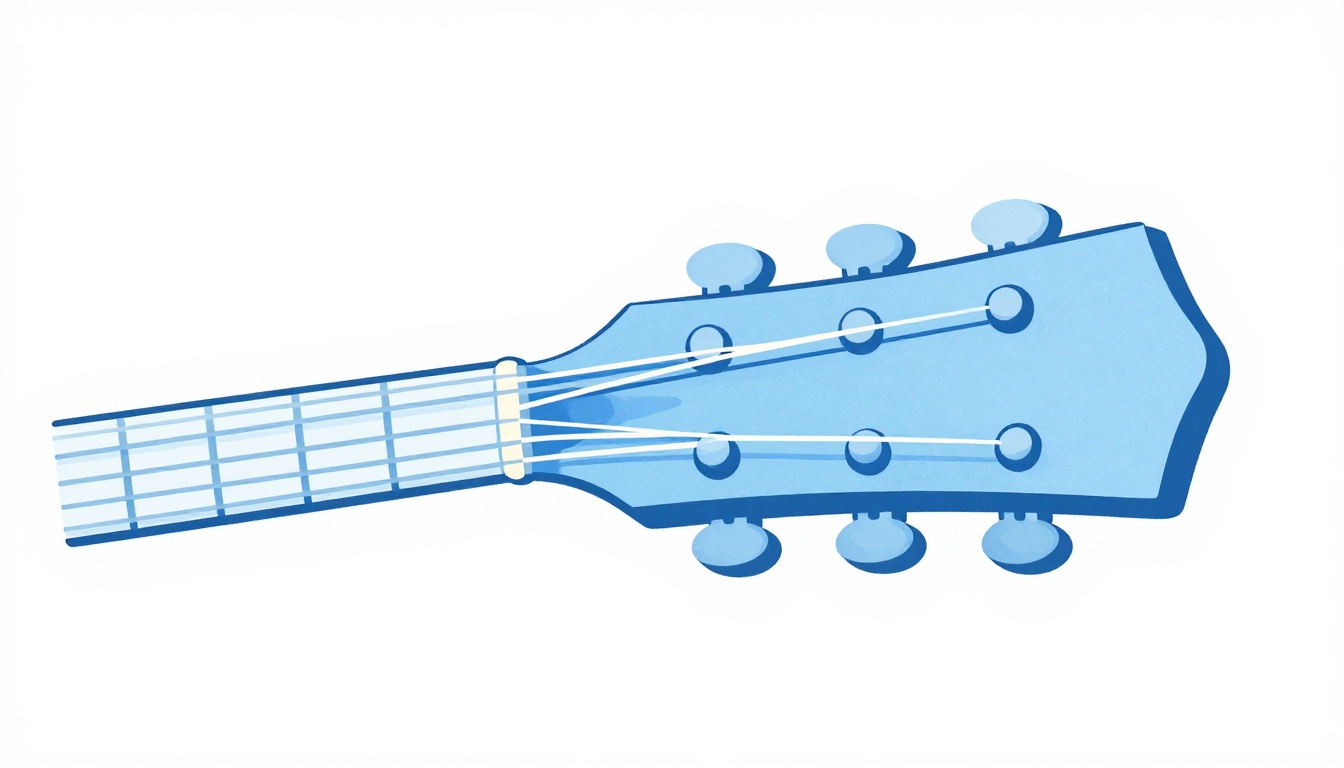
Twelve strings at standard pitch put substantially more combined pulling force on the neck and top than six strings do, and that is the reason a 12-string is built differently from a six-string rather than just strung differently. The headstock is elongated to fit twelve tuning machines instead of six, the neck is usually wider, closer to a classical guitar's width, and both the neck and the internal bracing under the top are reinforced to handle the added load. None of that is cosmetic. It is the structural answer to the same tension problem that made low tunings the default on pre-1970s instruments.
A truss rod, the adjustable steel rod running through the neck, is what lets a modern 12-string sit at standard pitch indefinitely without the neck bowing forward under that load. If you own an older 12-string, particularly one built before the 1970s or built without a truss rod, that instrument was very likely designed with a lower tuning in mind, and pushing it up to modern standard pitch is worth doing gradually, checking the neck's relief as you go, rather than cranking all twelve strings straight up to E-A-D-G-B-E from a full step down. If your 12-string's action creeps higher over months of standard-pitch tuning, or the neck looks like it is bowing away from the strings when you sight down it from the headstock, that is the tension talking, and a truss rod adjustment, ideally by someone experienced with one, is the fix, not a change in how you tune.
Why a 12-String Goes Out of Tune Faster Than a Six-String
If your 12-string will not hold a tuning through a single song, this is almost always one of these causes, and it is rarely the tuner's fault.
The Extra Strings Add Real Tension to the Neck
Six more strings at pitch means six more strings pulling on the neck, and that additional tension flexes the neck and top more than a six-string guitar experiences. Every time you retune one course, you are slightly changing the tension the whole neck is under, which nudges every other course a hair off pitch. This is why the second full pass through all twelve strings during tuning is never optional, and why a 12-string benefits from a truss rod check more often than a six-string if it sees big tuning changes.
New Strings Have Not Stretched In Yet
A fresh set of strings, especially the thin plain octave strings, stretches measurably over its first hour of play. If you just restrung the guitar, tune it up, then gently pull each string a few millimeters away from the fretboard and retune, repeating a few times, before trusting the tuning to hold. Skipping this step is the single most common reason a freshly strung 12-string goes flat within minutes of a first play.
One Octave String Has Slipped Slightly Off Pitch
Because each course relies on two strings matching a specific interval, a single string drifting even a few cents throws off the whole course in a way that is more noticeable than a lone string drifting on a six-string guitar. The beating or warble you hear is not always "the guitar is out of tune," it is often one string in one course needing a small correction while its partner is fine.
Temperature and Humidity Swings Hit a 12-String Harder
More strings under tension means more total force acting on the top and neck, so a 12-string's wood generally responds more noticeably to humidity and temperature changes than a six-string's does. A guitar that was in tune in an air-conditioned room and goes noticeably flat or sharp after being carried into a humid or dry outdoor space is behaving normally for the instrument, not malfunctioning.
Old or Corroded Strings Lose Their Grip on Pitch
Strings that have been on the guitar for months, especially the thin plain octave strings, can develop tiny corrosion pits that change how they grip the tuning post and how consistently they vibrate. If a specific course has been unreliable for weeks despite careful tuning, a fresh string in that position, matched to gauge, usually solves it faster than repeated retuning.
A Worn Nut Slot or a Loose Tuning Machine
With twelve tuning posts instead of six, the odds that one of them has developed slight play in its gears go up simply because there are more of them to wear out. A tuning peg that feels loose or slips slightly under string tension, rather than turning smoothly and holding where you leave it, is a hardware problem a tuner cannot compensate for. Likewise, a nut slot that has worn wider than the string sitting in it lets that string shift position slightly every time you play, which shows up as a course that will not hold even though you just tuned it correctly. Both are mechanical fixes, tightening or replacing the tuning machine, or having the nut slot addressed, not a tuning technique to practice harder.
Should You Tune a 12-String Down?
Tuning a whole step below standard, so the six main pitches read D-G-C-F-A-D instead of E-A-D-G-B-E, with the octave and unison relationships in each course staying the same, is a long-standing practice on 12-strings, and it solves a real problem rather than being a stylistic quirk.
Lower tension makes the strings easier to fret, which matters more on a 12-string than a six-string because you are pressing two strings per course instead of one every time you fret a chord. It also reduces the sustained load on the neck and top, which is part of why pre-1970s 12-strings, built before truss rods were standard on most American-made guitars, were frequently tuned down a full step or more as a matter of course rather than choice. Tuning down a full step lowers string tension by roughly a fifth compared to standard pitch at the same gauge, which is a meaningful reduction for both your fretting hand and the guitar's structure.
| Tuning | 6th course | 5th course | 4th course | 3rd course | 2nd course | 1st course |
|---|---|---|---|---|---|---|
| Standard | E | A | D | G | B | E |
| Half step down | Eb | Ab | Db | Gb | Bb | Eb |
| Whole step down | D | G | C | F | A | D |
The tradeoff is real: strings tuned down with the same gauge they were designed for at standard pitch feel looser and can sound slightly less defined, since the string is no longer under the tension it was built for. Some players compensate with a heavier gauge set tuned down a full step, which restores tension closer to what a standard-gauge set has at standard pitch while keeping the lower pitch. If your 12-string feels genuinely too stiff to fret comfortably at standard pitch, tuning down a half step first is the smaller change to try before committing to a full step or a heavier string set.
Drop D Tuning on a 12-String
Drop D works on a 12-string exactly the way it works on a six-string, applied to both strings in the 6th course. Lower the main low E string from E2 down to D2, and lower its octave partner from E3 down to D3, keeping the octave relationship intact between them. Every other course stays in standard tuning.
The result gives you a full, ringing low D power chord across the 6th and 5th courses using one finger, and lets you play in keys built around D without an open D chord shape needing a capo. Because the 6th course is two strings, not one, that dropped low D rings out with more weight than a drop D power chord on a six-string, which is part of why drop D is popular with 12-string players who write in D or G.
DADGAD and Other Open or Modal Tunings
DADGAD, tuning the six main pitches (and their octave or unison partners) to D-A-D-G-A-D instead of E-A-D-G-B-E, is one of the most common alternate tunings on a 12-string, particularly in Celtic and folk fingerstyle playing. It turns an open strum into a spacious Dsus4 chord and opens up drone-based fingerpicking patterns that lean on the 12-string's natural doubling for a fuller sound than the same tuning gets on a six-string.
| Course | DADGAD note | Compared to standard |
|---|---|---|
| 6th | D | Down a whole step from E |
| 5th | A | Same as standard |
| 4th | D | Same as standard |
| 3rd | G | Same as standard |
| 2nd | A | Up a whole step from B |
| 1st | D | Down a whole step from E |
Open D (D-A-D-F#-A-D) and open G (D-G-D-G-B-D) also transfer to a 12-string with the same octave-and-unison structure preserved within each course, and both are common choices for slide playing, where the chorus effect from the doubled strings adds sustain and shimmer to a slide note that a six-string cannot match. As with drop D, the rule for adapting any six-string alternate tuning to a 12-string is simple: retune both strings in a course to the new pitch, keeping the octave courses an octave apart and the unison courses matched.
Because retuning six courses (twelve strings) to a genuinely different tuning takes real time and puts a different tension profile on the neck, most 12-string players who move in and out of alternate tunings keep a second guitar tuned to their alternate tuning rather than retuning the same instrument back and forth for a single song.
Nashville Tuning: Getting the 12-String Sound From a Six-String
Nashville tuning, sometimes called high-strung tuning, takes the octave idea from a 12-string and moves it onto a regular six-string guitar. You restring the bottom four strings, low E, A, D, and G, with the thin octave-gauge strings a real 12-string set uses for those courses, tuned a full octave above where they would normally sit, while leaving the B and high E strings as normal gauge. The result is a six-string guitar that plays the same chord shapes but rings out almost entirely in the upper register, with none of a low end at all.
On its own, a Nashville-tuned guitar sounds thin and chiming rather than full, which is the point: it is built to be recorded or played alongside a normally tuned six-string or a 12-string, doubling the part an octave up to add shimmer to a chord progression without changing what is being played. It is a common studio trick specifically because it recreates the top half of a 12-string's octave courses without needing an actual 12-string or its extra tuning and fretting demands.
Mexican (Requinto-Style) All-Unison Tuning
Not every 12-string uses octave pairs on the bottom four courses. In Mexican and Tejano music, particularly in the requinto and bajo sexto traditions, some 12-strings are strung and tuned with all six courses in unison, including the bottom four that would normally be octave pairs on a standard instrument. This trades the bright, chiming shimmer of octave pairing for a thicker, more unified tone closer to a bajo sexto, useful for the rhythmic, driving accompaniment style that norteño and Tejano music calls for.
This setup is not a simple retuning of a standard 12-string. Doubling the low strings in unison rather than an octave apart puts significantly more tension on the bridge and neck than the standard octave arrangement does, since you lose the tension relief that a thin, high-octave string provides compared to a second full-gauge string at the same low pitch. Instruments set up this way typically need nut modifications and often bridge reinforcement to handle it safely, so this is a purpose-built configuration rather than something to try on a standard 12-string without those changes.
Restringing a 12-String Without Losing Your Mind
Restringing a 12-string is the same core process as restringing any acoustic guitar, repeated six times with an extra string threaded alongside each main one, but the order and pacing matter more here.
Work one course at a time rather than removing all twelve old strings before installing any new ones. Removing every string at once drops the neck's tension all at once, and while modern truss-rodded necks handle this fine, it also means you lose the nut slot's guidance for which string goes on which side of a course. Replacing one course, then the next, keeps that reference in place.
Feed both strings of a course through the bridge or bridge pin together, keep the thinner octave or matching unison string on the correct side according to the order this guide covered earlier, and wind each tuning post the same number of times as you would for a six-string, generally two to three wraps for a wound string and three to five for a plain string, so the string angle behind the nut stays consistent across the headstock.
Bring the new course up to pitch, then move to the next course, rather than bringing all twelve strings to pitch only at the end. This spreads the tension increase across the whole process instead of asking the neck to absorb it all at once, and it also means if a thin octave string is going to snap from over-tightening, which is the most common casualty during a 12-string restring, you catch it on one course at a time instead of losing your place across twelve strings.
Common Mistakes When Tuning a 12-String
Tightening an Octave String Too Fast
The thin plain strings used for the octave partners on the bottom four courses, often as light as .008, have very little margin between correct pitch and snapping. Turning the tuning peg in large, fast movements while watching a tuner is the most common way these strings break. Small, slow turns with frequent tuner checks avoid this.
Confusing Which String in a Course Is the Octave
If you tune the thin octave string to the same pitch as its thick partner instead of an octave above it, the course will sound like a slightly detuned unison rather than the intended shimmer, and it is an easy mistake to make if you are tuning by app and misread which string you are adjusting. Always confirm the octave string reads the same note name one octave higher, not the same octave, on your tuner's display.
Tuning All Twelve Strings Only Once
As covered above, the tension pull from finishing all twelve strings means a single pass leaves the first several courses flat. Skipping the second pass is the most common reason a 12-string sounds "close but off" immediately after tuning.
Not Muting Neighboring Strings
Because the courses sit close together, a tuner or your ear can easily pick up the ringing of an adjacent, already-tuned string while you are trying to adjust a different one. Rest your palm or a finger across the strings you are not currently tuning.
Ignoring a Buzzing or Dead-Sounding Course
If one course sounds muted or buzzes against the fret while every other course rings clean, that is usually a string sitting in the wrong nut slot, a burr in the slot itself, or an old string that has lost its ability to vibrate cleanly, not a tuning problem. Retuning will not fix a mechanical issue at the nut or a dead string.
Trusting a Tuning From Days Earlier
Picking a 12-string back up after it has sat untouched for several days and assuming it is still close to pitch is a common way to snap a string, since you cannot tell by looking whether one course has drifted a full step flat or sharp in the meantime. Always check every course with a tuner before your first strum after any real gap, rather than tuning by feel from where you left off.
How Playing Changes With Twelve Strings
The chord shapes are identical to a six-string guitar. An open G, a barre F, a D chord, none of them change because the guitar has twelve strings instead of six, since each course still functions as a single note in the shape. What changes is the physical effort and the sustain.
Fretting requires noticeably more finger pressure, since you are pressing two strings per course rather than one, and a chord that felt effortless on a six-string can feel stiff on a 12-string until your fretting hand adapts. Barre chords in particular ask a lot of your first finger, since it is now clamping down on twelve strings across the fret rather than six. New 12-string players commonly find their hand tires faster during a first few sessions, and that is normal, not a sign of doing something wrong.
Sustain and resonance last noticeably longer on a 12-string, since twelve vibrating strings, several of them ringing in octaves, keep the top and the air inside the body moving longer than six strings do. This makes a 12-string forgiving for strummed accompaniment, where a chord's ring naturally fills the space between strums, but it also means muting unwanted ring, for example between a verse and a quieter bridge, takes a more deliberate palm mute than it would on a six-string.
Single-note lead lines and string bends are harder and less common on a 12-string, since bending one string in a course pulls it out of tune with its octave or unison partner, producing a noticeably clashing sound rather than the clean pitch bend a six-string gives you. This is why 12-strings are used far more often for full chordal accompaniment and fingerstyle patterns than for solo lead playing.
A capo works exactly as it does on a six-string, clamping across all twelve strings at once, and is a common way 12-string players change key without retuning, since the octave and unison relationships inside each course are unaffected by where the capo sits on the neck.
Electric 12-String Tuning Differences
Electric 12-strings, most associated with the jangly rock and folk-rock sound of the 1960s, follow the same standard tuning, octave courses on the bottom four and unison on the top two, as an acoustic 12-string. The tuning process with a tuner is identical.
The one notable exception is Rickenbacker's convention, mentioned earlier under string order: on Rickenbacker 12-strings like the 360/12, the main string in each octave course sits in front of the octave string relative to a downstroke, the reverse of the typical acoustic order. This does not change what note either string is tuned to, only which string your pick or fingers meet first, and it is part of why a Rickenbacker's attack on a chord sounds slightly different from a typical acoustic 12-string's.
Electric 12-strings are generally easier to keep in tune session to session than acoustic ones, since a solid or semi-hollow electric body responds less to humidity swings than an acoustic top does, though the same tuning-order and stretch-in advice from earlier in this guide still applies fully.

Keeping a 12-String in Tune Day to Day
A few habits make the difference between a 12-string that holds tune through a set and one you are fighting between every song.
Stretch new strings deliberately after any restring, pulling each string gently away from the fretboard a few times and retuning between pulls, until the pitch stops dropping noticeably on its own. Store the guitar in a case rather than on an open stand when humidity or temperature is likely to swing, since the extra string tension makes a 12-string's neck and top more responsive to those changes than a six-string's. Retune immediately before playing rather than trusting a tuning from hours earlier, and get in the habit of a quick second pass through all twelve courses even on a guitar that has already settled, since the cumulative tension still shifts slightly with temperature and playing time. If a specific course repeatedly drifts while the rest of the guitar holds, treat it as a sign to check that string's condition and the nut slot it sits in rather than assuming your tuning technique is at fault.
A clip-on tuner that reads vibration through the headstock rather than a microphone that listens through the air is worth the small investment specifically for a 12-string, since it is far less likely to get confused by a neighboring course still ringing while you adjust the one under your hand. Pedal tuners with a dedicated mute function are the other common choice for players who tune between songs on stage, since muting the signal while you tune keeps the process quiet without needing to physically dampen eleven other strings by hand each time.
A Practice Routine for Learning to Tune One Confidently
Set aside five minutes before your next few practice sessions to tune the guitar entirely by yourself, tuner in hand, working one course at a time in the order this guide covered: the six main strings first, low E through high E, then the six octave and unison partners. Say the note and octave out loud as you tune each string, "low E, E two" then "octave E, E three," so the octave relationship becomes automatic rather than something you have to re-derive every time. Once the full set is up to pitch, play through a simple open chord you already know, like a G or a D, and listen specifically for any course that sounds like two separate pitches rather than one blended note. That is your ear learning to catch a slightly mistuned octave string before it becomes a problem mid-song, which is the actual skill this whole process is building toward.
Over your first few weeks on the instrument, try tuning without looking at which string is which on the tuner display before you turn a peg, relying instead on which course you are touching and what you already know its role is. By the time you can tune a full 12-string confidently without narrating every step to yourself, you will also have built the finger strength and instinct for fretting six extra strings that made the instrument feel stiff when you started.
Frequently Asked Questions
Is a 12-string guitar tuned the same as a 6-string? The six named pitches are identical, E-A-D-G-B-E low to high. The difference is that each pitch is doubled into a pair, tuned in octaves on the bottom four courses and in unison on the top two, rather than being a single string per note.
Why does my 12-string sound out of tune even right after I tune it? Almost always one specific course has an octave or unison string slightly off from its partner rather than the whole guitar being flat or sharp. Check each course individually rather than relying on a general sense that "something" is wrong.
Can I put six-string strings on a 12-string guitar? No. A 12-string set includes specifically gauged octave and unison partner strings, often as thin as .008, that do not exist in a standard six-string set. Using six-string gauges in those positions will not track pitch correctly and risks snapping strings under the wrong tension.
Should beginners tune a 12-string down to make it easier to play? Tuning down a half step is a reasonable first thing to try if the guitar feels genuinely stiff to fret, since it meaningfully reduces string tension without changing the chord shapes or note relationships you already know. A full step down is a bigger change and is more of a stylistic and tonal choice than a beginner necessity.
How often should I restring a 12-string guitar? There is no fixed schedule, but because a 12-string relies on the octave and unison relationships between paired strings staying accurate, strings that have visibly dulled, feel rough under your fingers, or repeatedly will not hold pitch in one specific course are worth replacing sooner than you might on a six-string, where a single aging string is less audible.
Does a 12-string need a different tuner than a six-string? No. Any tuner that can isolate and read a single string works fine, since you are always tuning one string at a time even though there are twelve of them. A clip-on headstock tuner is often easier to use than a microphone-based tuner simply because it is less likely to pick up the ringing of the string next to the one you are adjusting.
Why do some old 12-strings look warped or have a raised bridge? Before truss rods became standard in American-built guitars, many 12-strings were built without one, and the constant tension from twelve strings at standard pitch caused necks to bow and tops to distort over years of use. This is why many pre-1970s 12-strings were commonly tuned down a whole step as routine practice, not as a stylistic choice, and it is also why any older 12-string you are buying secondhand is worth having checked for neck relief before assuming it just needs a tuning.
Can I use alternate tunings like drop D or DADGAD on any 12-string? Yes. Any alternate tuning that works on a six-string transfers to a 12-string by applying the new pitch to both strings in the affected course, or courses, while keeping the octave or unison relationship between them intact. The chord shapes and finger positions you already know for that tuning do not change.
What is the fastest way to check that a single course is actually in tune? Play the course alone and listen for beating, a wavering or pulsing quality in the sound. A correctly tuned octave or unison pair rings as one solid, blended note. If you hear a slow or fast wobble, one of the two strings in that course needs a small adjustment, and tightening or loosening it slightly while listening to the beating slow down and disappear will get you there faster than staring at a tuner display alone.
Is Nashville tuning the same thing as 12-string tuning? No, though the two are related. Nashville tuning restrings a regular six-string guitar with the thin octave strings from a 12-string set, tuned a full octave above normal on the bottom four strings, to get a 12-string's shimmering upper register out of an instrument with only six strings and no unison or octave pairing. A true 12-string keeps its normal-gauge low strings in place alongside the octave strings, so it still has real bass response that a Nashville-tuned six-string does not.
GuitarLowKey
Ready for fifteen focused minutes?
Open the web app and train the change that is blocking your song.