
The A Minor Pentatonic Scale on Guitar, All 5 Boxes
Every A minor pentatonic scale shape on guitar, with exact frets, how the boxes connect, the bends that make it sound like music, and why it isn't working yet.

The A minor pentatonic scale is five notes, A, C, D, E and G, played from a "box" shape that starts with your first finger on the 5th fret of the 6th string (low E). That single box gets you soloing over almost anything in A minor within a few minutes. The rest of the fretboard is four more boxes just like it, each one a shift up the neck, and learning where they sit is what turns "I know a scale" into "I can actually solo."
The Notes in the A Minor Pentatonic Scale
A minor pentatonic is built from five notes: A, C, D, E, and G. In scale-degree terms, that is the root (1), the minor third (b3), the perfect fourth (4), the perfect fifth (5), and the minor seventh (b7) of A minor.
| Degree | Note | Distance from root |
|---|---|---|
| 1 (root) | A | Start |
| b3 | C | Minor third |
| 4 | D | Perfect fourth |
| 5 | E | Perfect fifth |
| b7 | G | Minor seventh |
Compare that to the full A natural minor scale, A, B, C, D, E, F, G, and you can see exactly what got left out: the 2nd (B) and the 6th (F). Those two notes are the ones most likely to clash against a chord if you land on them wrong, so pulling them out leaves a scale where almost any note you play sounds like it belongs. That is the entire reason the pentatonic scale exists as a separate thing worth learning on its own: fewer notes, fewer wrong turns, faster progress.
Neither A nor any of the other four notes carries a sharp or a flat, which is a convenient side effect of A minor being the relative minor of C major, the one key signature with no sharps or flats at all.
Box 1: The Shape Every Player Learns First
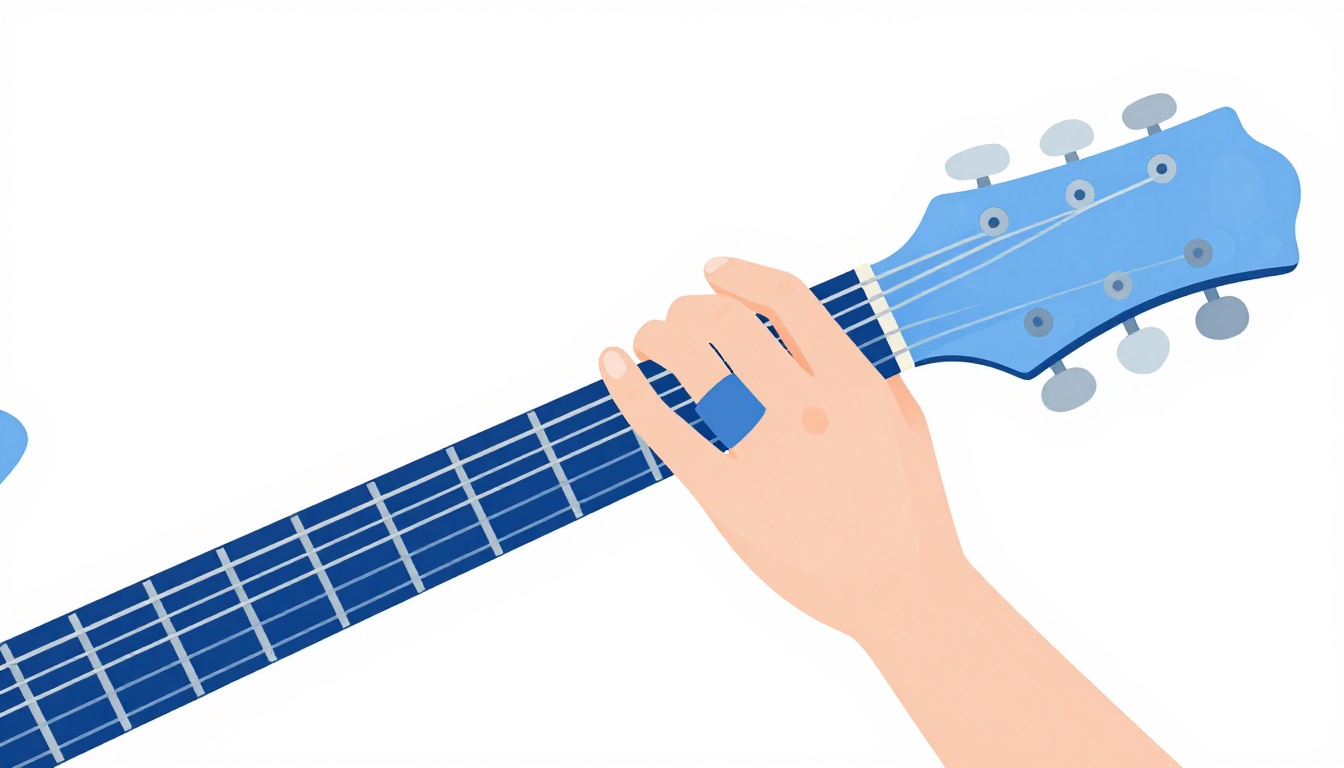
Box 1 is the shape almost every guitarist learns first, and it is usually the one people mean when they just say "the pentatonic scale" without specifying which one. The root note sits under your first (index) finger on the 5th fret of the 6th string (low E), which is the note A.
| String | Fret (finger 1) | Fret (finger 3 or 4) |
|---|---|---|
| 6 (low E) | 5 | 8 |
| 5 (A) | 5 | 7 |
| 4 (D) | 5 | 7 |
| 3 (G) | 5 | 7 |
| 2 (B) | 5 | 8 |
| 1 (high E) | 5 | 8 |
Use one finger per fret as a starting rule: index finger on every note at fret 5, ring finger on the notes at fret 7, and pinky on the notes at fret 8. Some players swap the pinky for a stretched ring finger on the outer strings, which is fine once the shape is under your hand, but starting with strict one-finger-per-fret keeps the shape honest while you are learning it.
Notice the shape is not identical on every string. Strings 6, 2, and 1 span three frets (5 to 8), while strings 5, 4, and 3 span only two (5 to 7). That is not an accident or a typo, it is the actual note layout of the scale falling across the strings, and it is why the box has a slightly lopsided, "wide on the outside, narrow in the middle" feel under your hand. Once you have played it a few dozen times that asymmetry stops feeling strange and starts feeling like the shape.
The Other Four Box Shapes
Box 1 is only one fifth of the fretboard. The same five notes repeat in four more shapes as you move up the neck, and learning all five is what lets you solo anywhere from the open strings to the top of a 22-fret neck without running out of room.
Box 2 (Frets 7 to 10)
Box 2 picks up right where box 1 leaves off. The lowest notes in this box, on strings 6, 2, and 1, are the exact same pitches as the highest notes in box 1, just fingered as the starting point of a new shape instead of the end of the old one.
| String | Lower fret | Higher fret |
|---|---|---|
| 6 (low E) | 8 | 10 |
| 5 (A) | 7 | 10 |
| 4 (D) | 7 | 10 |
| 3 (G) | 7 | 9 |
| 2 (B) | 8 | 10 |
| 1 (high E) | 8 | 10 |
The 5th and 4th strings need a three-fret stretch here (7 to 10), so lead with your index finger on 7 and reach with your pinky for 10, rather than trying to walk your whole hand up.
Box 3 (Frets 9 to 12)
| String | Lower fret | Higher fret |
|---|---|---|
| 6 (low E) | 10 | 12 |
| 5 (A) | 10 | 12 |
| 4 (D) | 10 | 12 |
| 3 (G) | 9 | 12 |
| 2 (B) | 10 | 13 |
| 1 (high E) | 10 | 12 |
The stretch moves to the 3rd and 2nd strings in this box. On the 2nd string specifically, the higher note lands on fret 13, one fret past where the octave A sits on that string, which trips people up the first time because it feels like it should stop at 12.
Box 4 (Frets 12 to 15)
| String | Lower fret | Higher fret |
|---|---|---|
| 6 (low E) | 12 | 15 |
| 5 (A) | 12 | 15 |
| 4 (D) | 12 | 14 |
| 3 (G) | 12 | 14 |
| 2 (B) | 13 | 15 |
| 1 (high E) | 12 | 15 |
Fret 12 is the octave, the same pitch as your open strings one octave up, which makes box 4 a useful landmark: if you can find the 12th fret by ear or by the double inlay dot most necks have there, you can find box 4 without counting frets at all.
Box 5 (Frets 2 to 5)
Box 5 sits below box 1, closer to the nut, and it is the shape most players learn last even though it is the one that connects the scale down to the open strings.
| String | Lower fret | Higher fret |
|---|---|---|
| 6 (low E) | 3 | 5 |
| 5 (A) | 3 | 5 |
| 4 (D) | 2 | 5 |
| 3 (G) | 2 | 5 |
| 2 (B) | 3 | 5 |
| 1 (high E) | 3 | 5 |
The stretch here lands on the 4th and 3rd strings (D and G), a three-fret reach from 2 to 5, mirroring the same pattern box 2 used further up the neck.
How the Five Boxes Connect Into One Fretboard
The five boxes are not five separate scales, they are one scale seen through five overlapping windows. Each box shares its top notes with the box above it and its bottom notes with the box below it, which is exactly why box 2 starts on the same frets where box 1 ends, and box 3 starts where box 2 ends, all the way up the neck.
The fastest way to feel this is to play the root note, A, in every box in order and notice it is the same pitch class showing up again and again as you move up:
| Box | Root A locations |
|---|---|
| 5 | 5th string, 3rd fret and 4th string, 5th fret (higher octave) |
| 1 | 6th string, 5th fret and 5th string, open |
| 2 | 4th string, 7th fret |
| 3 | 5th string, 10th fret and 3rd string, 9th fret |
| 4 | 6th string, 12th fret and 5th string, 12th fret and 1st string, 12th fret |
Play a lick in box 1, slide up to the same phrase shape in box 2, then box 3, and you start to hear the neck as one continuous scale rather than five disconnected patterns. This is the single most useful drill for anyone who has memorized the shapes but still feels stuck when a solo needs to move past the twelfth fret.

The Open-Position Version
Because A minor pentatonic contains no sharps or flats, most of the open strings on a guitar in standard tuning (E, A, D, G, B, E, low to high) already belong to the scale. Open low E, open A, open D, and open G are all scale tones (E is the 5th, A is the root, D is the 4th, and G is the b7). The one exception is the open B string, which is not in the scale at all, since B is the 2nd degree of A minor, one of the two notes the pentatonic scale deliberately leaves out.
That makes an open-position version of the scale possible, mixing open strings with the low frets of box 5:
| String | Open? | Fretted notes |
|---|---|---|
| 6 (low E) | Yes (E) | 3 (G) |
| 5 (A) | Yes (A) | 3 (C) |
| 4 (D) | Yes (D) | 2 (E) |
| 3 (G) | Yes (G) | 2 (A) |
| 2 (B) | No, skip or mute | 1 (C), 3 (D) |
| 1 (high E) | Yes (E) | 3 (G) |
This open version rings out more than any of the fretted boxes because four of the six strings are unfretted, which gives it a slightly different, more resonant character. Folk, country, and singer-songwriter players lean on it for exactly that reason. It is worth learning even after box 1 feels comfortable, since it is the version that connects the scale to open chords like Am and C.
A Minor Pentatonic vs. the Full A Minor Scale
The full A natural minor scale is seven notes: A, B, C, D, E, F, G. The pentatonic version removes two of them, the 2nd (B) and the 6th (F), and keeps the other five untouched.
| Scale | Notes |
|---|---|
| A natural minor (7 notes) | A, B, C, D, E, F, G |
| A minor pentatonic (5 notes) | A, C, D, E, G |
| Notes removed | B (2nd), F (6th) |
Those two removed notes are not bad notes, they are simply the ones most likely to create a half-step clash against common chords in the key, B against the C in a C major chord, F against the E in an Am chord. Stripping them out is what makes the pentatonic scale so forgiving: you can play almost any note against almost any beat and it will land somewhere that sounds intentional. That forgiveness is also its limit. A full natural minor line has more color and more tension available to it, which is why players usually learn pentatonic first for confidence and add the two missing notes back in later for more expressive lines.
A Minor Pentatonic and C Major Pentatonic Are the Same Shape
A minor and C major are relative keys, they share the exact same key signature (no sharps, no flats), and the same relationship carries over to their pentatonic scales. A minor pentatonic (A, C, D, E, G) and C major pentatonic (C, D, E, G, A) contain the identical five notes. The only difference is which note your ear and your phrasing treat as home.
Play box 1 exactly as written above, but resolve your licks to C instead of A, land your held notes on C, and the same fret pattern suddenly sounds like C major pentatonic instead of A minor pentatonic. Nothing about the shape changes, only what you emphasize. This is a useful shortcut: every box shape you learn for A minor pentatonic doubles as a C major pentatonic shape for free, and vice versa. It also explains why a scale that sounds moody and bluesy in one context can sound bright and upbeat in another, using the exact same notes.
Turning It Into the Blues Scale
Add one note to A minor pentatonic and it becomes the A blues scale: A, C, D, D#, E, G. That extra note, D# (also written Eb), sits between the 4th (D) and the 5th (E), and it is often called the "blue note" because it does not belong cleanly to either the major or minor version of the key, it sits in the crack between them.
| Scale | Notes |
|---|---|
| A minor pentatonic | A, C, D, E, G |
| A blues scale | A, C, D, D#, E, G |
In box 1, the blue note falls on the 6th fret of the 3rd string (G string) and the 6th fret of the 4th string (D string), right between the two notes you already know. It works best as a passing tone, played briefly on the way from D up to E or back down, rather than held. Held for too long it can sound simply wrong; passed through quickly it is one of the most recognizable sounds in blues and rock guitar.
Why It Isn't Working
The shapes above are correct, but a correct shape and a good sound are two different things. Here is where the scale usually falls apart in practice, one cause at a time.
You're Bending Out of Tune
The most common problem by far. A bend that lands flat of its target pitch sounds worse than no bend at all, because it reads as a mistake rather than an expressive choice. Fix it by bending up to a fretted reference note first (bend the note, then check it against the actual pitch played normally a string over or two frets up), memorizing what that distance feels like under your finger, and only then trying the bend by ear without the reference.
You Lose the Root When You Shift Boxes
Sliding from box 1 to box 2 mid-phrase and suddenly not knowing where "home" is happens to almost everyone early on. The fix is the root-note table above: know exactly where A sits in every box before you try to improvise across more than one of them. Practice landing squarely on the root at the end of a phrase in each box until it stops requiring conscious thought.
Your Lines Sound Like Scale Practice, Not Music
Running straight up and down the box in order, note by note, is how you learn the shape, but it is not how anyone plays a solo. If your lines still sound like an exercise, the fix is rhythm, not more notes: leave space, repeat a short phrase twice before changing it, and vary which note you start and stop on. Two notes played with intention beat eight notes played on autopilot.
Notes on the High Strings Sound Thin or Get Buried
The 1st and 2nd strings have less natural sustain and volume than the wound strings, so a phrase that sounds full on strings 6, 5, and 4 can disappear when it moves up to strings 2 and 1. Dig in slightly harder with your picking hand on those two strings, and consider adding vibrato to notes you hold there, since a note with movement in it reads as intentional even at lower volume.
You're Muting Neighboring Strings by Accident
The three-fret stretches in boxes 2, 3, and 5 make it easy to let a fretting finger lean against the string next to it and choke it dead. Arch your fingers so only the fingertip touches the string, and check each note in isolation the first few times you play a new box, listening for any note that comes out muted or buzzing.
Your Pinky Won't Cooperate
Boxes that ask the pinky to reach three frets from the index finger (box 2 on strings 5 and 4, box 5 on strings 4 and 3) expose a weak pinky fast. Do not compensate by sliding your whole hand for that one note, since it breaks the timing of everything around it. Instead, isolate that single stretch, play just those two notes back and forth slowly, and let the strength build with repetition rather than working around it.
You Sound the Same in Every Box
Five boxes that all get played the same way, same rhythm, same starting note, same speed, end up sounding like one box repeated five times rather than five distinct colors on the neck. Each box has a slightly different physical feel because of where the stretches fall, and leaning into that instead of ironing it out gives your playing more variety without needing a single new note. Try deliberately playing a phrase you know well in box 1, then translating it into box 3, and notice how much the physical shift changes the phrasing even though the notes are identical.
Your Timing Drifts When You Improvise Freely
Practicing the scale with a metronome and improvising without one are two different skills, and plenty of players who sound solid on the first fall apart on the second. The fix is not more scale repetition, it is deliberately improvising with a metronome or a drum backing track running the entire time, even when it feels restrictive at first. Losing the beat during a free solo almost always traces back to skipping this step rather than to any problem with the scale itself.
Bending Inside the Scale
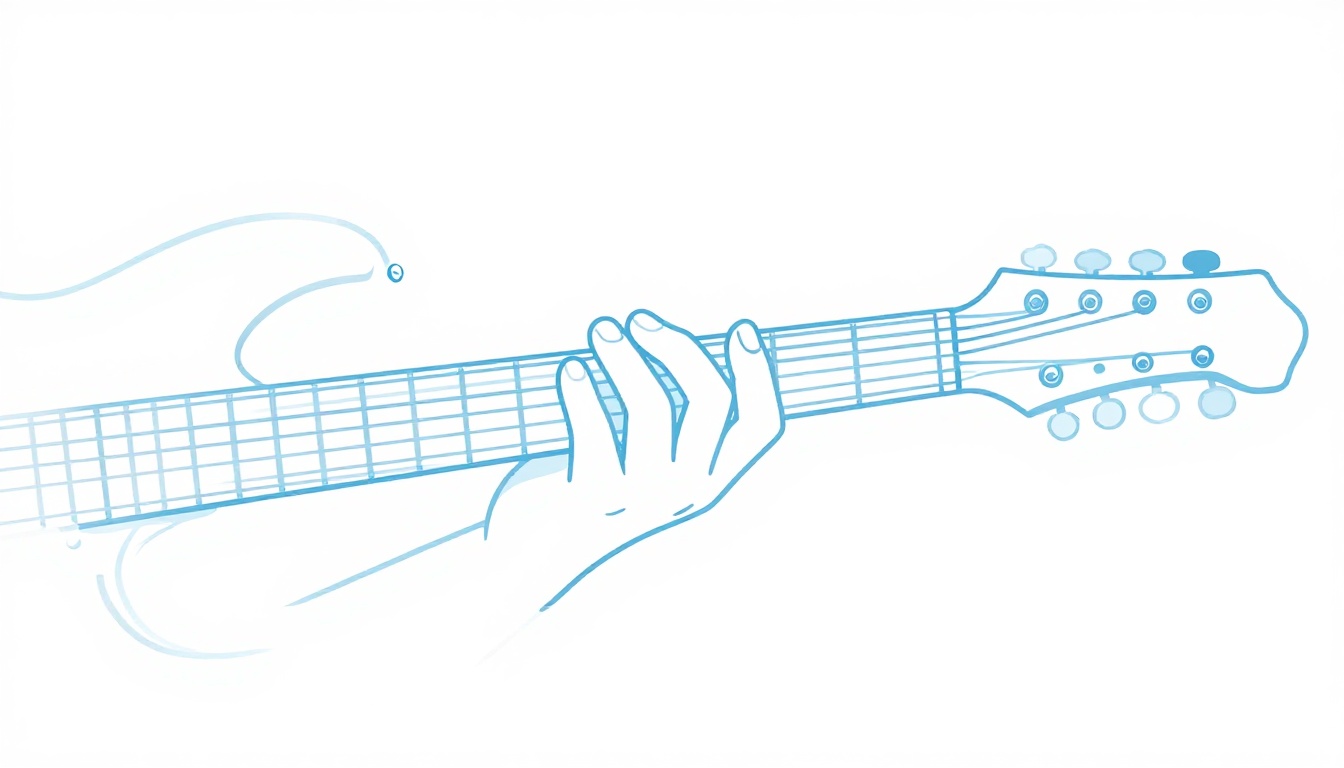
Bends are where the pentatonic scale stops sounding like a scale and starts sounding like a voice. Three bends come up constantly in this shape.
The Half-Step Bend
A half-step bend raises a note by one fret's worth of pitch. In box 1, bending the 3rd string at the 7th fret up a half step is a common way to add tension right before resolving down to the note under it.
The Whole-Step Bend
A whole-step bend raises a note by two frets' worth of pitch, and it is the workhorse bend of the entire style. In box 1, bending the 3rd string, 7th fret (the note D) up a full step to reach the pitch of E is one of the most recognized sounds in blues and rock lead playing, the "big bend" that shows up in solo after solo. The same whole-step bend also works on the 2nd string at the 8th fret (the note G), bent up to reach A, the root.
Target the Note, Not the Fret
The habit worth building early is bending to a target pitch, not to a fret count. Before you bend, play the note you are aiming for normally, listen to it, then bend up to match that exact pitch by ear. Guessing the distance from muscle memory alone is how bends drift flat over time, especially as strings age and tension changes slightly.
Hammer-ons, Pull-offs, and Slides
Picking every single note in a fast pentatonic line sounds mechanical. Legato technique, hammer-ons, pull-offs, and slides, is what smooths a line out and lets it move faster than your picking hand alone could manage.
A hammer-on brings a fretting finger down onto the string hard enough to sound the note without picking it, useful for climbing from a lower note to a higher one on the same string, for example hammering from the 5th fret to the 7th fret on the 4th string in box 1. A pull-off does the reverse, plucking the string slightly with a fretting finger as it lifts off, useful for descending, from the 7th fret down to the 5th fret on that same string.
A slide connects two notes on the same string by sliding one finger between two frets without lifting it, which works especially well when moving between boxes, sliding from the top note of box 1 into the bottom note of box 2 on the same string keeps the line connected instead of restarting it.
Mix all three with picked notes rather than choosing one technique for an entire phrase. A line that alternates picked notes with a hammer-on or a slide has more rhythmic variety and sounds far less like a scale being recited.
Playing the Scale in Sequences
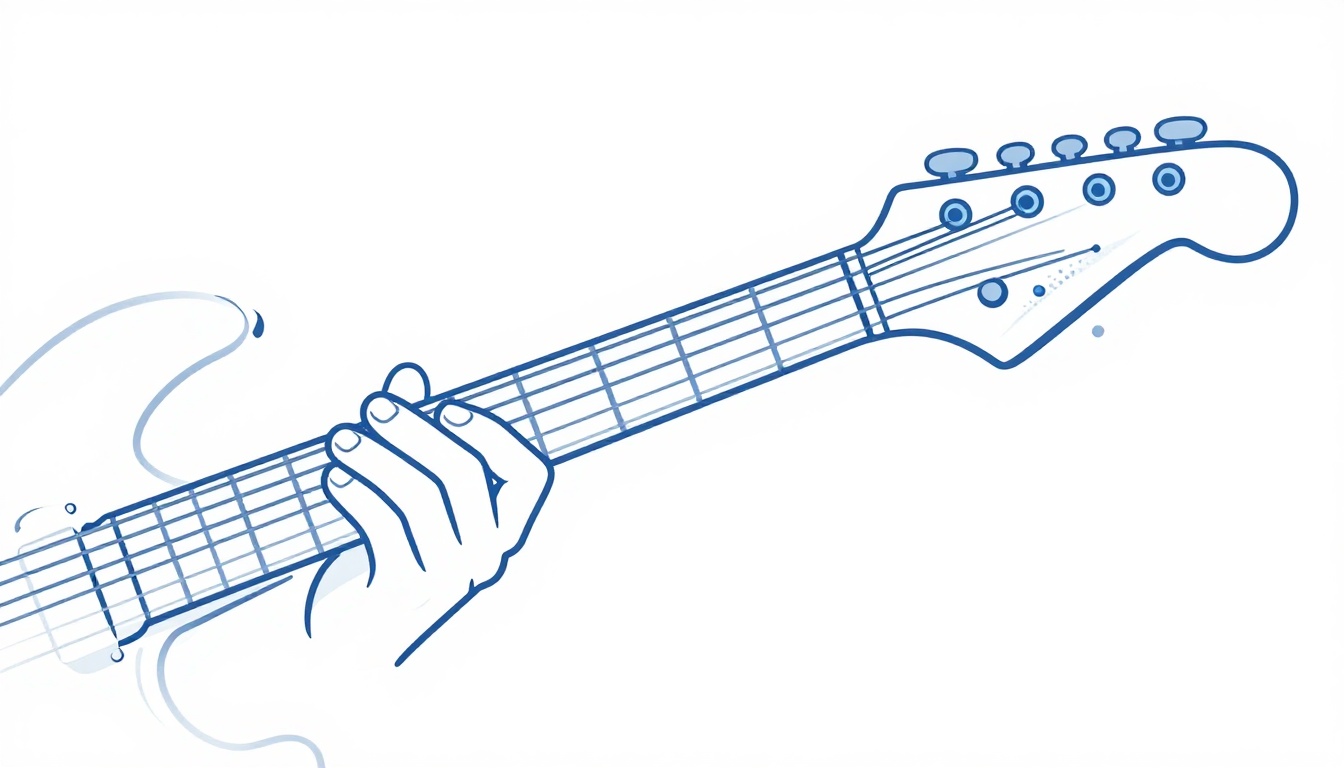
Once box 1 is comfortable ascending and descending in a straight line, sequencing patterns are the next step, and they do more for your fretting and picking coordination than repeating the plain scale ever will. A sequence takes a small group of notes and repeats that same grouping as you move through the scale, instead of playing every note once in order.
The simplest version is a three-note pattern: play the first three notes of box 1 (6th string, frets 5, 8, then 5th string fret 5), then start the next group of three one scale note higher (5th string frets 5, 7, then 4th string fret 5), and continue climbing the box that way. The pattern repeats, but the starting note shifts up each time, which is a completely different exercise for your hands than a straight ascending run, and it produces the kind of angular, less predictable melodic shapes that show up constantly in real solos.
A four-note version works the same way: group the scale in fours, shift the starting point by one note each repetition, and practice it both ascending and descending. Neither pattern needs to be fast. Play it slowly enough that every note is clean and evenly timed before adding speed, since a sequence played sloppily just sounds like random notes rather than a pattern.
A Two-Octave Run to Connect the Boxes
Here is one concrete way to hear boxes 1 through 3 as a single continuous scale rather than three separate shapes, climbing the root note (A) and a few of its neighbors from the 5th fret up to the 14th fret.
e|-------------------------|
B|-------------------------|
G|----------------12---14--|
D|-----------10--12--------|
A|------7--10---------------|
E|--5--8----------------------|
Play it slowly with a metronome, one note per click, and notice that every shift to a new string also means a small shift up the neck, since you are climbing through box 1, then box 2, then box 3 as you go. Once this run feels natural, try reversing it note for note on the way back down. That descending version is just as valuable as the ascent, since most players default to climbing and rarely practice coming back down with the same control.
Picking Hand Technique
The fretting hand gets most of the attention when people talk about scales, but the picking hand decides how the notes actually sound. Alternate picking, strictly switching down-up-down-up regardless of string changes, is the default and the one worth building first, since it keeps timing even at speed and translates directly to almost every other style of lead playing.
Economy picking, where you let the pick continue in the same direction when moving to an adjacent string in the same direction as the last stroke, can feel more efficient once alternate picking is solid, but layering it in too early tends to create timing inconsistencies that are hard to unlearn later. Get comfortable with strict alternate picking across all five boxes before experimenting with it.
Dynamics matter as much as the picking pattern itself. A phrase played at one constant volume, no matter how clean the technique, reads as flat and mechanical. Dig in harder on notes you want to emphasize, particularly the ones you are bending or holding with vibrato, and ease off on the notes that are just passing through on the way to somewhere else. That contrast in attack is a large part of what separates a phrase that sounds like a sentence from one that sounds like a list.
Vibrato on a Held Note
Any note you hold for more than a beat benefits from vibrato, a small, repeated bend-and-release that makes a static pitch feel alive instead of flat and mechanical. The motion usually comes from rotating your wrist and forearm rather than just wiggling a finger, which gives a wider, more controlled wobble than finger movement alone.
Start slow. A wide, slow vibrato on the root note at the end of a phrase, held for a full bar, does more to make a solo sound confident than any number of fast notes crammed in before it. Speed and width are both adjustable once the motion itself feels natural, and different genres lean different ways, blues and rock generally favor a wider, slower vibrato, while some styles of pop and country lean narrower and faster.
Where the Scale Sits Over a Chord Progression
A minor pentatonic works cleanly over an A minor chord and an A minor 7 chord, since every note in the scale is either a chord tone or a note that resolves smoothly against one. It is also the standard choice over a blues progression built on A7 (a dominant chord), even though A7 technically calls for a major third (C#) rather than the minor third (C) the pentatonic scale provides.
That clash is not a mistake, it is the entire sound of blues guitar. The minor third bent slightly sharp, toward but not fully reaching the major third, is the "blue" quality that defines the genre. Play the notes straight and it sounds like minor pentatonic laid over a major chord, slightly at odds with itself in a way that still works. Bend that third note expressively and it sounds like blues.
Over a I-IV-V blues progression in A (A7, D7, E7), A minor pentonic can be played straight through all three chords without changing shape, which is exactly why it is often the first scale taught for blues improvisation: one shape, one key, three chords, and it holds up over all of them.

Where You'll Hear This Scale
Minor pentatonic is the backbone of blues guitar, but it did not stay confined to that genre. Rock lead playing, from the earliest electric blues-rock through decades of arena rock, leans on the same five notes for the majority of its solos, often mixed with the blue note to get the full blues scale sound described above. Funk and R&B rhythm players use short pentatonic fragments as riffs rather than solos, repeating a two- or three-note pattern as a hook rather than stretching it into a long melodic line.
Pop and pop-punk lead lines borrow the shape too, usually played faster and with fewer bends than blues phrasing, favoring clean, quick runs over sustained, vocal-style bending. Metal players frequently use the same boxes at higher speed and with heavier gain, often adding extra notes back in from the full natural minor or harmonic minor scale for a darker sound, but the pentatonic shape remains the skeleton underneath.
Country and Americana players regularly swap between the minor pentatonic feel and its relative major pentatonic (the same notes, different resolution point, as covered above) within the same solo, moving from a bluesy minor phrase into a bright major-sounding run without ever leaving the fretboard positions they already know. Recognizing that a huge share of guitar music you already listen to is built from this same five-note scale, just played with different technique, tone, and rhythm, is often the moment this scale stops feeling like a beginner exercise and starts feeling like the actual vocabulary of the instrument.
Turning the Scale Into Licks
A scale is raw material, not a finished idea. Licks, short, memorable phrases built from a handful of the scale's notes, are what a scale actually turns into once you can play. A few starting points:
The three-note pickup. Play the b7, the root, and the b3 in quick succession (in box 1: 6th string 8th fret, 5th string 7th fret, 5th string 5th fret) as a short run into a longer phrase. This exact shape, three notes climbing or falling in sequence, is one of the most recycled building blocks in blues and rock lead playing precisely because it fits under the hand so naturally.
The call and response. Play a two-bar phrase, then repeat it with one note changed at the end, the same way a singer might repeat a lyric with a different final word. This single habit does more to make an improvised solo sound composed than almost any other trick, because repetition with small variation is how the ear recognizes a musical idea rather than a random string of notes.
The held note into a run. Hold the root with vibrato for a full bar, then release into a fast four- or five-note run down the box. The contrast between stillness and motion is what makes both halves of the phrase land.
The string-skip. Instead of moving strictly to the adjacent string, skip from the 6th string directly to the 4th, or the 3rd string directly to the 1st, playing two notes that are not next to each other on the neck. The wider interval this creates sounds noticeably different from anything a straight-through-the-box run produces, and a single well-placed skip can make a phrase stand out from everything around it.
None of these need to be played fast. A slow, well-placed lick with clean bends and confident timing communicates more than a fast run played without conviction, and it is far more forgiving of small technical mistakes.
Common Mistakes Beginners Make With This Scale
Treating the scale like a memorized sequence instead of a set of available notes. Once box 1 is memorized, the temptation is to play it start to finish, every time, in the same order. Break the order. Start in the middle. Skip notes. The shape is a map of where the good notes are, not a melody you are required to play in full.
Ignoring the low strings. New players gravitate toward the high strings because that is where the "guitar hero" sound lives, but the low strings, especially the 6th and 5th, carry weight and character that a solo confined to the top two strings never gets. Spend deliberate time down there.
Never practicing without a backing track or drone. A scale played in silence has no context, no chord to sound consonant or dissonant against, which makes it much harder to hear whether a note or a bend actually works. Even a single sustained A note played on a second instrument, or a free drone track, gives your ear something to measure against.
Rushing to learn all five boxes before box 1 is solid. Five half-known shapes are less useful than one fully internalized shape you can improvise freely within. Box 1 alone, played well, with good bends, good timing, and real phrasing, will carry a beginner further than a shaky knowledge of all five boxes played mechanically.
Forgetting the scale is movable. Every box shape shown here works in any key, you only need to find the new root note and shift the whole shape to that fret. A player who only ever plays these shapes rooted on the 5th fret has learned A minor pentatonic, not the minor pentatonic scale in general.
Moving the Shape to Play Any Minor Pentatonic Key
None of the fret numbers above are fixed to A specifically, they are fixed to where A happens to sit on the neck. Slide box 1 up two frets, so the root moves from the 5th fret to the 7th fret on the 6th string, and the exact same shape becomes B minor pentatonic. Slide it down to the 3rd fret and it becomes G minor pentatonic.
| Root note | Fret on 6th string (low E) |
|---|---|
| E | Open |
| F | 1 |
| F# | 2 |
| G | 3 |
| G# | 4 |
| A | 5 |
| A# | 6 |
| B | 7 |
Find the root note you need on the low E string using this table (or any tuner or fretboard reference), place your index finger there, and every box shape from this post transfers over unchanged. This is the real payoff of learning the shapes as patterns rather than as memorized note names: one hour spent mastering A minor pentatonic is really an hour spent learning all twelve minor pentatonic keys at once.
Ear Training Before You Fret
The scale shapes tell your fingers where the right notes live, but they do not teach your ear to recognize those notes before you play them, and that skill is what eventually lets you improvise without staring at the fretboard. A simple habit builds it quickly: before fretting a note in a lick you already know, try to sing or hum it first, even quietly and even if you do not consider yourself a singer. If the pitch in your head matches what comes out of the guitar, you are starting to hear the scale rather than just executing a memorized shape.
A drone, a single sustained note, usually the root, played on a second instrument, a tuner app, or a looper pedal, is one of the most useful practice tools for this. With an A drone playing underneath, every note in the box reveals its actual character against that root: the b3 sounds moody, the 5th sounds stable, the b7 sounds like it wants to move somewhere. That context is invisible when you practice the scale in silence, and it is exactly what separates a player who knows the shape from a player who understands what each note in it actually does.
Warm-Up Exercises Before You Solo
A few minutes of deliberate warm-up inside the scale shape makes the rest of a practice session noticeably cleaner, especially for the stretches that trip beginners up.
The spider walk. Inside box 1, play all six notes on the 6th string and 5th string using strict one-finger-per-fret assignment (index on fret 5, ring on fret 7, pinky on fret 8), moving back and forth between the two strings without lifting your hand position. This builds the independent finger control the rest of the box depends on, and it isolates the exact motion that goes wrong when a note buzzes or a neighboring string gets muted.
The stretch-and-release. For the boxes with a three-fret reach (box 2 on strings 5 and 4, box 5 on strings 4 and 3), play the low note, then the high note, then release the stretch completely before playing the pair again. Repeating the stretch and release, rather than holding the stretch continuously, is what actually builds flexibility over time without straining your hand.
The string-crossing pattern. Play two notes on one string, then two notes on the neighboring string, alternating back and forth across all six strings within a single box. This warms up the picking hand's ability to change strings cleanly, which matters as much for a good-sounding scale as anything the fretting hand does.
None of these need more than a minute or two each, but doing them cold, before jumping into fast licks, prevents the sloppy, rushed technique that shows up when your hands haven't had time to settle into the shape.
A Practice Routine for This Scale
Fifteen minutes a day, structured, beats an hour once a week played aimlessly. A routine that actually builds the scale into your playing:
- Two minutes, slow and clean. Play box 1 up and down, one note per beat, with a metronome at a slow tempo. The goal is zero buzzed notes and zero muted strings, not speed.
- Three minutes, root-note drill. Land on the root A at the end of every phrase, moving through boxes 1, 2, and 3 in turn, confirming you know where home is in each one.
- Three minutes, bends. Isolate the two signature bends (3rd string 7th fret, 2nd string 8th fret in box 1) and bend each to pitch ten times, checking against the fretted target note before and after.
- Four minutes, licks over a drone or backing track. Improvise short phrases against a sustained A or a simple Am backing track, focusing on repetition and space rather than covering every note in the box.
- Three minutes, one box shift. Practice sliding a short phrase from box 1 into box 2, keeping the timing steady through the shift instead of pausing to find the new shape.
Repeat this most days rather than doing a longer version occasionally. Muscle memory for a scale shape, and especially for the pitch accuracy of a bend, builds through short, frequent repetition far more reliably than through infrequent long sessions. If you are just starting out and want a broader daily structure to build this kind of habit around, a short, consistent daily session works better than saving it all for the weekend.
FAQ
What are the notes in the A minor pentatonic scale? A, C, D, E, and G. In scale-degree terms, that is the root, minor third, fourth, fifth, and minor seventh of A minor.
Is A minor pentatonic the same as A blues scale? Almost. The A blues scale is A minor pentatonic with one extra note added, D# (also called Eb), which sits between the fourth (D) and the fifth (E) and gives the scale its characteristic "blue" sound.
What is the easiest way to start learning this scale? Learn box 1 first and only box 1: index finger on the 5th fret of the low E string, then the shape shown in the box 1 table above. Get that one shape comfortable, in tune, with clean bends, before adding any of the other four boxes.
Do I need to know music theory to use this scale? No. You can learn the box 1 shape by fret number alone and start improvising with it the same day. The theory, degrees, intervals, relative major, becomes useful later for understanding why certain notes and bends work, but it is not a prerequisite for playing.
Why does my version of the scale sound different from a recording I'm learning from? Most often it is technique, not the notes themselves, bend accuracy, vibrato, timing, and dynamics do more to shape the sound of a pentatonic line than the specific notes chosen. Two players using the exact same five notes can sound completely different.
Can I use this scale on an acoustic guitar, or is it only for electric? The scale itself works identically on both. Bends are physically harder on an acoustic because the strings are heavier gauge and sit higher off the neck, so start with hammer-ons, pull-offs, and slides on acoustic and add bending gradually as your fretting hand builds strength.
How long does it take to get comfortable with all five boxes? There is no fixed timeline, it depends entirely on how consistently you practice, but a player working through the routine above most days typically has box 1 solid within a couple of weeks and starts connecting two or three boxes within a couple of months. The other boxes come faster once the first two are genuinely internalized, since the finger patterns repeat.
What's the difference between this and the A major pentatonic scale? A major pentatonic uses different notes (A, B, C#, E, F#) built from the major scale rather than the minor scale, and it has a brighter, more resolved sound. A minor pentatonic and C major pentatonic, by contrast, share the exact same notes since A minor and C major are relative keys, only the note you treat as "home" changes between them.
Should I learn the boxes in order, box 1 through box 5? Box 1 first is close to universal advice, since it is the most commonly referenced shape and the one most instructional material assumes you already know. After that, most players find box 2 or box 5 easiest to add next, since both connect directly onto box 1 without a large jump up the neck. Boxes 3 and 4 tend to come more naturally once the two neighboring the first are solid.
Does this scale work on a bass guitar too? Yes, the same five notes and the same relative box shapes apply on a four-string bass tuned E, A, D, G, though the string spacing and lower range change how the stretches feel under your hand. If you play both instruments, the minor pentatonic shapes built specifically for bass are worth learning on their own rather than assuming the guitar version transfers perfectly.
GuitarLowKey
Ready for fifteen focused minutes?
Open the web app and train the change that is blocking your song.