
The C Minor Guitar Chord: Every Shape, Plus a Capo Trick
The full C minor guitar chord as a barre, an easy no-barre version, and a capo trick that skips it, plus why it buzzes and how to change chords fast.

The standard C minor chord (Cm) is played as a barre: lay your index finger flat across the 5th, 4th, 3rd, 2nd, and 1st strings at the 3rd fret, add your ring finger on the 5th fret of the D string (4th string), your pinky on the 5th fret of the G string (3rd string), and your middle finger on the 4th fret of the B string (2nd string), then strum from the A string down. Mute the low E string. If a full barre is still out of reach, there is a genuine two-finger version and a capo trick that gets you the identical sound without barring at all. Every shape, every fix for the buzz, and every way to move into and out of Cm smoothly is below.
String names, numbers, and standard tuning
Before the shapes themselves, it helps to have the six strings straight, since every fret number and finger placement in this post refers to them by both name and number.
| String number | Name | Standard tuning pitch |
|---|---|---|
| 6 | Low E | E |
| 5 | A | A |
| 4 | D | D |
| 3 | G | G |
| 2 | B | B |
| 1 | High E | E |
Guitars are numbered from thinnest to thickest, so the 1st string is the high E string closest to the floor when you hold the guitar in playing position, and the 6th string is the thick low E string closest to the ceiling. Standard tuning, low to high, is E-A-D-G-B-E. Every chord table in this post lists the 6th string first and the 1st string last, matching the order your hand actually meets them from the top of the neck down.
Fret numbers count from the nut, the strip of material at the very top of the neck where the strings first make contact. The 1st fret is the first space your finger can land in, not the first thin metal wire, so "3rd fret" means the third space down, counting spaces rather than wires.
The C minor chord, string by string
This is the shape most chord charts show first, a five-string barre built on the A string, using the same finger pattern as an open A minor chord slid up the neck. "Finger" uses standard numbering: 1 is your index finger, 2 is your middle finger, 3 is your ring finger, 4 is your pinky.
| String | Fret | Finger |
|---|---|---|
| 6 (low E) | Muted | - |
| 5 (A) | 3 | 1 (barre) |
| 4 (D) | 5 | 3 (ring) |
| 3 (G) | 5 | 4 (pinky) |
| 2 (B) | 4 | 2 (middle) |
| 1 (high E) | 3 | 1 (barre) |
Lay your index finger across the top five strings at the 3rd fret, pressing firmly enough that each one rings clearly, and either mute the low E string with the underside of that same finger or simply leave it out of your strum. Then set your ring finger on the 4th string (D) two frets ahead, at the 5th fret, your pinky right next to it on the 3rd string (G), also at the 5th fret, and your middle finger on the 2nd string (B) at the 4th fret. The 1st string rings from the barre alone, no extra finger needed. Strum from the A string down through the high E string.
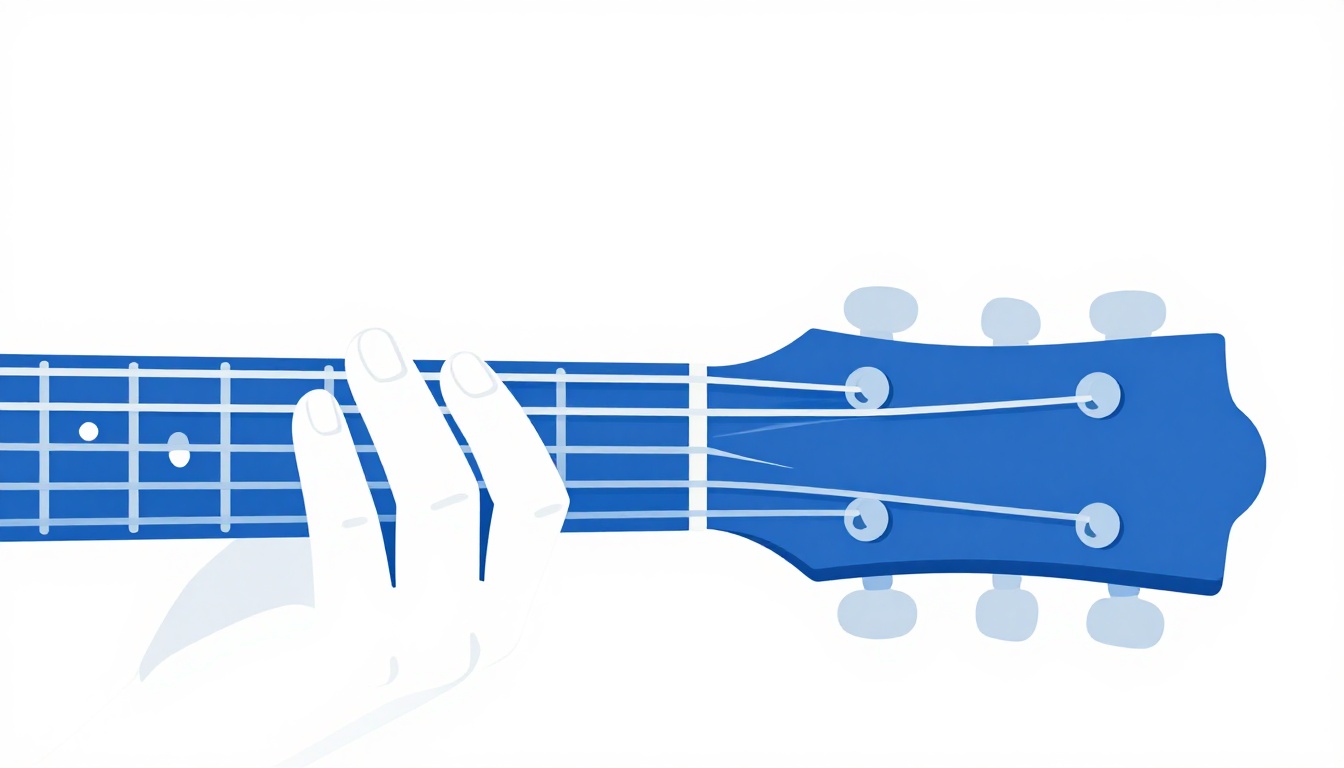
This shape is exactly an open A minor chord (A, D, G, B, high E played 0-2-2-1-0), moved up the neck with your index finger standing in for the nut. Slide that same shape to any other fret and you get a different minor chord, and at fret 3 the root note lands on C, which is what makes it C minor rather than something else.
What makes C minor a minor chord
A chord's name comes from the notes stacked on top of its root. Cm is a triad: the root (C), a minor third above it (Eb), and a perfect fifth above the root (G). Swap that minor third for a major third and you would have E instead of Eb, which makes the chord C major, not C minor. That one note, the third, is the entire difference between a chord that sounds bright and one that sounds unsettled or melancholic.
| Interval | Note | Semitones from root |
|---|---|---|
| Root | C | 0 |
| Minor 3rd | Eb | 3 |
| Perfect 5th | G | 7 |
You do not need to memorize interval math to play the chord, but it explains why certain notes repeat across the shape above. In the five-string barre, C appears twice (5th and 3rd strings), G appears twice (4th and 1st strings), and Eb appears once (2nd string). Doubling the root and fifth while keeping a single minor third is standard practice in guitar chord voicings, it reinforces the chord's foundation without muddying the note that actually defines it as minor.
The two-finger easy version
If the full barre is not happening yet, this version gets you three of the same chord tones, Eb, G, and C, with only two fingers and no barre at all.
| String | Fret | Finger |
|---|---|---|
| 6 (low E) | Muted | - |
| 5 (A) | Muted | - |
| 4 (D) | 1 | 1 (index) |
| 3 (G) | Open | - |
| 2 (B) | 1 | 2 (middle) |
| 1 (high E) | Muted | - |
Put your index finger on the 1st fret of the D string and your middle finger on the 1st fret of the B string, leaving a gap between them where the G string rings open, untouched by either finger. Mute the low E, A, and high E strings, either by resting your fretting hand lightly against them or simply avoiding them with your strumming hand. Strum only the D, G, and B strings.
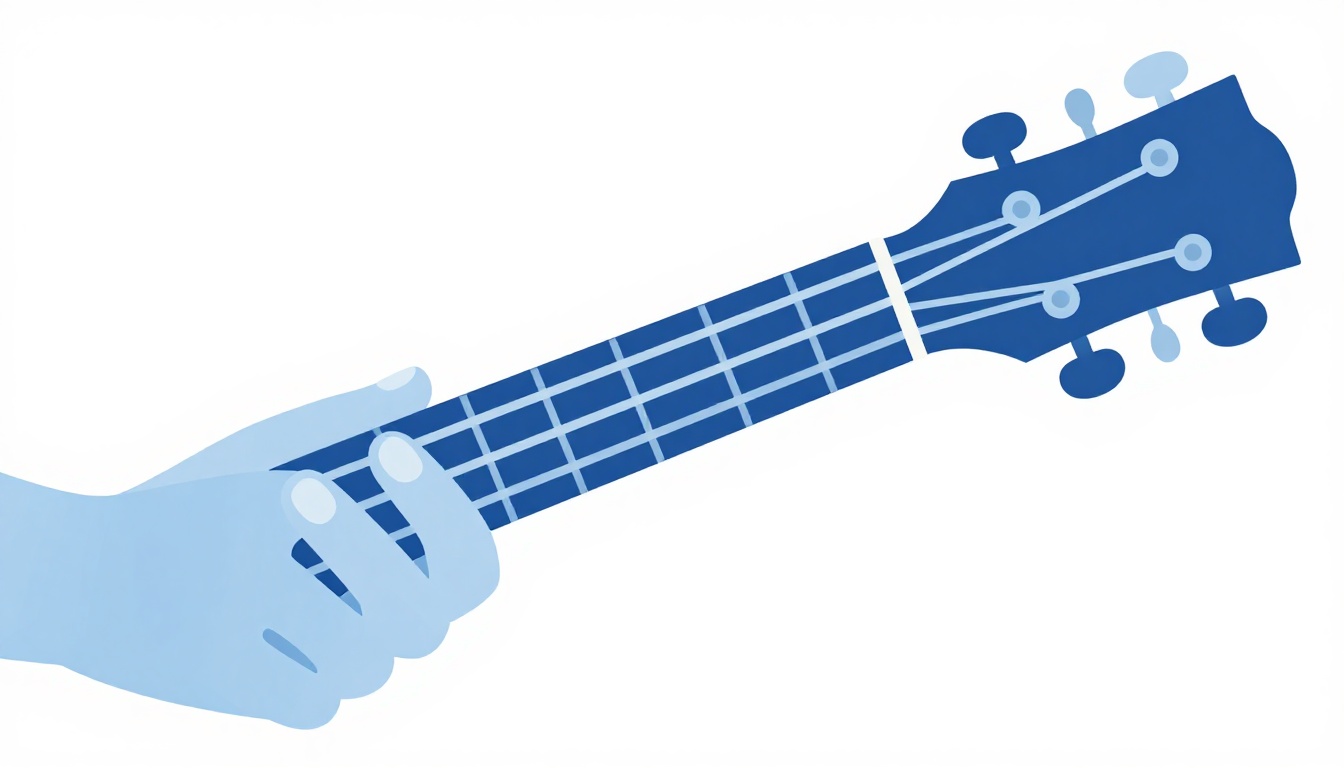
This voicing puts Eb in the bass rather than C, since the D string is the lowest string actually sounding, but it is a genuine, correctly fingered C minor chord, not a simplification that drifts off pitch. The tradeoff is a thinner sound with only three strings ringing and the root buried in the middle of the voicing rather than the bottom, but every note that does ring is a correct chord tone, and it gets you playing Cm in real songs today rather than waiting on barre strength.
The root 6 barre shape further up the neck
A second common way to play Cm roots the chord on the low E string instead of the A string, using the same finger pattern guitarists use for an open E minor chord.
| String | Fret | Finger |
|---|---|---|
| 6 (low E) | 8 | 1 (barre) |
| 5 (A) | 10 | 3 (ring) |
| 4 (D) | 10 | 4 (pinky) |
| 3 (G) | 8 | 1 (barre) |
| 2 (B) | 8 | 1 (barre) |
| 1 (high E) | 8 | 1 (barre) |

Barre your index finger across all six strings at the 8th fret, then add your ring finger on the 5th string (A) two frets ahead, at the 10th fret, and your pinky right next to it on the 4th string (D), also at the 10th fret. The 3rd, 2nd, and 1st strings ring from the barre alone. Strum all six strings.
This is the exact open E minor shape (low E, A, D, G, B, high E played 0-2-2-0-0-0) slid up the neck, the same relationship the fret-3 A-shape barre has to open A minor. It sits considerably further up the neck than the main shape above, which puts it in a stretch of the fretboard where the frets sit closer together and some players find the reach genuinely easier, at the cost of a higher-pitched voicing further from the open strings you already know by feel.
Playing the root 6 shape with a thumb-over technique
If your thumb comfortably reaches over the top of the neck, a common variation of the root 6 shape above swaps which finger handles the root note and makes the barre noticeably smaller. "T" below stands for thumb.
| String | Fret | Finger |
|---|---|---|
| 6 (low E) | 8 | T (thumb) |
| 5 (A) | 10 | 3 (ring) |
| 4 (D) | 10 | 4 (pinky) |
| 3 (G) | 8 | 1 (mini-barre) |
| 2 (B) | 8 | 1 (mini-barre) |
| 1 (high E) | 8 | 1 (mini-barre) |
Wrap your thumb over the top edge of the neck to fret the low E string at the 8th fret, the chord's root note. With the thumb handling that string, your index finger only needs to cover the G, B, and high E strings at the 8th fret, a much smaller three-string barre than holding all six. Your ring and pinky fingers stay exactly where they were, on the A and D strings at the 10th fret.
This is not a beginner shortcut so much as a genuinely different way of distributing the work across your hand, common on electric guitars with slimmer necks where the thumb has an easier reach, and less practical on a wide classical guitar neck where getting the thumb over the top at all is a stretch. If your hand and neck allow it, a smaller barre is generally easier to keep buzz-free than a larger one, since there is less finger length that has to stay in even contact with the strings at once.
The capo trick: playing Cm without a barre
There is a genuine shortcut that skips the barre entirely: clip a capo on the 3rd fret and play an open A minor chord shape behind it, and it sounds as Cm.
| String | Fret (counted from the capo) | Finger |
|---|---|---|
| 6 (low E) | Muted | - |
| 5 (A) | Open | - |
| 4 (D) | 2 | 2 (middle) |
| 3 (G) | 2 | 3 (ring) |
| 2 (B) | 1 | 1 (index) |
| 1 (high E) | Open | - |
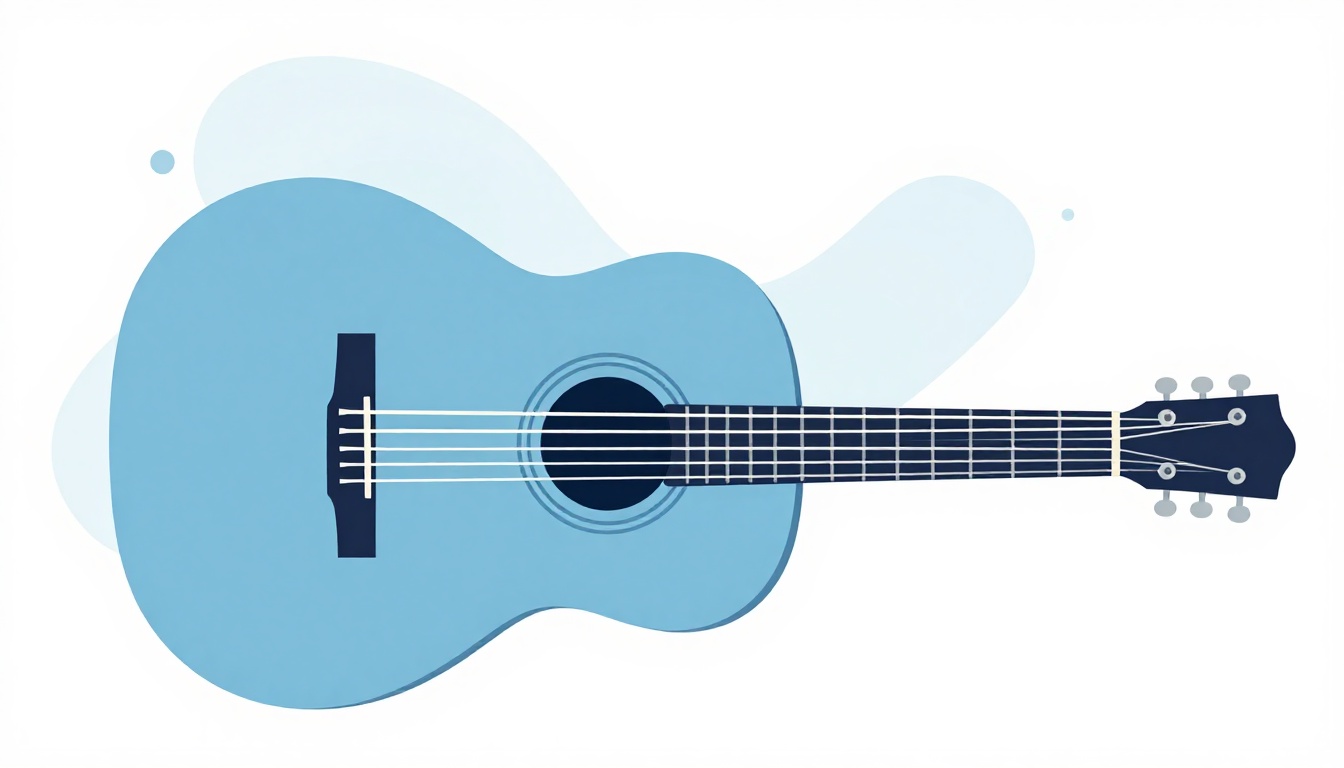
Clip the capo on so it sits just behind the 3rd fret wire, pressing evenly enough that every string rings clearly when picked open. Then finger the shape exactly as you would an open A minor chord: index finger on the 2nd string (B) one fret up from the capo, middle finger on the 4th string (D) two frets up from the capo, ring finger on the 3rd string (G) two frets up from the capo, and the 5th string left open. Mute the low E string. Strum from the A string down.
This works because a capo does mechanically what your index finger does in the barre shape above, it presses across the strings at a fixed fret, freeing your other fingers to play the open-position shape they already know. Since the main Cm barre shape earlier in this post is literally an open Am shape moved to the 3rd fret, capoing at the 3rd fret and fingering plain open Am produces the identical notes as the five-string barre, with no barre technique required at all. The tradeoff is that every other chord you play also shifts up by whatever the capo adds, so this works cleanly for a whole song or section played in that capoed position, not for switching freely between capoed and non-capoed chords mid-song without a plan for it.
Which Cm shape should you actually use
With four workable versions covered so far, main barre, two-finger, root 6, and the capo trick, it helps to know which one actually fits a given moment rather than defaulting to whichever you learned first.
For a beginner still building barre strength, the two-finger version or the capo trick are the more sensible daily choice. Both produce the correct notes, neither depends on strength your hand has not built yet, and reaching for either while you build toward the full barre is not a compromise, it is simply the right tool for where your hand currently is. For a full band setting or a song that needs Cm to fill space with a low, rooted sound, the main barre at the 3rd fret is the standard choice. For a tighter voicing further up the neck, or when a song is already sitting in that part of the fretboard, the root 6 shape at fret 8 is worth reaching for instead.
| Situation | Recommended shape |
|---|---|
| Still building barre strength | Two-finger version or the capo trick |
| Full band, needs a rooted, direct sound | Main barre at fret 3 |
| Already playing higher up the neck | Root 6 barre at fret 8 |
| A whole song or section in one key | Capo trick, if it fits the rest of the song |
Nothing stops you from using more than one of these within the same song, either. A verse played with the two-finger version to keep the sound light, moving into the full barre for a fuller-sounding chorus, is a legitimate arrangement choice rather than a sign of an unfinished technique.
Why your C minor chord is buzzing or sounds dead
A muted or buzzing note in a barre chord almost always traces back to one of a small set of causes. Work through them one at a time rather than pressing harder everywhere at once.
Your index finger is too flat
A completely flat finger tends to dip in the middle, where the string sits between your finger bones, leaving whichever string lands there muted. Roll your index finger slightly onto its side, toward the thumb, so the fretting edge is firmer and more even across the strings it covers.
Your thumb is in the wrong spot
The thumb needs to sit roughly behind your index finger on the back of the neck, not hooked over the top and not too low. A thumb positioned too far down the neck reduces the leverage your hand has to close the barre evenly, which shows up as buzz on the strings farthest from where the thumb is pushing.
The barre isn't close enough to the fret wire
Just like any fretted note, a barre pressed near the middle of the fret space takes more force and still buzzes more easily than one pressed right up against the fret wire itself. Move your whole index finger slightly closer to the 3rd fret's metal wire and the same amount of pressure will produce a cleaner sound.
Uneven pressure across the strings
Because one finger is doing the work of five strings, pressure often ends up uneven, usually weaker on the high E string under the pinky-side of the barre. Pick through each string one at a time with the barre held and no other fingers added, and note exactly which string is weak before deciding what to adjust.
The ring and pinky fingers are collapsing the barre
If your ring finger's first joint bends backward under pressure, it can push down and mute the string directly underneath it on the barre. Curve that joint slightly and check that your ring and pinky fingers are arching up and over the barre rather than pressing flat into it.
Your guitar's setup is working against you
Some of the buzz genuinely is not you. Strings sitting unusually high above the fretboard, known as high action, ask your barre to work harder than it should for the same result, and a neck with excess relief or a fret that has worn unevenly can make one specific string buzz no matter how correctly your finger is placed. If you have checked every point above and one particular string still will not ring, a setup issue is worth ruling out rather than assuming the fault is entirely technique.
How Cm is written on a chord chart
Chord charts and lead sheets are not always consistent about how they notate C minor, so it helps to recognize the variations rather than being thrown by one you have not seen before.
"Cm" is by far the most common in guitar tabs and chord charts, and it is the notation used throughout this post. "Cmin" is a fuller spelling of the same thing, more common in printed sheet music and jazz charts where abbreviations are sometimes spelled out to avoid ambiguity. "C-" (a C followed by a minus sign) turns up occasionally in jazz lead sheets and some digital notation software, using the minus as shorthand for minor the way a plus sign sometimes marks an augmented chord. In Roman numeral analysis, the kind of notation used to describe a chord's function within a key rather than its absolute pitch, C minor as the tonic of its own key is written as a lowercase "i", since lowercase Roman numerals denote minor chords and uppercase denote major ones.
All of these point to the exact same three notes and the exact same shapes covered in this post. If you see one you do not recognize on a chart, it is worth checking rather than guessing.
C minor versus C major
C on its own, with no "m," means C major, built from C, E, and G. The middle note is the only difference from Cm: a major third (E) instead of a minor third (Eb). If you already play the standard open C chord, it is worth noticing that C minor has no equivalent open version near the nut, which is exactly why the barre and its workarounds get so much attention in this post.
Because the main Cm barre and C major barre in the same A-shape family share almost the same shape, only the third moves. On the fret-3 barre covered earlier, sliding your middle finger from the 4th fret of the B string (Eb) up one fret to the 5th fret (E) turns the whole chord from Cm into C major without moving anything else. That single-finger difference is worth practicing on its own, since mixing the two up under pressure is one of the more common slips once a song moves quickly between related major and minor chords.
C minor versus Cm7
Cm7 takes the full Cm triad, C, Eb, G, and adds a fourth note, Bb, a minor seventh above the root. It is a related but genuinely different chord, common in jazz, soul, and softer arrangements where a smoother, less plain sound is wanted. If a chart specifically calls for Cm7, playing plain Cm in its place is close but not exact, since the added note is missing, though in a full band mix with bass and other instruments filling in that seventh, the substitution is often close enough to pass unnoticed.
C minor versus Cdim
Cdim (C diminished) shares its root and minor third with Cm, C and Eb, but flattens the fifth, using Gb instead of G. Diminished chords carry a tense, unresolved quality quite different from a standard minor chord, and they show up far less often, usually as a brief passing chord rather than one a song settles into. You are more likely to meet Cdim as a quick connector between two other chords in a progression than as a chord you strum and hold.
C minor versus Cm6
Cm6 adds a major sixth, A, to the base Cm triad rather than the minor seventh Cm7 uses. It has a distinct, slightly brighter character than Cm7 despite both being built by adding a single note. It is less common than Cm7 but does turn up, particularly in jazz-leaning writing, and swapping it in for a plain Cm at the end of a phrase is a common way players add a touch more color without changing the underlying chord's function.
C minor versus a C5 power chord
A C5 power chord, common in rock and metal rhythm parts, is only the root and fifth, C and G, with no third at all. Because the third is what makes a chord major or minor, a power chord is technically neither, it works equally well in a major or minor context, which is exactly why distorted rhythm parts lean on power chords instead of full major or minor voicings so often. A power chord is also considerably easier to fret than the full Cm barre, since it uses only two or three adjacent strings, which makes it a practical stand-in when a heavily distorted tone would turn a full barre into an indistinct wall of sound anyway.
C minor versus C#m
These share almost nothing beyond starting with the letter C. C#m is C sharp minor, built from C#, E, and G#, a full half step higher than Cm's C, Eb, and G. They are unrelated chords that happen to look similar in text, and mixing them up on a chart is an easy, common mistake since the names differ by a single character. On the neck, C#m's main barre shape sits one fret higher than Cm's, at fret 4 instead of fret 3, using the identical finger pattern.
The pattern across all of these comparisons: the difference between chords that share most of a name usually comes down to one note, most often the third (major versus minor) or an added extension (a 6th or 7th on top). Once you can hear that one-note difference, telling related chords apart by ear gets considerably easier.
C minor in a chord progression
Cm is the i chord (the tonic) in the key of C minor, and it shares a key signature with Eb major, its relative major, both use three flats, Bb, Eb, and Ab. The C natural minor scale, the notes that key is built from, runs as follows.
| Degree | Note |
|---|---|
| 1 (root) | C |
| 2 | D |
| b3 | Eb |
| 4 | F |
| 5 | G |
| b6 | Ab |
| b7 | Bb |
Stacking a chord on each of those seven notes, using only notes from the scale, gives you the full set of chords that belong naturally to the key of C minor.
| Degree | Chord | Role |
|---|---|---|
| i | Cm | Tonic |
| ii° | Ddim | Passing chord |
| III | Eb | Relative major |
| iv | Fm | Subdominant |
| v | Gm | Dominant (natural minor) |
| VI | Ab | - |
| VII | Bb | - |
A common minor-key progression built from the i, iv, and v chords gives you Cm, Fm, and Gm, and hearing those three chords move against each other is a fast way to get a feel for how Cm functions rather than just how it sounds in isolation.
In practice, that v chord is very often played as G major rather than the Gm the natural minor scale technically produces. The b7 degree of C natural minor, Bb, is also the note that forms the third of the Gm chord. Raise that one note a half step, from Bb to B natural, and Gm becomes G major, and B natural also happens to sit a half step below C, giving the chord a much stronger pull back to the Cm tonic than Gm provides. This raised note comes from the harmonic minor scale, a close relative of natural minor that raises only the seventh degree (C, D, Eb, F, G, Ab, B). You do not need to learn a second scale to use it, just recognize that G major showing up in an otherwise Cm-centered progression is normal, not a mistake in the chart.
Cm also turns up constantly as a borrowed chord inside songs that are mostly in a major key, since dipping from a major key into its relative or parallel minor for a phrase or two is one of the most common ways songwriters add a darker moment without leaving the song's overall key entirely. A song in Eb major borrowing its relative minor's tonic chord, Cm, for a bridge or pre-chorus is common enough that recognizing Cm on a chart does not automatically mean the whole song is in C minor.
Common chord progressions that use Cm
A few genuinely common progression patterns, built from standard music theory, show how Cm tends to get used in practice.
In the key of C minor itself, a i, iv, v progression gives you Cm, Fm, Gm, one of the most fundamental minor-key movements across almost every genre. A i, VI, VII gives you Cm, Ab, Bb, a very common minor-key pop and rock movement, structurally the same shape as Am, F, G in A minor, just transposed. A i, VI, III, VII gives you Cm, Ab, Eb, Bb, expanding that same movement with the relative major stopped through on the way.
Cm also turns up as the destination of a minor ii, V, i movement, Ddim7 (or Dm7b5), G7, Cm, a progression borrowed directly from jazz harmony but common in soul and R&B writing too, where the tension of the ii chord resolves through the V into the i.
These are patterns, not prescriptions, plenty of music uses Cm outside of them entirely. But if you are trying to work out a song by ear and you have found Cm, checking whether the next chord fits one of these families is a reasonable first guess.
Scales for soloing over Cm
If you want to improvise or solo over a Cm chord rather than just strum it, the most direct starting point is the C natural minor scale, sometimes also approached through the C minor pentatonic scale (a simplified five-note version that is considerably easier to learn first) or, for a more textured, modal sound, the C Dorian or C Phrygian modes.
Scales are their own deep topic with their own fretboard patterns, well beyond what a chord-focused guide like this one can properly cover. If soloing over Cm specifically is what you are after, that deserves its own dedicated walk-through of the actual fretboard patterns rather than a summary paragraph here.
Changing between C minor and other chords smoothly
Knowing the shape is rarely the hard part once you have put in the practice above, the hard part is getting into and out of it at tempo without a dead beat while your hand repositions. A few specific transitions come up often enough to be worth practicing on their own.

Moving from Cm to Fm, the i to iv movement, is a big jump if you are using root-6 barre shapes for both, since Fm in that position sits at fret 1, a seven-fret slide down from Cm's root-6 shape at fret 8. Practicing this specific jump slowly, watching your hand lift cleanly off the strings and land as one unit rather than finger by finger, prevents the buzzy, half-formed chord that comes from fingers arriving at slightly different times.
Moving from Cm to Bm is one of the smallest moves on the neck, since Bm's main barre shape uses the identical finger pattern one fret lower, at fret 2 instead of fret 3. Sliding the whole hand down one fret, fingers included, is far easier than releasing and reforming the shape from scratch.
Moving from Cm to G major, the i to V movement common in a minor-key song using the harmonic-minor pull described above, is really about releasing the barre cleanly and reforming an entirely different, more open hand shape in the same beat, rather than sliding anything, since G major's common open shape bears no resemblance to any Cm barre.
Moving from Cm to Eb, the i to III movement and Cm's relative major, works well as an A-shape major barre rooted on the 5th string at fret 6, muting the low E string, three frets up from the main Cm shape's fret 3. Because both use the same A-shape family of barre chords, only with a major rather than minor finger pattern, the hand travels a short, familiar distance.
In all of these, the fix for a messy change is almost never "practice the individual chords more." It is practicing the change itself, in isolation, slowly, over and over, until the specific motion between those two exact shapes is memorized on its own.
Playing C minor in a fingerpicking pattern
Not every use of Cm is a strummed barre chord. In fingerstyle playing, you fret the same shapes covered above and pluck the strings individually or in a set pattern rather than strumming across all of them at once, which changes what you need from the chord.

A common basic pattern, using the main A-shape barre, plucks the A string (root, C) with your thumb first, then the D string, G string, and B string in sequence with your remaining fingers, then reverses back down. Because a fingerpicked chord sustains each note individually rather than all at once in a single strum, any string that is buzzing or muted becomes far more obvious than it would in a fast strum, where a weak note can hide inside the overall sound. This makes fingerpicking a genuinely useful diagnostic tool even if you mostly plan to strum: play the shape fingerstyle first, slowly, and you will hear exactly which string, if any, still needs work.
The two-finger easy version works well fingerpicked too, since its open G string rings especially well when plucked individually rather than strummed, and the smaller shape leaves your picking hand more room to work without brushing against the fretting hand.
Playing C minor on different guitars
The same Cm shapes apply across acoustic and electric guitars, but how they feel in the hand is not identical, and it helps to know why before assuming your technique is at fault.
Acoustic guitars generally carry thicker strings and sit at a somewhat higher action than electric guitars, both of which ask more of a barre chord specifically, since you are pressing more string tension down at once. An electric guitar's thinner strings and typically lower action make the same Cm barre noticeably easier to fret cleanly, which is part of why some players find barre chords click into place faster after spending time on an electric neck, even if their main instrument is acoustic.
A classical or nylon-string guitar adds a different challenge: its neck is usually wider than a steel-string neck, which changes the reach your index finger needs to cover the same strings and can make an already demanding barre feel like a bigger stretch than the identical chord on a narrower neck. Nylon strings themselves are also generally lower tension than steel strings, which can offset some of that extra width, so the net difference varies more by individual instrument than by nylon-string guitars as a category.
None of this changes which notes make up Cm or which shape is correct, it only changes how much resistance your hand meets getting there, so if a barre that feels manageable on one guitar feels considerably harder on another, the guitar itself, not a change in your technique, is very likely the reason.
Common mistakes beyond buzzing
A few habits show up often enough in players working on Cm specifically that they are worth naming directly.
Trying to learn the full barre before the hand has any barre chord experience at all. If Cm is your very first barre chord, consider practicing an easier barre shape first, or lean on the two-finger version or the capo trick above while your hand builds general barre strength.
Strumming through a change before the new chord shape is actually formed. This produces a scratchy, unclear strum right on the beat where the chord changes, which is often mistaken for a strumming problem when it is really a timing problem in the fretting hand. Slowing the whole progression down until the chord is fully formed before the strum arrives fixes this faster than practicing the strum pattern alone.
Confusing Cm with C major under pressure. Because the two chords share two of their three notes and a nearly identical barre shape one fret apart in finger position, it is easy to grab the wrong one mid-song, especially when moving fast. Deliberately naming the chord out loud as you switch to it during slow practice helps this stick.
Letting the wrist collapse toward the fretboard. A wrist that flattens out against the neck, rather than staying slightly arched away from it, reduces the angle your fingers can approach the strings from, which makes it harder for the ring and pinky fingers to clear the barre underneath them without muting it. Keeping a small gap between your palm and the back of the neck gives your fingers the angle they need.
Giving up on the full barre after one bad session. Barre chords are one of the few guitar skills that genuinely require the muscles and calluses in your hand to adapt over time, not just your coordination, and a barre that will not ring cleanly after one or two practice sessions is normal rather than a sign you are doing something fundamentally wrong.
Sliding the barre down to the open position out of habit and playing plain Am instead of Cm. Because the main Cm shape is literally an open Am chord moved up three frets, it is a surprisingly easy slip to let your hand drift back to the nut mid-song, especially once the barre shape is comfortable enough to stop thinking about consciously. If a Cm in your playing keeps coming out sounding like Am, check that your hand is actually landing on the 3rd fret and not creeping back toward open position.
If your hand still isn't ready for the full barre
Barre strength builds gradually, and there is no shortcut around the weeks it takes for a new player's hand to get there. In the meantime, the two-finger version and the capo trick above are not lesser chords, they produce the correct notes and are genuinely usable in real songs, not just practice tools to be abandoned as soon as possible.
What does help the barre arrive faster is practicing it in isolation, just the index finger across the top five strings, no ring or pinky added, picking through each string one at a time until every one rings, for a minute or two most days. This isolates the exact motion the barre needs without the added coordination of the ring and pinky fingers, and most players notice a real difference within a few weeks of doing this consistently.
The time spent on the Cm barre is not chord-specific practice, it is barre-chord practice in general, since the same finger pattern, index across five strings, ring and pinky two frets ahead on the D and G strings, produces a different minor chord at every fret. Slide it down two frets and you get Bb minor. Slide it up two frets from Cm and you get D minor. The identical shape, moved anywhere on the neck, always gives you the minor chord named for whichever note the barre lands on along the A string.
A practice routine for C minor
Something concrete to do today, rather than a vague instruction to "practice more." The whole routine below fits comfortably inside fifteen minutes, and doing it in short daily sessions builds barre strength faster than one long session once a week, since the hand adapts through repeated brief exposure rather than duration in any single sitting.

Spend the first few minutes on the barre alone, no other fingers, picking through the top five strings one at a time at the 3rd fret until each rings cleanly, adjusting your index finger's angle and your thumb position as you go. Then add the ring, pinky, and middle fingers and repeat the same string-by-string check.
Next, fret the full chord and strum it slowly four times, resting your hand completely between each strum. This teaches your hand to form the shape from scratch repeatedly, rather than holding it continuously, which better matches how the chord actually gets used in a song.
Then pick one transition, Cm to Bm is a good first choice since so little of the hand shape changes, and practice moving between the two chords slowly, at a tempo slow enough that every note rings cleanly on both sides of the change. Speed comes later, accuracy first.
Finish by playing through the two-finger easy version and the capo trick once each, even once your barre is solid, so both stay available to you for the moments a song needs a fast Cm and there is no time to form the full barre.
FAQ
Is C minor a hard chord for beginners? The standard barre version is genuinely one of the harder early chords, since it asks a beginner's hand to press several strings with one finger before that finger has built any barre-specific strength. The two-finger version and the capo trick both produce the correct Cm sound without that demand, and either is a reasonable place to start.
What notes are in a C minor chord? C, Eb, and G. C is the root, Eb is the minor third, and G is the perfect fifth.
Can you play C minor without a barre? Yes. The two-finger version (index finger on the 1st fret of the D string, middle finger on the 1st fret of the B string, G string open) uses the same chord tones with no barre. A capo at the 3rd fret with an open Am shape behind it also produces the identical sound.
Why does my C minor chord sound like C major? Almost always a fingering slip rather than a technique problem, if the note that should be Eb is landing as E natural, the chord becomes major instead of minor. Double-check that your middle finger is on the 4th fret of the B string, not accidentally shifted to the 5th fret.
Is Cm the same as C minor? Yes, Cm and C minor are the same chord, Cm is simply the standard shorthand used in chord charts and lead sheets.
What is the difference between Cm and Cm7? Cm7 adds one note, Bb, a minor seventh above the root, to the plain Cm triad. It has a smoother, jazzier sound and is common in soul and softer pop arrangements, while plain Cm has a more plain, direct sound.
Why does the main Cm barre sit at the third fret specifically? Because that shape's root note lives on the A string, and the A string only reaches C by fretting up three semitones from open A. The root-6 shape covered earlier sits at fret 8 for the same reason, since the low E string needs eight semitones to reach C. The fret-3 A-shape version is almost always the more practical starting point, since it sits closer to the nut.
What is the fastest way to check that my C minor chord is actually correct? Play the notes one at a time rather than strumming the whole chord at once, and listen for the root, minor third, and fifth, C, Eb, and G, sounding clean and separate on whichever strings your shape uses. A tuner app that can identify individual pitches is a reliable outside check if your ear is still developing, and confirming the notes this way catches a wrong fret or a slipped finger that a quick strum can hide.
Why does my Cm chord keep coming out as Am instead? Because the main Cm shape is an open Am chord shape moved up three frets, it is easy for your hand to drift back toward the nut without noticing, especially once the barre feels comfortable enough to stop watching consciously. Check that your barring finger is actually on the 3rd fret rather than resting at the open position.
Does Cm sound sad or aggressive? Minor chords generally read as darker or more unresolved than their major counterparts because of the flattened third, but the emotional character of any single chord depends heavily on tempo, tone, and the chords around it. Cm on its own is neither inherently sad nor aggressive, a slow fingerpicked Cm and a fast, distorted, barred Cm can sound like entirely different emotional colors despite being the exact same three notes.
GuitarLowKey
Ready for fifteen focused minutes?
Open the web app and train the change that is blocking your song.