
How to Play the Dm7 Guitar Chord (Every Shape, Fixed)
The open Dm7 guitar chord shape, two movable barre versions, the one-fret mistake that turns it back into plain Dm, and how to keep it ringing clean.

To play the open Dm7 chord on guitar, mute the low E and A strings, leave the D string open, press your middle finger on the 2nd fret of the G string, and lay your index finger flat across the 1st fret of both the B and high E strings. Strum from the open D string down through the high E string. That is the whole shape, four notes, three of them fretted with two fingers. Everything below covers exactly why each finger goes where it does, the barre versions that let you play Dm7 anywhere on the neck, the one-fret mistake that quietly turns it back into a plain Dm, and how to move into and out of it without stalling the song around it.
String names, numbers, and standard tuning
Every fret number and finger placement in this post refers to the six strings by both name and number, so it helps to have those straight first.
| String number | Name | Standard tuning |
|---|---|---|
| 6 | Low E | E |
| 5 | A | A |
| 4 | D | D |
| 3 | G | G |
| 2 | B | B |
| 1 | High E | E |
Strings are numbered thinnest to thickest, so the 1st string is the thinnest string, the high E, and the 6th string is the thickest, the low E. That numbering follows pitch, not the order your eye meets them when you look down at the neck, where the low E is usually the first string you notice.
Standard tuning, low to high, is E-A-D-G-B-E. Every fret and finger position described in this post assumes your guitar is in standard tuning. If your open strings are not producing those exact notes, none of the fret numbers below will land on the notes this chord needs, so it is worth checking your tuning before troubleshooting a shape that will not ring clean.
What notes make up Dm7
Dm7 is built from four notes: D (the root), F (the minor third), A (the perfect fifth), and C (the minor seventh). Stacked as a chord, that formula, root, minor third, fifth, minor seventh, is what defines any minor seventh chord, not just this one. Learn the pattern here and it transfers directly to Am7, Em7, or Gm7 later, since they are all built the same way from their own root note.
The seventh is the note that gives the chord its character. A plain D minor triad (D, F, A) has a settled, resolved sound. Add the C, and the chord stops feeling finished, it leans forward, reaching toward whatever comes next rather than sitting still. That reaching quality is why Dm7 shows up constantly as a chord you pass through on the way somewhere else, rather than one a song lands on and stays, the same reaching quality behind the Em7 chord, built the same way from its own root note.
How Dm7 shows up on a chord chart
Chord charts and songbooks abbreviate D minor 7th a few different ways, and it helps to recognize all of them as the same chord before you assume a symbol means something unfamiliar. "Dm7", "Dmin7", and "D-7" all refer to the identical chord described in this post, with the minus sign in "D-7" being jazz notation shorthand for "minor" rather than a subtraction of any kind. Some software and lead sheets also write it as "Dmi7". None of these change the shape, the fingering, or the notes, they are just different house styles for writing the same four-note chord down.
The one symbol worth reading carefully is anything that adds a number or letter after the 7, such as Dm7b5, Dm9, or Dm7#11. Those are related but distinct chords built by altering or extending Dm7, covered later in this post, and treating them as interchangeable with plain Dm7 will change what a passage sounds like even though the chord names look similar at a glance.
The open Dm7 chord, string by string
Here is the full shape as a table. "Finger" uses standard numbering: 1 is your index finger, 2 is your middle finger, 3 is your ring finger, 4 is your pinky.
| String | Fret | Finger |
|---|---|---|
| 6 (low E) | Muted | - |
| 5 (A) | Muted | - |
| 4 (D) | Open | - |
| 3 (G) | 2 | 2 (middle) |
| 2 (B) | 1 | 1 (index) |
| 1 (high E) | 1 | 1 (index) |
Build it from the bottom up. Your index finger lies flat across the 1st fret, covering both the B and high E strings at once, a small two-string mini-barre rather than a full six-string barre. Your middle finger then lands on the G string's 2nd fret, just above and to the right of your index finger. The open D string supplies the root, and the low E and A strings are left out of the chord entirely.
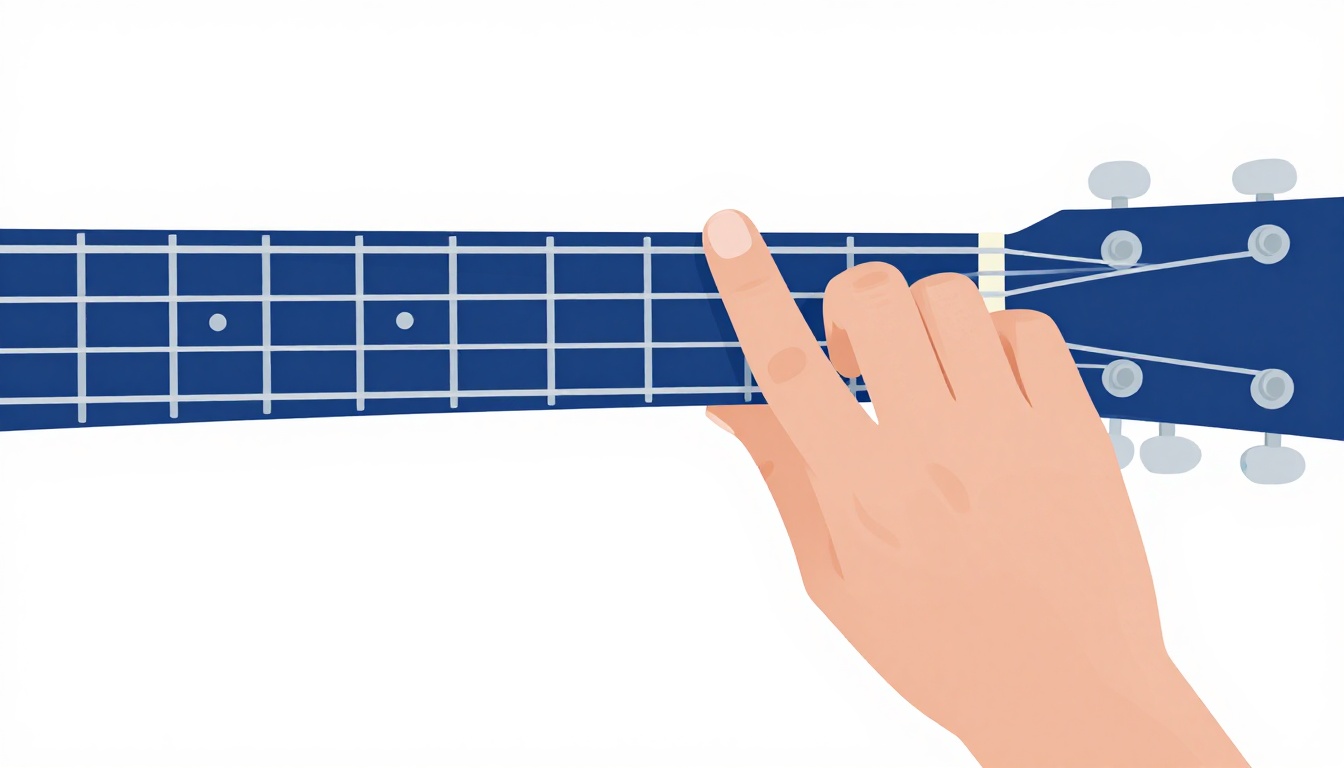
Every fretted or open string in this shape supplies one of Dm7's four notes. The open D string is the root. The G string's 2nd fret gives you A, the fifth. The B string's 1st fret gives you C, the minor seventh, and the high E string's 1st fret gives you F, the minor third. Nothing here is a doubled note or a filler string, every string that rings is doing real harmonic work.
An alternative fingering without the mini-barre
The two-string mini-barre is not the only correct way to finger this chord. If flattening your index finger across two strings feels awkward while your hand is still new to barring anything, three separate fingers produce the exact same notes.
| String | Fret | Finger |
|---|---|---|
| 6 (low E) | Muted | - |
| 5 (A) | Muted | - |
| 4 (D) | Open | - |
| 3 (G) | 2 | 2 (middle) |
| 2 (B) | 1 | 3 (ring) |
| 1 (high E) | 1 | 1 (index) |
Here, your index finger takes only the high E string, your ring finger takes only the B string, and your middle finger stays on the G string exactly as before. Nothing about the sound changes, since it is the same four notes in the same places, only which finger presses which string is different. Some players find this version easier at first because each finger has a single, clear job, while others find the original mini-barre faster once it is learned, since it is one motion instead of three separate placements. Try both and use whichever your hand settles into more reliably, there is no wrong choice between them.
Which strings to strum and which to mute
Mute the low E and A strings and strum from the open D string down through the high E string, four strings in total. Neither the low E nor the A string belongs to this shape, since Dm7's root is on the open D string instead, one string higher than where a lot of players instinctively expect a "D" chord to start.
The most reliable way to keep the low E and A strings quiet is to let the underside of your index finger, the part not busy fretting the 1st fret, rest lightly against the A string as it crosses toward the B string, muting it by contact rather than by aiming your strumming hand carefully around it. The low E string is far enough from your fretting hand that the simplest fix is aim: start your downstroke at the D string and do not let the pick travel past it.
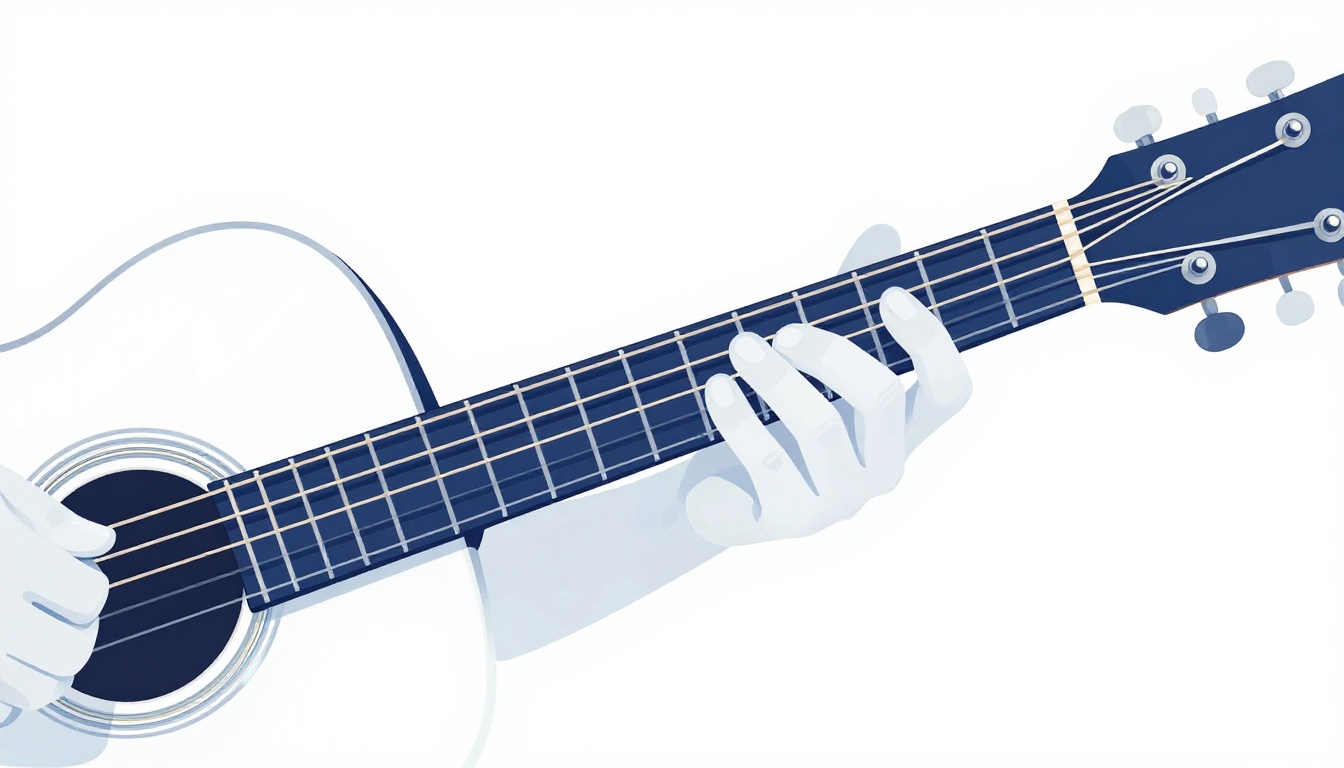
If you strum all six strings out of habit, the open low E and A strings will ring underneath the chord and blur its bass. A stray low E in particular clashes here, since E is not one of Dm7's four notes, and it will noticeably muddy the chord's low end even if every fretted note above it is clean.
Why your Dm7 is buzzing or sounds dead
With two fingers doing the work, there are two specific places anything can go wrong, and they tend to fail in predictable ways. Work through these one at a time rather than guessing at the fix.
Your index finger is not flat enough
The 1st fret mini-barre needs the side of your index finger's first pad to lie flat across both the B and high E strings evenly. If your finger rolls too far onto its side, it can press the high E string too hard while barely touching the B string, or the reverse, leaving one of the two notes muted or buzzing while the other rings fine.
Fix it by flattening your index finger slightly more than feels natural for a single-string note, and check both strings individually by picking them one at a time while the rest of the shape stays held. Adjust the angle in small increments until both ring clean together.
Your middle finger is too close to the fret behind it
Fret numbers count the space between two metal fret wires, not the wire itself. If your middle finger sits in the middle of the "2nd fret" space instead of hugging the fret wire on the side closer to the guitar's body, the G string will need considerably more pressure to stop buzzing, and your hand will tire faster for no reason.
Move your fingertip until it sits just behind the fret wire, then pick the G string alone and listen. A finger correctly placed right behind the fret often needs surprisingly little pressure to ring clean.
Your middle finger is touching the B string
Because the middle finger's job is one fret higher than the index finger's barre, it is easy for the side of that finger to lean back and brush against the B string, muting the note your index finger is already supplying there.
Arch your middle finger so it comes down on its tip rather than its pad, giving the B string room to ring underneath it. Pick the B string on its own with the full shape held down. If it sounds shorter or duller than it does with your fretting hand off the guitar, your middle finger is the likely culprit.
The open D string is being muted by accident
The open D string carries the root of the chord, and it is the easiest string in this shape to mute without noticing, usually by the side of your index finger drifting slightly too low as it forms the mini-barre.
Pick the open D string by itself while holding the rest of the shape. It should ring exactly as it does with no fingers on the neck at all. If it sounds choked, bring your index finger's angle up very slightly, just enough to clear the D string without losing contact with the B and high E strings underneath it.
Not enough downward pressure
Even with good finger placement, both fretted notes need a minimum amount of downward force before they stop buzzing against the fret in front of them. New players often under-press simply because the specific muscles involved have not built the strength yet, and a mini-barre in particular asks more of the index finger than a single-note fret does.
There is no shortcut here except repetition. Fret each note, pick it on its own, and listen. If it buzzes, add pressure gradually until it clears, then remember what that exact amount of pressure felt like, since you are training a specific amount of force into muscle memory, not just memorizing a shape.
Dm vs Dm7: the one fret that changes everything
If you already know the standard open D minor chord, Dm7 is a smaller change than it looks, and knowing exactly what that change is prevents the single most common mistake with this chord.
| String | Dm fret | Dm7 fret | What changed |
|---|---|---|---|
| 6 (low E) | Muted | Muted | Same |
| 5 (A) | Muted | Muted | Same |
| 4 (D) | Open | Open | Same |
| 3 (G) | 2 (middle finger) | 2 (middle finger) | Same |
| 2 (B) | 3 (ring finger) | 1 (index finger) | Moves down two frets |
| 1 (high E) | 1 (index finger) | 1 (index finger) | Same |
The only difference between Dm and Dm7 is the B string. In plain Dm, your ring finger frets it at the 3rd fret, giving you D. In Dm7, that same string is fretted two frets lower, at the 1st fret, with your index finger, giving you C, the minor seventh. Every other finger and every other string stays exactly where it already was.
This is also the most common way a Dm7 quietly turns back into a Dm without the player noticing. If you already have Dm's shape built into muscle memory, your ring finger will sometimes drift to the 3rd fret out of habit even when you meant to play Dm7, especially at speed. If a Dm7 in a song is sounding a little too plain, too settled, check that B string first. Because the actual finger movement is small, a second, deliberate finger position, index instead of ring, two frets lower rather than a different string entirely, it is worth practicing the switch between the two shapes on its own until your hand stops defaulting to the more familiar one.
The Am7-shape barre chord at the 5th fret
Every open-position voicing above depends on open strings, which means it cannot move to a different key. This barre version fixes that by replacing the open notes with your index finger flattened across the neck, built on the same shape as an open Am7 chord and moved up until its root lands on D.
| String | Fret | Finger |
|---|---|---|
| 6 (low E) | Not played | - |
| 5 (A) | 5 | 1 (index, barre) |
| 4 (D) | 7 | 3 (ring) |
| 3 (G) | 5 | 1 (index, barre) |
| 2 (B) | 6 | 2 (middle) |
| 1 (high E) | 5 | 1 (index, barre) |
Lay your index finger flat across the A, G, B, and high E strings at the 5th fret, leaving the low E and D strings out of the chord entirely. Then place your ring finger on the D string's 7th fret and your middle finger on the B string's 6th fret. Strum from the A string up through the high E string, and keep the low E string muted, either by resting the underside of your fretting hand against it or by aiming your strumming hand to start at the A string.
This shape is movable. Slide the whole hand position up or down the neck and the barre fret becomes the new root, so the same finger pattern gives you any minor seventh chord on the A string, not just Dm7, once you know which fret carries which note.
The E-shape barre chord at the 10th fret
A second common way to play Dm7 as a barre chord uses the low E string as its root instead of the A string, built on the same shape as an open Em7 chord.
| String | Fret | Finger |
|---|---|---|
| 6 (low E) | 10 | 1 (index, barre) |
| 5 (A) | 12 | 3 (ring) |
| 4 (D) | 10 | 1 (index, barre) |
| 3 (G) | 10 | 1 (index, barre) |
| 2 (B) | 10 | 1 (index, barre) |
| 1 (high E) | 10 | 1 (index, barre) |
Barre your index finger flat across all six strings at the 10th fret, then place your ring finger on the A string's 12th fret. Strum from the low E string all the way through the high E string, using all six strings this time, unlike the open shape or the 5th fret barre version.
This voicing sits high up the neck, past where an acoustic guitar's body usually starts getting in the way of a full barre, so it tends to be more comfortable on an electric guitar or a cutaway acoustic. If a full six-string barre at the 10th fret feels out of reach right now, the open shape and the 5th fret version both give you the same chord with far less of a stretch.
Why two different barre shapes exist for the same chord
Both barre versions produce the same four notes, D, F, A, and C, just arranged across the strings differently and rooted on different strings. The 5th fret version keeps its root on the A string and leaves the low E string out entirely, giving a lighter, more midrange sound. The 10th fret version roots on the low E string itself, using all six strings for a fuller, bassier chord, but demands a bigger stretch and sits in a less common playing position.
Neither is more correct than the other. Guitarists reach for the 5th fret shape more often in practice, since it is lower on the neck and easier to reach from most open chords, while the 10th fret shape gets used when a part specifically calls for that higher register, or when the low E string's extra weight suits the moment. Learning both means you are never stuck without a movable option, regardless of what the rest of a chord progression is doing on the neck.
Making the barre versions easier on a smaller hand
Both barre shapes ask more of your hand than the open version, and a few adjustments make either one noticeably more reachable rather than just a matter of pushing through discomfort.
Bring your fretting-hand thumb down lower on the back of the neck, closer to the middle, rather than letting it creep up over the top edge. A thumb positioned centrally behind your first and second fingers gives your hand more leverage to close the barre without your wrist bending at an awkward angle. Rotate your whole forearm slightly so your index finger approaches the strings from more of an angle rather than dead straight on, which lets the side of the finger, rather than its softest pad, do the pressing, and that side is naturally firmer.
If the 5th fret Am7-shape barre still feels like a stretch, work on it as two separate motions before combining them: hold just the index finger's barre across the A, G, B, and high E strings on its own until it rings clean, then add the ring and middle fingers on top once the barre itself is solid. Trying to place all three fingers at once before the barre is dependable usually means the barre is the part that gives out first.
Dm7 vs Dm7b5: the one note that changes the mood entirely
Dm7b5, also called D half-diminished, looks like a small variation on Dm7 but is a genuinely different chord with a different function. Where Dm7 is built from D, F, A, and C, Dm7b5 flattens the fifth, replacing A with Ab, giving D, F, Ab, and C.
| Chord | Formula | Notes | Character |
|---|---|---|---|
| Dm7 | Root, minor 3rd, perfect 5th, minor 7th | D, F, A, C | Open, reaching, still fundamentally minor |
| Dm7b5 | Root, minor 3rd, flat 5th, minor 7th | D, F, Ab, C | Tense, unstable, unresolved |
That single flattened fifth removes the stable interval that gives Dm7 its grounded quality, replacing it with a dissonant tritone against the root. Dm7b5 shows up almost exclusively as the ii chord leading into a V7 in a minor key, a specific jazz function that plain Dm7 does not serve. If a chord chart specifically calls for Dm7b5, playing Dm7 in its place removes that tension entirely and changes what the progression is doing, so treat the "b5" as a completely different instruction rather than a simplified version you can round off.
Dm7 vs Dm6 and Dm9
Two other D minor chords look close enough to Dm7 on a page to get confused with it.
Dm6 replaces Dm7's minor seventh (C) with a major sixth (B), giving D, F, A, and B. It has a brighter, jazzier lean than Dm7's darker seventh, and it is a different chord entirely, not a simplified or extended version of Dm7. Swapping one for the other changes the color of that moment in a song.
Dm9 takes the full Dm7 chord (D, F, A, C) and adds a ninth (E) on top. Every Dm9 voicing contains a Dm7 inside it, which is why Dm9 chord shapes often look like a Dm7 shape with one extra note added higher up. If a Dm9 shape feels out of reach right now, playing the Dm7 underneath it in the same spot in a progression is a reasonable simplification, since four of its five notes are already shared.
Where Dm7 fits in a key
Dm7 is not just a standalone shape, it shows up predictably inside several common keys, built naturally from the notes already in those keys' scales.
| Key | Dm7's role | Why |
|---|---|---|
| C major | ii7 | D is the 2nd note of the C major scale, and F, A, C are all diatonic to it |
| F major | vi7 | D is the 6th note of the F major scale, the relative minor, with a seventh added |
| Bb major | iii7 | D is the 3rd note of the Bb major scale |
The C major row is the one worth knowing cold. In the key of C, the progression Dm7, G7, Cmaj7 is the textbook example of a ii-V-I, one of the most common chord movements in Western music, jazz especially. The ii chord (Dm7) creates gentle tension, the V chord (G7) increases it, and the I chord (Cmaj7) resolves it, a three-chord arc songwriters and jazz players return to constantly, whether or not they are thinking about roman numerals while they play it.
Knowing this does not change how you finger the chord, but it changes how you predict what is coming. If you see Dm7 in a chart written in the key of C or F, there is a good chance a G7, C, or Bb chord is nearby, and you can start anticipating the shift with your fretting hand before the chart tells you to move.
The ii-V-I progression: Dm7, G7, Cmaj7
This specific three-chord movement is common enough, and useful enough, to walk through on its own.
| Progression | Chords in order | What each chord is doing |
|---|---|---|
| ii-V-I in C major | Dm7, G7, Cmaj7 | Tension, more tension, resolution |
Play through the three chords slowly, one per bar, and listen to how each one leans toward the next. Dm7 sounds unfinished on its own, like the first half of a sentence. G7 raises that tension further, since it contains a tritone that wants to resolve. Cmaj7 finally releases it, landing the progression back on solid ground. This three-chord arc is worth practicing in isolation, slowly, with a full stop between each chord at first, since it is one of the most transferable chord movements you can learn, showing up across jazz, soul, gospel, and plenty of pop written by musicians who learned their harmony from those traditions.
Changing into and out of Dm7
The shape itself is rarely the hard part. The hard part is getting into it and out of it without a gap in the sound, and that depends entirely on which chord comes next.
Dm7 to C
The standard open C chord uses your ring finger on the A string's 3rd fret, your middle finger on the D string's 2nd fret, and your index finger on the B string's 1st fret. Your index finger's position barely moves, from a two-string mini-barre at the B and high E strings' 1st fret to a single note at the B string's 1st fret, so anchor that finger first and build the rest of the C shape around it.
Dm7 to G7
Standard open G7 places your middle finger on the low E string's 3rd fret and your index finger on the A string's 2nd fret, with the D, G, B, and high E strings all open. Coming from Dm7, your fretting hand releases entirely, since none of G7's two fretted notes reuse any of Dm7's finger positions, so the change is really about speed and confidence in a completely fresh two-finger shape rather than reusing muscle memory from the chord before it.
Dm7 to Am
Standard open Am uses your middle finger on the D string's 2nd fret, your ring finger on the G string's 2nd fret, and your index finger on the B string's 1st fret, with the low E string muted. Your index finger's B string position stays exactly where it was in Dm7, just without the high E string underneath it, which makes this one of the more forgiving changes on this list. Anchor the index finger and build the other two fingers around it.
Dm7 to F
The standard open F chord barres the index finger across the B and high E strings at the 1st fret, exactly like Dm7's mini-barre, then adds the middle finger on the G string's 2nd fret and the ring finger on the D string's 3rd fret. Because the index finger barre is identical between the two chords, F is arguably the smoothest change in this entire post, keep the index finger locked in place and only the ring finger has real work to do, landing on the D string's 3rd fret while the middle finger stays put on the G string.
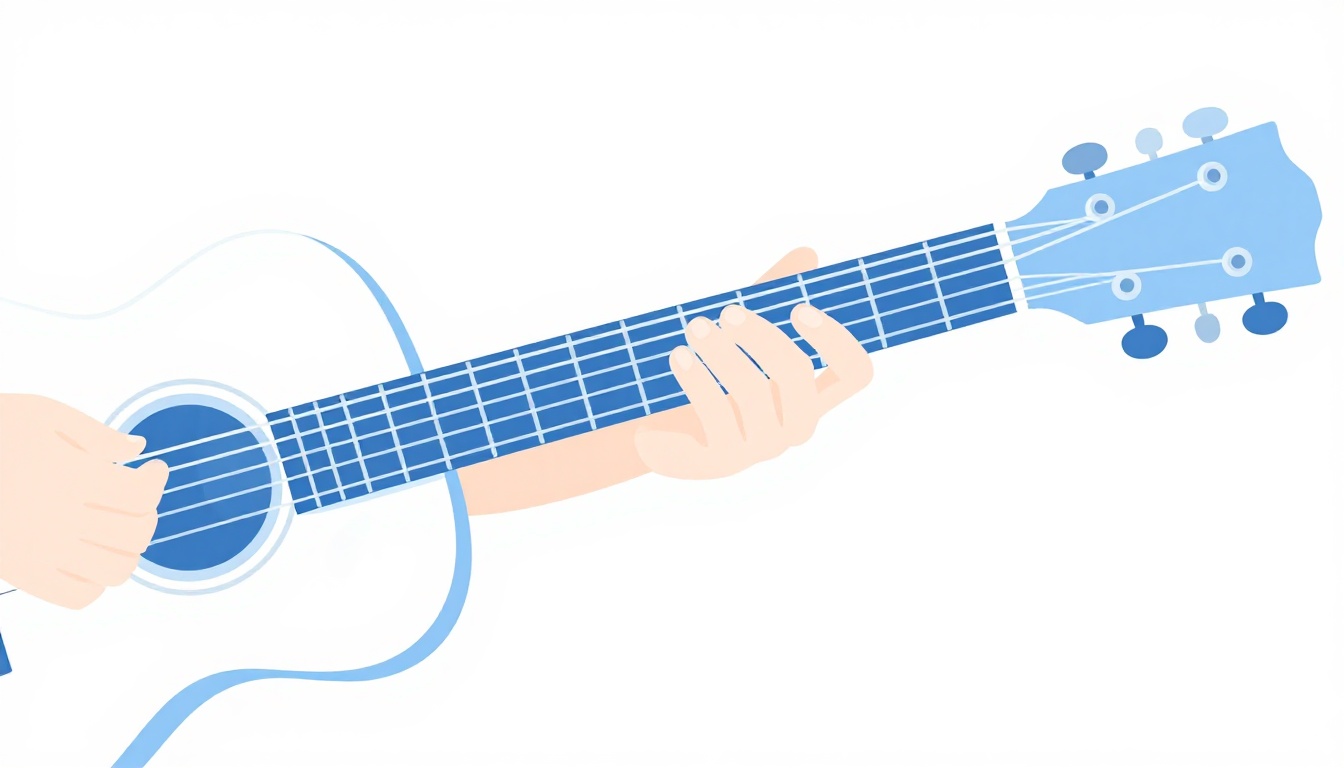
Dm7 to A
Standard open A places your index, middle, and ring fingers all on the 2nd fret, across the D, G, and B strings respectively, with the low E muted, the A string open, and the high E string open. All three fingers land fresh here, but because they all sit on the same fret, this change rewards moving your whole hand as one block once you know the A shape well enough to think of it as a single unit rather than three separate finger placements.
For all five of these changes, the same practice method works. Fret Dm7, then the target chord, back and forth slowly with a full stop between each one, checking that every string rings clean before moving on. Only once that is reliable should you add rhythm, holding Dm7 for a full bar and changing on the beat, gradually tightening the gap until there is none.
Common progressions built around Dm7
Recognizing Dm7 inside a real progression, and anticipating what is likely to come next, is what makes the shape useful once you are playing full songs rather than isolated chords.
| Progression | Chords in order | Where Dm7 sits |
|---|---|---|
| ii-V-I in C major | Dm7, G7, Cmaj7 | The opening tension, resolving two bars later |
| vi7-IV-I-V in F major | Dm7, Bb, F, C | The turn that starts the progression before it brightens into the IV chord |
| ii-V-vi-IV in C major | Dm7, G7, Am, F | A longer turnaround that delays resolution by landing on Am instead of C |
If you already know C, G7, F, Bb, and Am, learning Dm7 alongside them fills in the missing piece of all three of these progressions at once, rather than being a new chord learned in isolation. Try playing through each row slowly, one chord per bar, and listen for how Dm7 behaves differently depending on what follows it: resolving cleanly into Cmaj7 in the first row, brightening into Bb in the second, and quietly delaying resolution in the third.
Where Dm7 shows up in real music
Minor seventh chords like Dm7 are especially common in jazz, soul, R&B, and funk, genres built around exactly the kind of gentle, unresolved tension a seventh adds to a plain minor triad. That is not a coincidence: the ii-V-I movement covered above is one of the most reused chord progressions in those styles, and Dm7 is the textbook ii chord in the enormously common key of C major, so once you start listening for it, it turns up constantly in rhythm guitar parts, keyboard comping, and horn-section backing across those genres.
Blues and blues-rooted rock lean on minor and dominant seventh chords as their default vocabulary rather than an occasional flavor, so Dm7 also shows up there whenever a progression moves through the key of D minor or borrows the ii chord from F or C major. Folk and singer-songwriter guitar parts use it more sparingly, usually as a softer substitute for a plain Dm in a verse that wants to feel like it is moving forward rather than settling.
Dm7 and the D Dorian mode
Once the chord shape is solid, Dm7 is also a natural entry point into the D Dorian mode, a scale lead guitarists reach for specifically over minor seventh chords because every note in it is either a chord tone or a smooth passing note against Dm7.
| Degree | Note | Role |
|---|---|---|
| 1 | D | Root |
| 2 | E | Passing tone |
| b3 | F | Minor third |
| 4 | G | Passing tone |
| 5 | A | Perfect fifth |
| 6 | B | The note that defines Dorian |
| b7 | C | Minor seventh |
D Dorian shares six of its seven notes with the D natural minor scale, and differs by exactly one note: where natural minor flattens the sixth to Bb, Dorian keeps it natural, as B. That single raised sixth is what gives Dorian its brighter, slightly more open character compared to a plain natural minor scale, and it is why the mode pairs so naturally with Dm7 specifically, since Dm7 itself contains no note that conflicts with that raised sixth. This is a scale to come back to once the chord shapes above feel comfortable, rather than something to tackle at the same time as learning the chord itself.
Fingerpicking Dm7
Because every note in the open Dm7 shape belongs to the chord, it is a solid chord for practicing basic fingerpicking, provided your thumb stays off the low E and A strings, which are not part of it.
A simple starting pattern uses your thumb (T) for the open D string and your index (I), middle (M), and ring (R) fingers for the G, B, and high E strings.
| Beat | String | Picking finger |
|---|---|---|
| 1 | 4 (D) | Thumb |
| 2 | 3 (G) | Index |
| 3 | 2 (B) | Middle |
| 4 | 1 (high E) | Ring |
Play the open D string alone on the first beat, then roll up through the G, B, and high E strings one at a time. Keep your thumb anchored to the D string only, resisting the pull to drift down onto the A string out of old habit from other open chords that do use it.
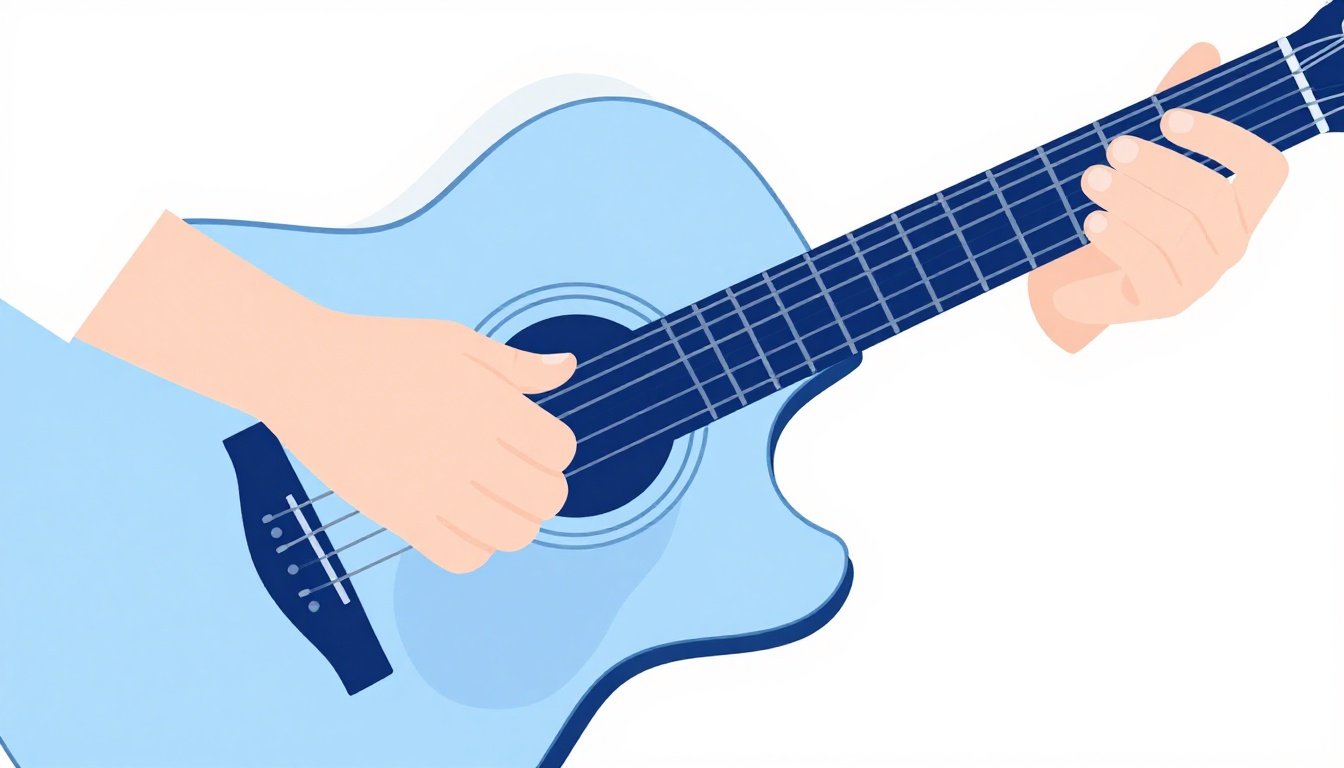
Once that basic roll feels steady, try breaking the pattern up: thumb on the D string, then straight to the high E and B strings before filling in the G string on the way back down. Because every string in this shape is either a chord tone or correctly muted, there is no wrong note to land on inside it, making it a safe shape to experiment with different picking orders on before trying the same experiments on a chord with more strings to keep track of.
Dm7 on acoustic vs electric guitar
The shape does not change between instruments, but how it behaves does, and it is worth knowing what to expect before assuming something is wrong with your playing rather than with the instrument's natural character.
On an acoustic guitar, the open D string rings loudly and for a long time, giving the open Dm7 shape a warm, resonant low end that anchors the chord without you needing to do anything extra with your picking or strumming hand. On an electric guitar, especially with any amount of gain or distortion, that same open string behaves differently. Overdrive makes it ring out more aggressively and picks up unwanted noise from the muted low E and A strings far more readily than a clean acoustic tone does, so pay closer attention to keeping those two strings muted between strums when playing through a distorted amp.
Clean electric tone sits closer to acoustic in how forgiving it is, though without an acoustic's natural volume and sustain from the body and soundhole, a clean electric Dm7 can sound comparatively thin unless you lean into one of the fuller barre voicings from earlier in this post.
Common mistakes beyond buzzing
A few habits show up specifically with Dm7 that are not really about buzzing or muted strings, but about how the chord gets used.
Strumming past the D string out of habit. Because so many other open chords start from the low E or A string, some players carry that habit into Dm7 and strum too far down, catching strings that are not part of the chord. Double-check your strumming hand is actually starting at the D string.
Reverting to Dm's ring finger. As covered earlier, the single most common mistake with this chord is the B string drifting back to the 3rd fret with the ring finger, out of muscle memory from plain Dm, especially on fast changes. If a Dm7 sounds a little too settled, check that finger first.
Confusing it with Dm7b5, Dm6, or Dm9 from a chart. Covered in detail above, but worth repeating: read the chord symbol carefully rather than assuming any D minor chord with extra letters after it is close enough to Dm7 to substitute freely, since the b5 in particular changes the chord's function entirely.
Treating the barre versions as strictly better. The open shape is not a beginner shortcut you graduate out of. It is a complete, correctly voiced Dm7 that many working guitarists use by default because it needs less movement to reach from nearby open chords. Reach for a barre version because a song needs that register or that movability, not because the open shape is somehow incomplete.
A practice routine for today
Fifteen minutes is enough to make real progress on this chord if you spend it deliberately rather than strumming through a song on repeat.
- Five minutes on the shape alone. Fret the open Dm7, strum from the D string down through the high E string, and listen for any string that sounds muted or buzzed. Isolate and fix it using the causes listed earlier in this post before moving on.
- Five minutes on one transition. Pick a single change, Dm7 to F is a good place to start since the index finger barely moves, and repeat it slowly with a full stop between chords. Once ten changes in a row ring clean, add a metronome at a slow tempo and change on the beat.
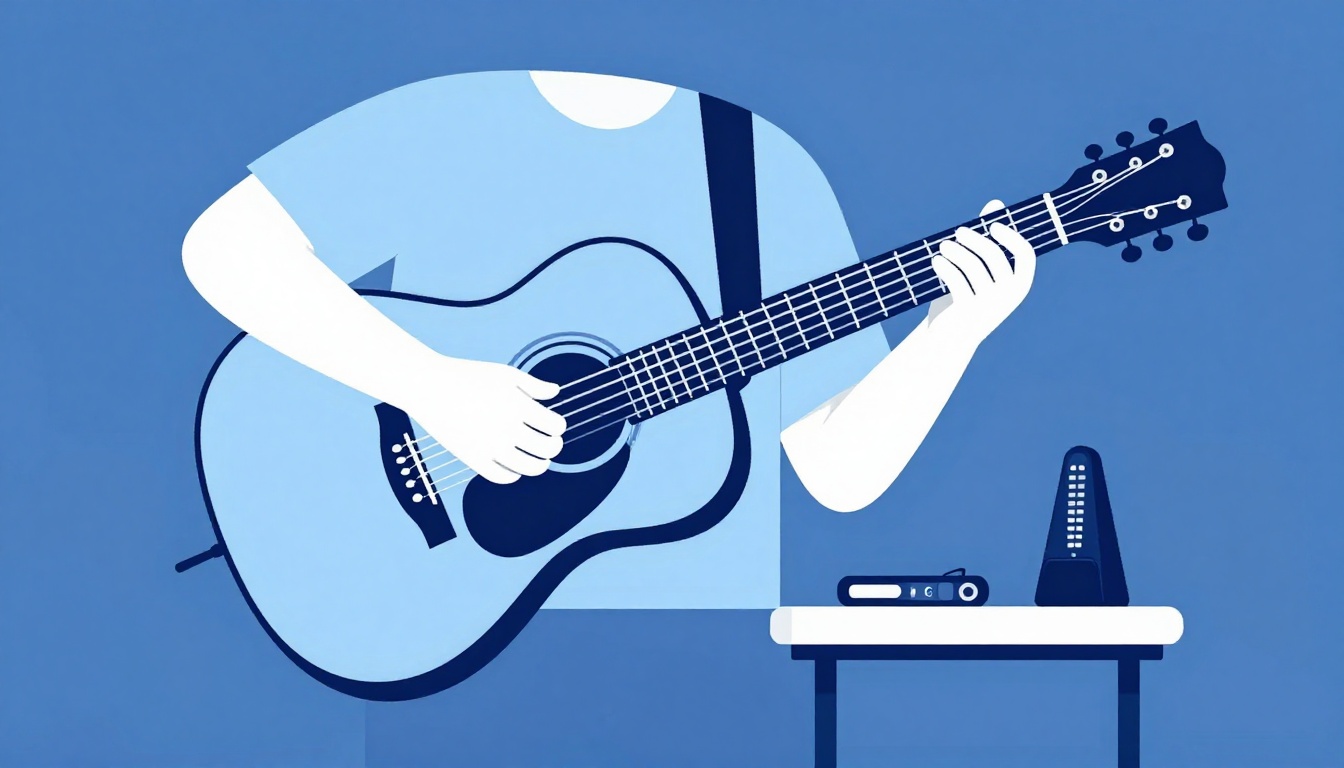
- Five minutes on the ii-V-I progression. Play through Dm7, G7, Cmaj7 slowly, one chord per bar, focusing on landing each change cleanly rather than on speed.
Repeat this same fifteen minutes for a few days before adding the barre versions or a second transition. Progress on a chord like this comes from consistency across several short sessions, not from one long session where your hand gets tired and your form starts to slip.
FAQ
Is Dm7 easier than Dm? For most players, yes, or at least no harder. The two shapes use the same number of fingers, and the only difference is where your ring or index finger lands on the B string. Since Dm7's version of that note sits two frets lower, some players find it slightly easier to reach.
Can I use Dm7 instead of Dm anywhere in a song? Often, but not always. They share three of four notes, so they usually sound fine swapped in, but the added seventh changes how the chord pulls toward whatever comes next, so a chart that specifically calls for Dm rather than Dm7 is sometimes making a deliberate choice about that pull.
Why does my Dm7 sound the same as my Dm? This almost always means your ring finger has drifted to the B string's 3rd fret out of habit from plain Dm, instead of your index finger holding the 1st fret. Check that finger position first, covered in detail in the comparison section above.
Do I need to barre Dm7 to play it in other keys? Only if you specifically want the same voicing moved to a different root. If you just need a minor seventh chord somewhere else on the neck, it is often easier to learn that chord's own open or barre shape rather than transposing Dm7's shape by ear.
What is the difference between Dm7 and D7? They share the same minor seventh interval, but Dm7 is built from a minor triad (D, F, A) with a minor seventh added, while D7 is built from a major triad (D, F#, A) with a minor seventh added. The F versus F# is the difference between a minor chord and a major one, so despite the similar names, Dm7 and D7 sound distinctly different, one darker and one brighter.
Why do some chord charts show Dm7 as a barre and others as an open shape? Both are correct voicings of the same four notes, just arranged differently across the strings and, in the barre versions, movable to other keys. Charts aimed at beginners tend to show the open shape first because it needs less stretch, while charts covering movable shapes show the barre versions because they work in any key without relearning a new fingering.
How do I stop my hand from cramping while holding Dm7? Cramping in this chord usually comes from unnecessary tension in the fingers that are not fretting anything, or from squeezing your thumb too hard against the back of the neck. Relax the fingers you are not using, and check that your thumb is providing light support rather than gripping.
Does Dm7 still use the same fingering with a capo on? Yes. A capo shifts every open chord's pitch up without changing the shape your fretting hand makes, so Dm7 played with a capo on any fret still uses the same finger and fret positions described in this post, it just sounds higher than it would without the capo.
Does Dm7 sound different on acoustic versus electric guitar? Yes, though the shape and fingering stay identical. Acoustic guitars give the open D string in Dm7 a warm, resonant sustain, while electric guitars, especially with gain or distortion, need more careful muting of the low E and A strings between strums to avoid unwanted noise from strings that are not part of the chord.
Is Dm7 a major or minor chord? Minor. It is built from a D minor triad (D, F, A) with a minor seventh (C) added on top. The word "minor" in its name refers to that underlying triad, and the seventh does not change the chord's fundamental minor quality, it only adds the reaching, unresolved character discussed earlier in this post.
Why does Dm7 sound different depending on which barre shape I use? The notes are the same either way, but their order and register on the strings are not. The 5th fret version roots on the A string and leaves out the low E entirely, giving a lighter, midrange-focused sound, while the 10th fret version uses all six strings and a low E root for a fuller, bassier voicing. Both are correct, they just emphasize different parts of the chord's range.
GuitarLowKey
Ready for fifteen focused minutes?
Open the web app and train the change that is blocking your song.