
How to Play the Gb Guitar Chord (Every Shape, No Buzzing)
The Gb guitar chord has no open-string shape. Here is the barre version most players use, an easier capo trick, and how to stop it from buzzing.

To play the Gb chord on guitar, barre your index finger across the 2nd fret of all six strings, then add your middle finger on the 3rd fret of the 3rd (G) string, your ring finger on the 4th fret of the 5th (A) string, and your pinky on the 4th fret of the 4th (D) string. Mute nothing, strum all six strings. That is the shape almost every player reaches for, and this post covers everything around it: why Gb has no open version, an easier capo trick, the barre position further up the neck, why it buzzes, and every chord built on the same root, Gbm, Gbm7, Gb7, Gbmaj7 and Gbsus4.
| String | Fret | Finger |
|---|---|---|
| 6 (low E) | 2 | 1 (barre) |
| 5 (A) | 4 | 3 |
| 4 (D) | 4 | 4 |
| 3 (G) | 3 | 2 |
| 2 (B) | 2 | 1 (barre) |
| 1 (high E) | 2 | 1 (barre) |
What "Gb" Means, and Why It's the Same Chord as F#
Gb (G flat) is the note one half step, one fret, below G. On a guitar neck, a flat and the sharp that sits at the exact same fret are the same pitch, just spelled two different ways. Gb and F# are what music theory calls enharmonic equivalents: identical strings, identical frets, identical sound, different name. You will see this chord written as Gb in some songbooks and F# in others, and neither is wrong.
The name that gets used usually follows the key signature of the song. Keys built around flats, Db major, Ab major, Cb major, tend to call this chord Gb. Keys built around sharps, D major, A major, E major, call it F#. If you are reading a chord chart and it says F#, use everything in this post, the shapes are identical.
| Chord tones | Note names |
|---|---|
| Root | Gb (or F#) |
| Major 3rd | Bb (or A#) |
| Perfect 5th | Db (or C#) |
String names and numbers, so the tables above make sense
Every fret and finger listed in this post refers to the six strings by both number and name, so it helps to have this settled before going further.
| String number | Name | Standard tuning pitch |
|---|---|---|
| 6 | Low E | E |
| 5 | A | A |
| 4 | D | D |
| 3 | G | G |
| 2 | B | B |
| 1 | High E | E |
Strings are numbered from thinnest to thickest, so the 1st string is the high E string nearest the floor when the guitar is in playing position, and the 6th string is the thick low E string nearest the ceiling. Standard tuning, low to high, is E-A-D-G-B-E. Fret numbers count from the nut, the strip of material at the very top of the neck where the strings first make contact, so "the 2nd fret" means the second space down the neck, not the second metal wire. Finger numbers follow the usual convention: 1 is the index finger, 2 is the middle finger, 3 is the ring finger, and 4 is the pinky.
Why Gb Has No Open-String Shape
Every easy chord you already know, C, G, D, A, E, works because at least a few of the six open strings happen to land on notes that belong to the chord. An open G chord uses the open D, G and B strings for free, and only needs three fretted notes to complete the shape. Gb major is built from Gb, Bb and Db. None of the six open strings, E, A, D, G, B, E, is one of those three notes, so there is no way to build a Gb chord using any open string. Every practical version of this chord has to be built entirely from fretted notes, or from an open shape moved up the neck behind a capo.
This is exactly the same problem F, Bb and Eb run into, and for the same reason: none of those roots line up with an open string either. Gb tends to show up after a player already knows C, G, D, A and E, so it usually arrives as a surprise the first time a song calls for it.
Reading a Gb chord diagram
Every table in this post can also be drawn as a vertical chord diagram, and it helps to know how to translate between the two if you come across one in a songbook or an app. The vertical lines represent the six strings, low E on the left and high E on the right, and the horizontal lines represent frets, with the nut at the top unless a number beside the diagram tells you it starts higher up the neck. A dot on a line marks where a finger goes, an "X" above a string means do not play it, and an "O" means play it open.
For the Gb barre shape, a diagram would show a curved line or a straight bar across the 2nd fret, covering all six strings, with three more dots stacked at frets 3 and 4 for the middle, ring and pinky fingers. Once you can read one diagram, you can read all of them, the layout is the same convention across every chord in every key.
Is Gb a hard chord to learn?
It is harder than the open chords you learned first, but not because the shape itself is unusually difficult. It is hard because it is very likely the first, second or third barre chord you ever attempt, and a barre chord asks your hand to do something genuinely new: one finger has to replace the nut, applying even pressure across all six strings at once, while the rest of your hand holds a completely different shape on top of it. Every skill involved, the flat finger, the thumb counter-pressure, the independence of the other three fingers, is a skill you have not needed yet.
The honest comparison is F, usually the very first barre chord a new player meets. Gb uses the identical hand shape, just one fret higher up the neck. If you can already play F cleanly, you already know how to play Gb, you are only relearning where your hand goes. If you cannot yet play F cleanly, working on Gb and F at the same time is not wasted effort, since fixing the barre technique on one fixes it on the other.
The Root 6 Barre Shape, Finger by Finger
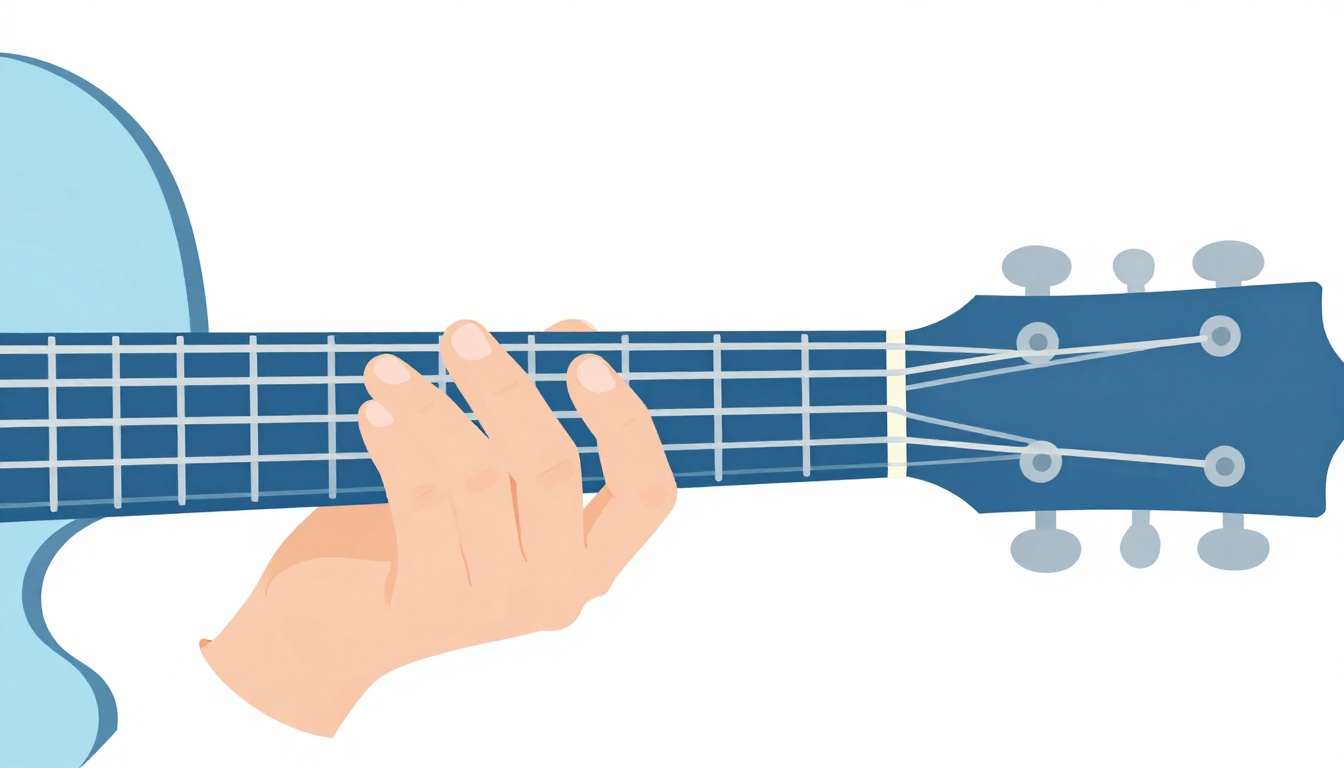
The shape in the opening table is called a root 6 barre chord because the lowest note, the root, sits on the 6th string. It is a moved version of the open E major shape, which is why guitarists call it an "E-shape barre chord." Here is what each finger is doing and why.
Your index finger lies flat across all six strings at the 2nd fret, acting as a movable nut. This alone gives you the root (Gb) on the low E string, the 5th (Db) on the B string, and the root again (Gb) on the high E string, three of the six notes, for one finger.
Your middle finger presses the 3rd (G) string at the 3rd fret, one fret past the barre, giving you the major 3rd (Bb). Your ring finger presses the 5th (A) string at the 4th fret, two frets past the barre, giving you the 5th (Db). Your pinky presses the 4th (D) string at the 4th fret, also two frets past the barre, giving you the root again, an octave up.
Every note has a job: root, 5th, root, 3rd, 5th, root, reading from the low E string to the high E string. Nothing is wasted and nothing is optional, which is why a barre chord that is missing even one of these fingers usually produces an audibly wrong or muted note rather than just a quieter chord.
The Two Movable Shapes Behind Every Barre Chord
The shape above is not really "the Gb shape," it is the E-shape barre pattern, and it produces a different chord depending only on which fret you put it on. There is a second movable pattern, the A-shape barre, built from the open A chord instead, with its root on the 5th string. Once your hand knows both shapes, you already know every major chord on the neck, you are only ever choosing a fret.
| Fret | E-shape barre (root on 6th string) | A-shape barre (root on 5th string) |
|---|---|---|
| 1 | F | Bb |
| 2 | Gb (F#) | B |
| 3 | G | C |
| 4 | Ab (G#) | Db (C#) |
| 5 | A | D |
| 6 | Bb (A#) | Eb (D#) |
| 7 | B | E |
| 8 | C | F |
| 9 | Db (C#) | Gb (F#) |
| 10 | D | G |
| 11 | Eb (D#) | Ab (G#) |
| 12 | E | A |
Read the table by matching the shape to the fret. The E-shape barre at fret 2 is Gb, which is the version this post opened with. The A-shape barre at fret 9 is also Gb, a different fingering for the exact same chord, further up the neck. Slide either shape to a new fret and the fingering never changes, only the root note printed on the chord chart does.
The A-Shape Version Further Up the Neck
Once the fret-2 shape feels solid, there is a second, fuller way to play Gb, built on the A-shape pattern instead, rooted on the 5th string.
| String | Fret | Finger |
|---|---|---|
| 6 (low E) | Muted | - |
| 5 (A) | 9 | 1 (barre) |
| 4 (D) | 11 | 3 |
| 3 (G) | 11 | 4 |
| 2 (B) | 11 | 2 |
| 1 (high E) | 9 | 1 (barre) |
Mute the low E string with the underside of your barre finger and strum from the A string down. This shape is a bigger stretch than the fret-2 version, since your middle, ring and pinky fingers all land on the same fret, two frets past the barre, rather than being staggered the way they are in the E-shape. Most players find it harder to hold cleanly, and use it only when a song is already sitting up near the 9th fret and moving there is faster than jumping all the way back down to fret 2.
Gb vs F and G: the chords that are easy to mix up
Because the E-shape barre is movable, Gb sits immediately next to two other chords you likely already know, one fret below it and one fret above it. That closeness is exactly why it is easy to land on the wrong one.
| Fret | Chord (E-shape barre) |
|---|---|
| 1 | F |
| 2 | Gb |
| 3 | G |
F major, at the 1st fret, is often the very first E-shape barre chord players get comfortable with, since it sits lowest on the neck where the frets are widest and most forgiving. G major, at the 3rd fret, is a common one too. Gb sits in between both, one fret up from F and one fret down from G, which means a hand that has memorized "the barre chord goes about here" by feel, rather than by counting, will regularly miss by exactly one fret in either direction. When a Gb comes out sounding like F or G, the shape was almost certainly right and the fret was not. Count from the nut every time until the fret becomes as automatic as the shape already is.
An Easier Way In: the Partial Top-String Version
If a full six-string barre is still out of reach, there is a genuinely easier version of the same chord that only asks your index finger to flatten across two strings instead of six.
| String | Fret | Finger |
|---|---|---|
| 6 (low E) | Not played | - |
| 5 (A) | Not played | - |
| 4 (D) | 4 | 3 |
| 3 (G) | 3 | 2 |
| 2 (B) | 2 | 1 (barre) |
| 1 (high E) | 2 | 1 (barre) |
Strum only the top four strings, D, G, B and high E. This is exactly the top of the full barre shape with the low E and A strings left out, so it contains the same notes, root, 3rd, 5th and root, just without the low root doubled on the bottom string. It will sound thinner than the full six-string version because there is no bass note under it, but it lets you build the finger independence for a barre chord without needing your whole hand to hold one yet.
Using Your Thumb to Make the Barre Easier
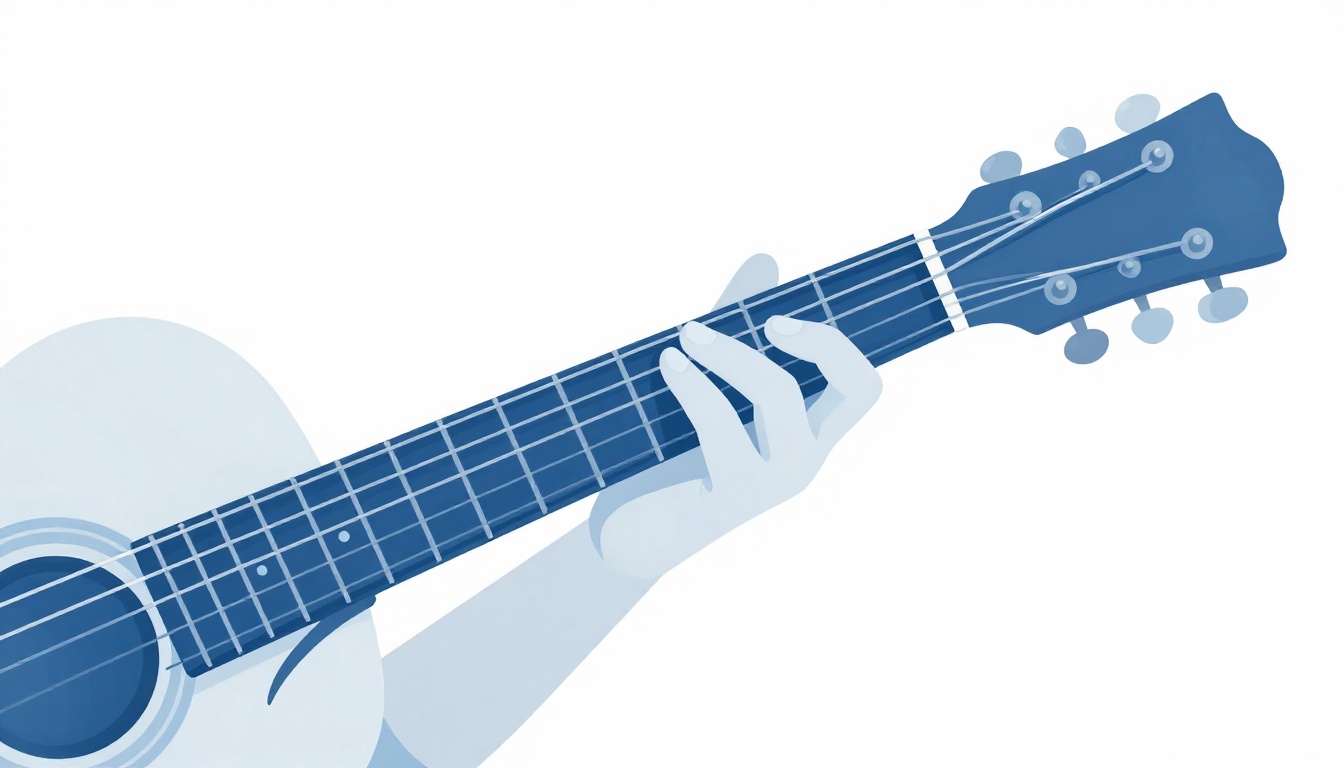
There is a third route in that many experienced players use without thinking about it: let your thumb reach over the top of the neck and fret the root note on the low E string, freeing your index finger from ever needing to barre all six strings.
For Gb, that means your thumb frets the low E string at the 2nd fret (the root), while your index finger only has to hold a small barre across the B and high E strings, also at the 2nd fret, with your middle and ring fingers on the G and D strings exactly as in the partial version above. The chord that comes out is the same one, now with a proper bass note underneath it, and the demand on your index finger drops from a six-string barre to a two-string one.
This is not a beginner's cheat. Plenty of experienced guitarists, especially in blues and rock styles, use thumb-over fretting on E-shape chords like this one as their normal technique, not a stepping stone. The trade-off is that it needs a neck profile your thumb can actually reach around, which depends on your guitar and your hand, so try it and judge for yourself whether it feels secure rather than assuming it will or will not work.
The Capo Shortcut: Playing Gb with an Open E Shape
There is one more way in that avoids a barre completely: a capo. Clip a capo onto the 2nd fret and play an ordinary open E major shape behind it, the same shape you use for E: index finger on the G string, middle finger on the A string, ring finger on the D string. Because the capo raises every open string by two half steps, the same E shape now rings out as Gb.
| String | Open E shape (behind the capo) | Finger |
|---|---|---|
| 6 (low E) | Open | - |
| 5 (A) | 2 frets past the capo | 2 (middle) |
| 4 (D) | 2 frets past the capo | 3 (ring) |
| 3 (G) | 1 fret past the capo | 1 (index) |
| 2 (B) | Open | - |
| 1 (high E) | Open | - |
This is a genuine shortcut, not a trick that only half works. The capo does the job your index finger's barre would otherwise do, so the only fingers left on the fretboard are the three that already form the open E shape you likely learned in your first week of playing. The trade-off is that every other chord in the song has to be played as if the capo were the nut, so a song that also needs, say, an open D chord now needs you to play a C-shape fretted behind the capo instead, since a C shape two frets up is D. A capo only helps if you are willing to re-think every chord in the song relative to the new capo position, not just the one you found hard.
This trade-off is exactly why the capo shortcut works best on songs where every chord happens to be a chord with a friendly open shape sitting two frets below it, since a capo on the 2nd fret turns E, A and D shapes into Gb, B and E at once. If the song mixes Gb with ordinary open chords like C or G that do not need help, a capo forces you to relearn the easy chords too, which usually costs more than it saves.
Why Your Gb Chord Is Buzzing or Not Ringing
A barre chord fails in more specific ways than an open chord, because one finger is doing the work of what used to be a nut. Work through these one at a time.
Your barre finger is curled instead of flat
The index finger needs to lie almost flat across the strings, using the side of the finger rather than the fleshy pad, so that the bony ridge along its length presses evenly. A curled finger presses hardest in the middle and leaves the strings near your other fingers too loose to ring.
Your barre finger is not close enough to the fret
Press the barre as close to the fret wire as you would for any single note, right behind it. A barre planted in the middle of the fret space needs far more pressure to avoid buzzing than one placed right up against the fret.
Your thumb is in the wrong spot
Your thumb should sit on the back of the neck, roughly behind your middle finger, pushing forward to create a clamp with your index finger. A thumb that has crept over the top of the neck, a habit left over from open chords, robs the barre of the counter-pressure it needs.
One of your other fingers is leaning into a neighboring string
Because your middle, ring and pinky fingers are close together in this shape, it is easy for one to lean sideways and mute the string next to the one it is supposed to be fretting. Check each string on its own by picking it slowly and listening for a dead thud instead of a clear note.
You are pressing harder than you need to
Once the shape rings cleanly, backing off the pressure slightly, just enough to keep every note clear, saves your hand from fatigue during a full song. A death grip is not a fix, it is a sign the barre itself is not positioned correctly yet.
The guitar itself is working against you
If every barre chord buzzes no matter how carefully you place your fingers, and open chords are fine, the guitar's setup may be the actual cause rather than your technique. Strings sitting unusually high off the fretboard demand more finger strength than they should, and a neck with too much forward bow can cause buzzing partway up the neck even with a textbook barre. This is worth ruling out with a second player or a shop if every barre chord feels disproportionately hard compared to how your open chords feel, since no amount of practice fixes a setup problem.
Gb Minor (Gbm): the Full Barre Shape
Change one note in Gb major and you get Gb minor, built from Gb, A (spelled as a minor 3rd, sometimes written Bbb) and Db. The full barre shape uses the same fret-2 hand position as Gb major, with one finger removed. This chord is more commonly written as F#m, and our F#m chord guide covers it in more depth, but the shape is identical either way.
| String | Fret | Finger |
|---|---|---|
| 6 (low E) | 2 | 1 (barre) |
| 5 (A) | 4 | 3 |
| 4 (D) | 4 | 4 |
| 3 (G) | 2 | 1 (barre) |
| 2 (B) | 2 | 1 (barre) |
| 1 (high E) | 2 | 1 (barre) |
The only difference from Gb major is the 3rd (G) string. In the major shape, your middle finger presses it at the 3rd fret to get the major 3rd. Here, you leave that string on the barre note instead, which gives you the minor 3rd for free. One fewer finger to place, and the chord that comes out is minor rather than major.
The Easy Three-String Gbm Shape
Gbm also has a genuinely simple version that many players reach for before they can hold a full six-string barre: lay your index finger flat across only the top three strings, G, B and high E, at the 2nd fret.
| String | Fret | Finger |
|---|---|---|
| 3 (G) | 2 | 1 (barre) |
| 2 (B) | 2 | 1 (barre) |
| 1 (high E) | 2 | 1 (barre) |
Strum only those three strings. It contains the same three notes as the full chord, the minor 3rd, the 5th (Db) and the root (Gb), just without a bass note. Because it is a three-string mini-barre rather than a six-string one, it is far more forgiving on a hand that is still building barre strength, and it is a genuinely usable voicing on its own, not just a stepping stone.
Gb7: the Dominant Seventh Version
Gb7 adds a minor 7th (Fb, sounding the same as E) to the Gb major triad, giving you Gb, Bb, Db and Fb, the tense, unresolved sound that wants to move somewhere else. This chord is more commonly written as F#7, and our F#7 chord guide walks through it in detail, including the easiest no-barre shape. Here it is again for the Gb spelling.
| String | Fret | Finger |
|---|---|---|
| 6 (low E) | Muted | - |
| 5 (A) | Muted | - |
| 4 (D) | 4 | 3 (ring) |
| 3 (G) | 3 | 2 (middle) |
| 2 (B) | 2 | 1 (index) |
| 1 (high E) | Open | - |
The three fretting fingers form a diagonal line climbing from the thinner strings toward the thicker ones, index lowest, ring highest, which is a natural, unforced hand position rather than a stretch. The high E string needs nothing at all, it just rings open as the flat 7th. Mute the low E and A strings by resting the underside of your fretting hand lightly against them, or simply avoid strumming past the D string.
For the full six-string version, use the same E7-shape barre at the 2nd fret.
| String | Fret | Finger |
|---|---|---|
| 6 (low E) | 2 | 1 (barre) |
| 5 (A) | 4 | 3 (ring) |
| 4 (D) | 2 | 1 (barre) |
| 3 (G) | 3 | 2 (middle) |
| 2 (B) | 2 | 1 (barre) |
| 1 (high E) | 2 | 1 (barre) |
Compare this to the Gb major shape earlier in the post: the only change is the 4th (D) string, which drops from the 4th fret back down to the barre note at the 2nd fret. That single change turns the root, an octave up, into the flat 7th instead, and the chord goes from major to dominant with one finger lifted.
Gbmaj7: the Major Seventh Version
Gbmaj7 keeps the same root and 5th as Gb major but adds a major 7th (F), giving you Gb, Bb, Db and F. Where Gb7 sounds restless, Gbmaj7 sounds smooth and a little wistful, the sound under a lot of soft jazz and singer-songwriter chord progressions.
| String | Fret | Finger |
|---|---|---|
| 6 (low E) | 2 | 1 (barre) |
| 5 (A) | 4 | 3 |
| 4 (D) | 3 | 4 |
| 3 (G) | 3 | 2 |
| 2 (B) | 2 | 1 (barre) |
| 1 (high E) | 2 | 1 (barre) |
This shape asks your pinky to press the D string at the 3rd fret, one fret short of where it sits for plain Gb major, while your ring finger stays on the 4th fret of the A string exactly as it does in the major shape. The 4th string is the only string that changes between Gb major, Gb7 and Gbmaj7, which makes it worth isolating and practicing on its own: 4th fret for major, 2nd fret (the barre, no separate finger) for dominant 7, 3rd fret for major 7.
Gbsus4: the Suspended Version
Gbsus4 swaps the major 3rd (Bb) for the 4th (Cb, sounding the same as B), built from Gb, Cb and Db, giving you the same unresolved, waiting sound that any sus chord has, without a barre position any different from the shapes you already know. It uses the E-shape barre again, with the middle finger moved one fret higher than it sits for Gb major.
| String | Fret | Finger |
|---|---|---|
| 6 (low E) | 2 | 1 (barre) |
| 5 (A) | 4 | 3 |
| 4 (D) | 4 | 4 |
| 3 (G) | 4 | 2 |
| 2 (B) | 2 | 1 (barre) |
| 1 (high E) | 2 | 1 (barre) |
Compare this to Gb major: every finger is in the exact same place except the middle finger on the 3rd (G) string, which moves from the 3rd fret up to the 4th fret, joining the ring and pinky fingers on the same fret line. That single move is the entire difference between a resolved Gb major and a suspended Gbsus4, and it makes the two chords a natural pair to practice moving between, since the shape barely changes shape at all.
Where Gb Actually Shows Up in a Key
Gb major is the IV chord in the key of Db major, one of the more common flat keys a guitarist runs into, especially behind a capo or in songs written on piano first.
| Scale degree | Chord (key of Db major) |
|---|---|
| I | Db |
| ii | Ebm |
| iii | Fm |
| IV | Gb |
| V | Ab |
| vi | Bbm |
| vii° | Cdim |
Because Db major is awkward to fret in open position, guitarists playing in this key very often reach for a capo instead, which is part of why the capo shortcut earlier in this post is worth having ready. Gb minor, by contrast, is rarely written that way at all. The identical chord, spelled F#m, is the much more common name, since it turns up naturally as the relative minor of A major and the ii chord in the key of E major, both far more common guitar keys than anything built around Gb.
A useful habit when you meet Gb in a chord chart is to glance at the key signature printed at the start of the song before deciding which shapes to reach for. A song marked with five flats is almost certainly in Db major, and Gb will behave the way the table above describes, sitting a fourth above the tonic and usually resolving toward Ab or back to Db. A song marked with sharps that still uses the identical fret positions is very likely calling the same chord F#, and it is worth checking the F#m chord guide if the minor version of it shows up alongside the major, since the two names tend to travel together within one song rather than mixing.
A Real Example: the Gb5 Power Chord
You do not need to look far to find Gb in a well-known riff, just under its power chord form. The intro riff of "Brain Stew" by Green Day moves through a run of power chords, Ab5, Gb5, F5, E5 and Eb5, walking down the low strings one shape at a time. A power chord drops the 3rd entirely and keeps only the root and the 5th, which is why it is written with a 5 rather than a plain chord letter.
| String | Fret | Finger |
|---|---|---|
| 6 (low E) | 2 | 1 |
| 5 (A) | 4 | 3 |
| 4 (D) | Not played | - |
Play just the root (low E string, 2nd fret) and the 5th (A string, 4th fret), muting or leaving out everything else. It is the simplest possible version of this chord, no barre and no major or minor decision required, which is exactly why power chords are usually the first place a new player meets this root note without realizing it.
Changing Between Gb and the Chords Around It
The shape is rarely the hard part once your hand knows it. The hard part is arriving at Gb in time and leaving it without a gap in the strum. Because Gb usually appears next to other barre or capo-based chords rather than easy open ones, practice it as a pair with whichever neighbor it actually shows up next to in your song, most often Db, Ab, or Bbm.
A useful drill: hold the Gb barre shape, then slide the whole hand up two frets to Ab without lifting your fingers off the strings, keeping the same shape and the same finger spacing. Because it is a movable shape, this costs you nothing extra to learn, it is the same muscle memory at a new fret. Do this slide slowly at first, checking that the chord still rings cleanly the instant it lands, before trying it at tempo.
A related drill worth building is the chromatic walk-up, sliding the same barre shape one fret at a time. This is the technique behind a lot of classic rock turnarounds, where an F chord climbs to G by passing through Gb on the way.
e|--2--3--
B|--2--3--
G|--3--4--
D|--4--5--
A|--4--5--
E|--2--3--
    Gb   G
Play the Gb shape, let it ring for a full beat, then slide the entire hand up one fret to G without changing the shape at all. The fret numbers move, the fingering does not, which is the entire point of learning barre chords as movable shapes rather than as one-off memorized positions.
Common Mistakes Beginners Make With Gb
Looking for an open-string shortcut that does not exist
It is worth accepting early that no amount of searching will turn up a genuinely easy open-string Gb chord, because the notes it needs simply are not available on any open string. Time spent hunting for a secret easy version is better spent on the partial or capo shapes above, which are real shortcuts rather than imaginary ones.
Jumping straight to the full six-string barre
Starting with all six strings before your hand has the strength for it usually produces a chord that buzzes on two or three strings at once, which is discouraging in a way that learning the shape gradually is not. Building up through the partial version and the mini-barre shapes first, then adding the remaining strings once those ring clean, gets to a solid six-string barre faster than repeatedly failing at it from the start.
Squeezing the neck instead of positioning the fingers correctly
More pressure is a natural instinct when a chord will not ring, but it tires the hand out fast without fixing anything if the barre finger is not flat, not close enough to the fret, or missing thumb counter-pressure from behind the neck. Fix the position first, and use only as much pressure as that position actually needs.
Never checking the 3rd (G) string on its own
The 3rd string is the one note in this shape most players accidentally deaden with a stray finger, since it sits in the middle of the hand where the middle finger has to reach past the barre without touching its neighbors. Pick it by itself every time you check the chord, not just as part of a full strum.
Practicing the shape in isolation and never in a chord change
A Gb that rings perfectly when nothing else is happening can still fall apart the moment it has to arrive in time after a different chord. Treat "sounds clean" and "arrives in time" as two separate skills, and practice both, not just the one that is easier to test while sitting still.
Not realizing Gb and F# are the same chord
A surprising number of players relearn this chord from scratch under its other name, not realizing they already know it. If a chart calls for F#, everything in this post still applies exactly as written.
Playing Gb on a Left-Handed Guitar
Everything in this post describes a right-handed guitar, fretted with the left hand and strummed with the right. On a left-handed guitar, the whole instrument is mirrored, so the string order is reversed, the low E string sits where the high E string would be on a right-handed guitar, and every fretting task in this post is done with the right hand instead. The fret numbers, the finger numbers, and the relationships between shapes, an E-shape barre at fret 2, an A-shape barre at fret 9, do not change at all. Only which physical hand does the fretting and which does the strumming flips, so read every table here by string number and name rather than by which side of the guitar it looks like it is on.
Building Strength and a Realistic Timeline
Building barre chord strength away from the guitar
Barre chords ask for a kind of sustained finger pressure that open chords never demand, and that pressure genuinely improves with repetition, separate from learning the shape itself. A few minutes of dedicated strength work between practice sessions helps the shape stick sooner.
Simple squeezing exercises, closing your hand around a soft ball or a rolled-up sock and holding for a few seconds before releasing, build the same finger and forearm strength a barre chord relies on. So does practicing the barre shape itself with no guitar at all, resting your fretting hand on a tabletop edge and pressing down as if you were fretting, which lets you feel exactly where the pressure in your index finger is landing without worrying about buzzing strings at the same time.
None of this replaces time spent actually fretting the chord on the guitar, but it is a genuinely useful supplement on days when your fingertips need a break from the strings but your hand still wants to work.
How long it realistically takes to get Gb clean
There is no fixed number of days that applies to every player, since it depends on how much you already play, how often you practice, and how much tension you are carrying in your fretting hand to begin with. What is consistent across almost everyone learning their first few barre chords is the shape of the progress, not the speed of it: the first attempts buzz on most strings, then buzz on fewer strings as the thumb and finger position settle in, then ring clean sometimes, then ring clean reliably. Each stage genuinely does come before the next one, there is no way to skip from buzzing everywhere to ringing clean every time without passing through "ringing clean sometimes" first.
If Gb still buzzes after a week of short daily practice, that is not unusual and not a sign you are doing something fundamentally wrong, it usually means the hand has not built the specific strength and position memory yet, not that the technique described in this post needs to be different. Keep the daily sessions short and consistent rather than occasional and long, since barre chord strength responds better to five minutes every day than to thirty minutes once a week.
Every Gb chord in this post, at a glance
| Chord | Notes | What changes from Gb major |
|---|---|---|
| Gb major | Gb, Bb, Db | The full root 6 barre shape |
| Gb minor | Gb, A (minor 3rd), Db | 3rd (G) string stays on the barre instead of fretting the 3rd fret |
| Gb7 | Gb, Bb, Db, Fb (E) | 4th (D) string stays on the barre instead of fretting the 4th fret |
| Gbmaj7 | Gb, Bb, Db, F | 4th (D) string moves to the 3rd fret instead of the 4th |
| Gbsus4 | Gb, Cb (B), Db | 3rd (G) string moves to the 4th fret instead of the 3rd |
Every one of these chords comes from the same starting hand position, with a single finger added, removed or shifted by one fret. Learning them as variations on one shape, rather than five separate chords, is the fastest way to make all of them stick.
A Practice Routine for Today
You do not need an hour to make real progress on this chord, ten focused minutes will move the needle if you spend them on the right things in the right order.
| Minutes | Focus |
|---|---|
| 0 to 2 | Fret the full barre shape, strum, and listen string by string for anything muted or buzzing. Adjust your thumb and finger angle after each attempt. |
| 2 to 5 | Play only the easier partial version, the top four strings. Focus on the small two-string barre ringing cleanly on its own before adding the middle and ring fingers. |
| 5 to 7 | Try the Gbm three-string shape and the Gbsus4 shape back to back, since both borrow directly from the full barre and reinforce the same hand position with less to hold. |
| 7 to 10 | Change between Gb and whichever chord follows it in a song you are learning, counting out loud on each beat so the change happens in time rather than whenever your hand catches up. |
Repeat this for a few days before expecting the full six-string version to ring cleanly every time. Barre chord strength genuinely builds with repetition in a way that finger placement on open chords does not, so a Gb that buzzes on day one and rings clean by day four is the normal path, not a sign anything is being done wrong. If you are still building up your daily habit, our guide on practicing guitar in short daily sessions has more on making ten minutes a day actually stick.
FAQ
Is Gb the same as F# on guitar?
Yes. Gb and F# are the same pitch and the same fret, just written with a flat or a sharp depending on the key of the song. Every shape in this post works for either name.
Why is there no easy Gb chord?
None of the six open strings, E, A, D, G, B, E, land on a note that belongs to Gb major (Gb, Bb, Db), so the chord has to be built entirely from fretted notes, or from an open shape moved up the neck behind a capo, rather than using any open string as a shortcut on its own.
What is the easiest way to play Gb?
The capo trick, clipping a capo to the 2nd fret and playing an open E shape, is the easiest full-sounding option, since it needs no barre at all. The partial top-string version, fretting only the D, G, B and high E strings with a small two-string barre, is the easiest option without a capo.
What is the difference between Gb and Gbm?
One note. Gb major uses the major 3rd (Bb), and Gbm uses the minor 3rd instead. In the barre shape, that is the difference between fretting the 3rd (G) string at the 3rd fret or leaving it on the barre.
Why does my Gb chord sound muted on one string?
Almost always a neighboring finger leaning into the string next to the one it is meant to fret, or the barre finger sagging in the middle instead of staying flat. Pick each string on its own to find exactly which one is dead, then check the finger closest to it.
What notes are in Gb7 and Gbmaj7?
Gb7 is Gb, Bb, Db and Fb (the same pitch as E). Gbmaj7 is Gb, Bb, Db and F. The only difference is the 7th, one half step apart, which on guitar comes down to a single string moving one fret.
Where does Gb come from in a song?
Most often as the IV chord in the key of Db major, or under its enharmonic name, F#, as the ii chord in the key of E major or the relative minor of A major when it is minor. It also turns up in power chord riffs, like the Gb5 in Green Day's "Brain Stew."
Can I use a capo instead of learning the barre?
Yes, capo the 2nd fret and play an open E shape for the full chord. The trade-off is that every other chord in the song now has to be played relative to the capo instead of the open neck, so it only saves effort if you rework the whole song, not just this one chord.
Is Gb the same chord as Ab or G?
No, and this is a common mix-up because the names look similar on the page. Ab sits two frets higher than Gb on the E-shape barre, and G sits one fret higher. Gb, G and Ab are three different chords a single fret apart from each other, not three names for the same shape, so double-check the exact letter before you fret anything.
GuitarLowKey
Ready for fifteen focused minutes?
Open the web app and train the change that is blocking your song.