
Jazz Chords for Guitar: The Shapes You Actually Need First
The three-note shell voicings, the ii-V-I progression, and the guide-tone logic that make jazz chords on guitar sound right instead of muddy.

Jazz chords on guitar are almost always seventh chords, played as small three or four note shapes rather than full six string strums. Start with three shapes: Dm7, G7, and Cmaj7, all rooted on the 5th string, and you already have the most common chord movement in jazz, the ii-V-I.
That last sentence is the whole trick of jazz guitar. Full open chords sound fine for folk and pop, but jazz harmony moves fast, often one new chord every one or two beats, and a full six string shape cannot keep up or fit the sound. Jazz guitarists strip the chord down to the notes that actually define it, the root, the 3rd, and the 7th, and move that small shape around the neck. Everything below builds from that idea.
The Three Notes That Actually Define a Jazz Chord
A basic major or minor chord is built from three notes: the root, the 3rd, and the 5th. A jazz chord adds a fourth note, the 7th, and that 7th is what gives jazz harmony its character. Once you have the 7th in place, the 5th becomes the least important note in the chord. You can drop it entirely and the chord still sounds complete, because your ear fills it in from context.
That leaves the root, the 3rd, and the 7th. Guitarists call this a shell chord, and it is the fastest way into real jazz harmony because it is only three fingers, it moves cleanly, and it never buzzes the way a stretched six string shape does.
- The root tells you which chord you are on.
- The 3rd tells you major or minor. Raise or lower it a fret and the whole chord's mood flips.
- The 7th tells you the chord's job in the progression: dominant (bluesy, wants to resolve), major (settled, at rest), or minor (dark, relaxed).
These two, the 3rd and the 7th, are called guide tones, and they are the two notes that matter most when you are comping behind a singer or another soloist. Everything from here builds on moving those two notes cleanly from chord to chord.
Why a Plain Triad Is Not Enough
If you already know open major and minor chords, a fair question is why you cannot just use those instead. The short answer is that a plain triad, root, 3rd, and 5th, only tells you major or minor. It does not tell you the chord's function, whether it wants to resolve, sit still, or pull toward something else, which is most of what jazz harmony is communicating from one chord to the next.
Add the 7th and that function becomes audible. A G major triad and a G7 both share the same root and quality of 3rd, but only the G7 announces "this is about to move to C." That forward pull is not decoration, it is the actual information a bandmate or listener is tracking as the progression goes by. Play triads through a ii-V-I and the progression is technically correct but harder for anyone, including you, to feel move. That is the real trade a seventh chord makes over a triad: one extra note in exchange for telling the room where the harmony is headed.
Shell Voicings With the Root on the 5th String
This is the shape most players learn first, because the 5th string gives you a clear root and the three notes sit close together under one hand position. Play the root on the 5th string (the A string), mute the low E string, and put the 3rd on the 4th string (D) and the 7th on the 3rd string (G). Mute the top two strings.
The formula only changes by one fret depending on chord quality, which is exactly what makes these shapes fast to move between:
| Chord type | 5th string (root) | 4th string (3rd) | 3rd string (7th) |
|---|---|---|---|
| Major 7 | fret R | one fret below R | one fret above R |
| Dominant 7 | fret R | one fret below R | same fret as R |
| Minor 7 | fret R | two frets below R | same fret as R |
Applied to the three chords that make up a ii-V-I in the key of C:
| Chord | 6th string | 5th string | 4th string | 3rd string | 2nd string | 1st string |
|---|---|---|---|---|---|---|
| Dm7 | Muted | 5 (D) | 3 (F) | 5 (C) | Muted | Muted |
| G7 | Muted | 3 (G) | 2 (B) | 3 (F) | Muted | Muted |
| Cmaj7 | Muted | 3 (C) | 2 (E) | 4 (B) | Muted | Muted |
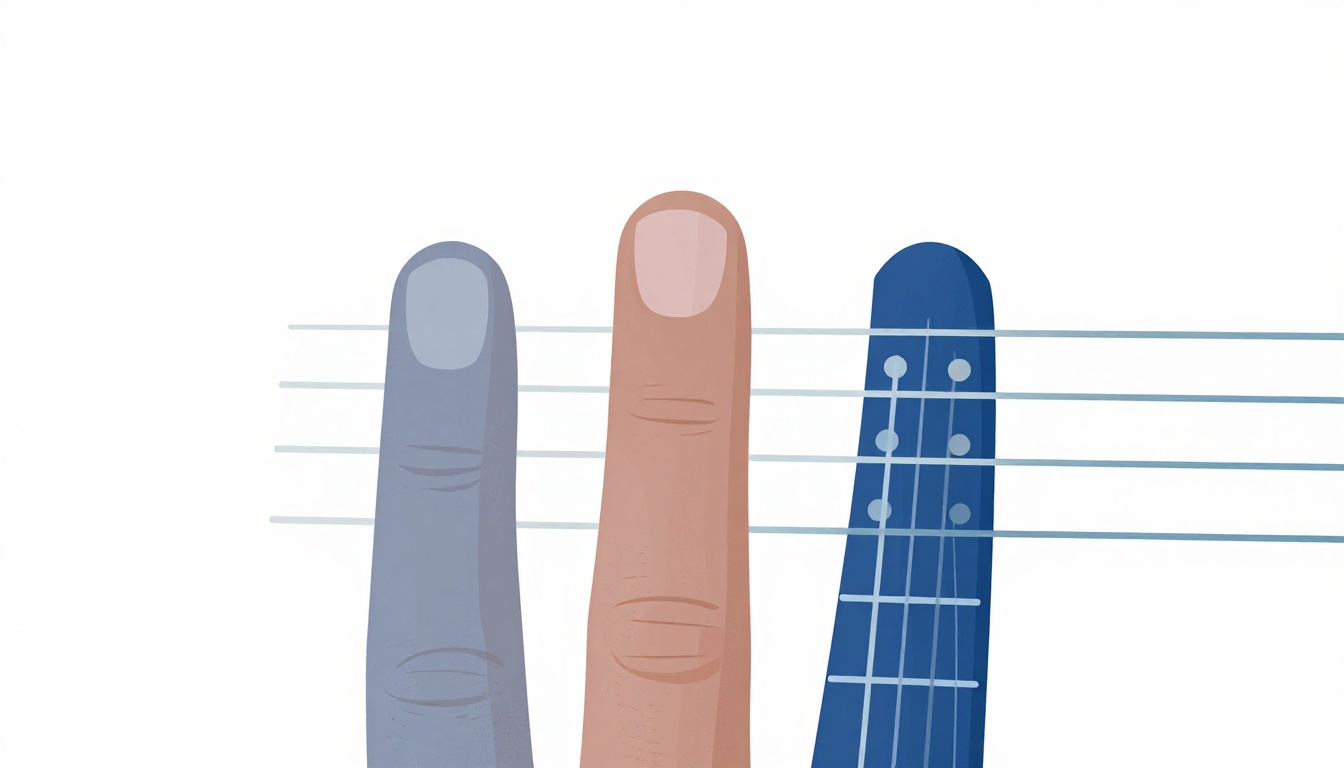
Fret with fingers 3, 1, and 4 (ring, index, pinky) so your index stays free to mute the low E string with its tip. Strum only the middle three strings, or better, pick them softly with your thumb and first two fingers so the low E and top two strings do not ring by accident.
Shell Voicings With the Root on the 6th String
The same idea works from the low E string, useful when the next chord in a song is more comfortably reached from a 6th string root. Here the root sits on the 6th string, the 3rd goes on the 4th string (D, skipping the A string entirely), and the 7th goes on the 3rd string (G).
| Chord | 6th string (root) | 5th string | 4th string (3rd) | 3rd string (7th) | 2nd string | 1st string |
|---|---|---|---|---|---|---|
| Cmaj7 | 8 (C) | Muted | 9 (E) | 9 (B) | Muted | Muted |
| C7 | 8 (C) | Muted | 8 (E) | 9 (Bb) | Muted | Muted |
| Cm7 | 8 (C) | Muted | 8 (Eb) | 8 (Bb) | Muted | Muted |
Notice the pattern again: the dominant 7 and major 7 share the same 3rd fret position, they only differ on the 3rd string, where the major 7 sits one fret higher than the dominant 7. The minor 7 keeps both notes at the same fret as the root. Once that pattern is under your fingers in one key, it transposes to every other key by sliding the whole shape up or down the neck. G major 7 sits at fret 3, F major 7 at fret 1, Bb major 7 at fret 6, all using the identical finger pattern.
Thumb position for 6th string root shapes
Because the 6th string root shell skips the 5th string entirely, jazz guitarists commonly bring the fretting hand's thumb up over the top of the neck to mute or even fret that low E root, freeing the first three fingers to handle the 3rd and 7th without your hand having to stretch across all six strings. This is a genuine, widely used technique in the style, not a shortcut, and it also naturally mutes the 5th string in the process, since the side of your thumb sits right where that string would otherwise ring.
If wrapping your thumb over the neck feels awkward at first, it is a hand position most players build gradually rather than something that clicks immediately. In the meantime, laying your index finger flat across the top of the neck to mute the 5th string, while your thumb stays behind the neck in the usual classical position, gets you the same clean result while that thumb strength develops.
The ii-V-I Progression: Jazz's Home Base
If you learn one progression from this page, make it this one. The ii-V-I shows up in some form in most jazz standards, usually more than once per tune, and it is the reason jazz guitarists can comp through a song they have never seen without reading every chord symbol. In the key of C major, it is Dm7 to G7 to Cmaj7, the ii chord, the V chord, and the I chord counted from the major scale.
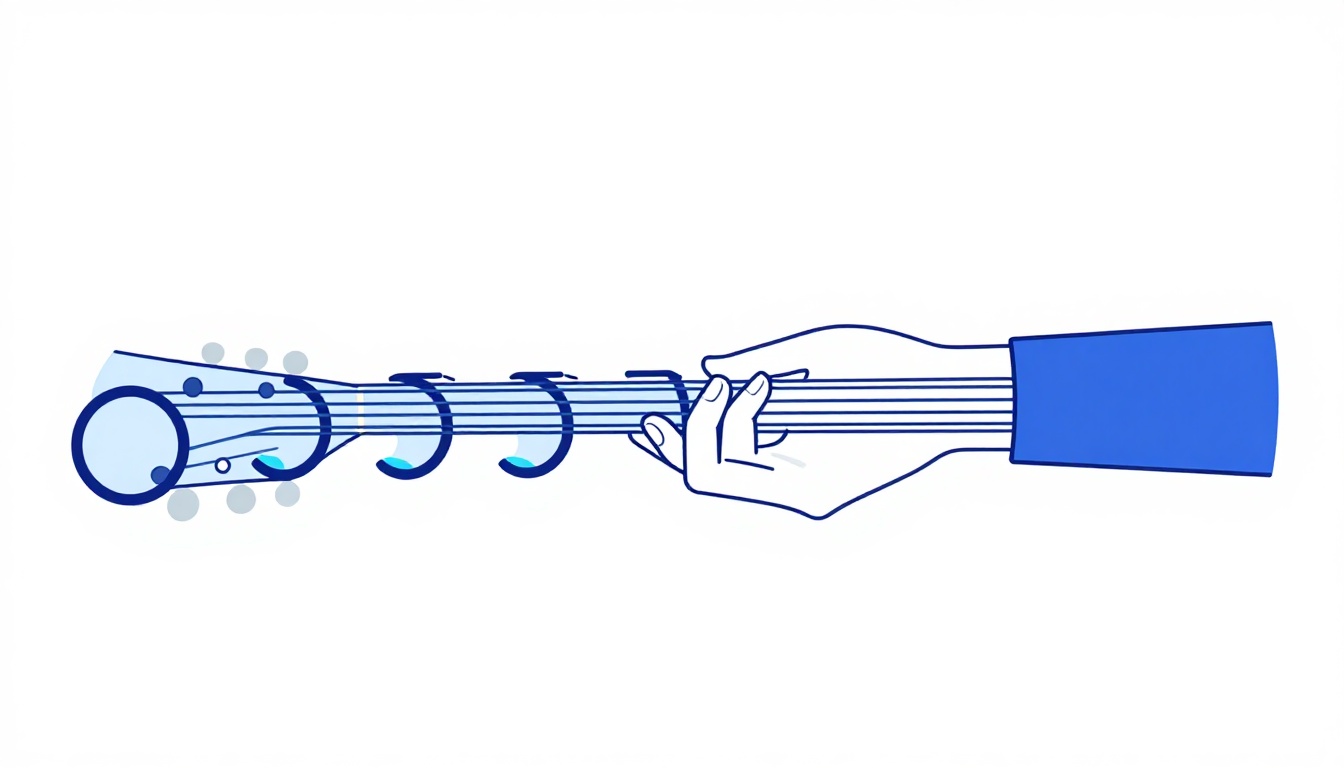
Play the three 5th string root shells from the table above back to back: Dm7, then G7, then Cmaj7. Watch your 4th string and 3rd string fingers specifically. Going from Dm7 to G7, the 4th string finger moves from fret 3 to fret 2, one fret down. Going from G7 to Cmaj7, the 3rd string finger moves from fret 3 to fret 4, one fret up. Nothing else moves more than a fret or two.
That small movement is called voice leading, and it is the actual sound of jazz comping. The guide tones swap roles from chord to chord: the 3rd of one chord becomes close to, or the same as, the 7th of the next. That is why these shapes were chosen over any other fingering that plays the same notes. A chord voicing that technically contains the right notes but forces your hand to jump across the neck will sound correct and feel wrong, because the movement itself is part of the sound.
Playing the ii-V-I in Other Keys
The whole point of a movable shape is that you never relearn the pattern, you just relearn where the root sits. Here is the same progression in two more common keys, using the identical 5th string root shell shapes from above.
| Key | ii (minor 7) | V (dominant 7) | I (major 7) |
|---|---|---|---|
| C major | Dm7 (5th fret, A string) | G7 (3rd fret, A string) | Cmaj7 (3rd fret, A string) |
| G major | Am7 (12th fret, A string, or open-position Am7 shape) | D7 (5th fret, A string) | Gmaj7 (10th fret, A string) |
| F major | Gm7 (3rd fret, A string) | C7 (3rd fret, A string) | Fmaj7 (1st fret, A string, thumb over the low string works well here) |
For F major, the whole progression sits in the first four frets, which makes it a good second key to practice once C feels comfortable. For G major, the ii chord (Am7) is low enough on the neck that most players use an open-position Am7 shape instead of sliding all the way to fret 12, then jump to the D7 and Gmaj7 shells higher up. Either is correct. Pick whichever keeps your hand closest to the next chord.
You can work out the ii-V-I for any key yourself without a table, once you know the major scale for that key. The ii chord is built on the scale's 2nd note, the V chord on the 5th note, and the I chord on the root, and only the ii and I chords are minor and major 7 respectively, the V chord is always dominant 7 regardless of key. If a chart tells you a song is in Bb major, count up the Bb major scale (Bb, C, D, Eb, F, G, A) to find the 2nd note (C) and the 5th note (F), which gives you Cm7, F7, Bbmaj7, the same three chord qualities in a new key, built from the shell formulas you already know.
Fuller Four-Note Voicings
Shells are the fast, safe starting point, but once the three-note shape feels automatic, adding the 5th back in in a different octave gives the chord more body without losing the compactness that makes it move quickly. A common four-note major 7 shape, still rooted on the 5th string, spreads the notes root, 5th, 7th, 3rd from low to high:
| Chord | 5th string (root) | 4th string (5th) | 3rd string (7th) | 2nd string (3rd) |
|---|---|---|---|---|
| Cmaj7 | 3 | 5 | 4 | 5 |
| Gmaj7 | 10 | 12 | 11 | 12 |
| Fmaj7 | 8 | 10 | 9 | 10 |
Finger it with 1 on the root, 3 on the 4th string, 2 on the 3rd string, and 4 on the 2nd string. It is a bigger stretch than the shell, so build up to it once your hand has some mileage with the smaller shapes. The extra 5th does not change the chord's identity, it just fills out the sound, which is why it is worth learning as an upgrade rather than a replacement.
The same root-5th-7th-3rd stacking works for dominant 7 and minor 7 chords too, you just adjust the 3rd and 7th the same way you did for the shells. The 5th itself never moves, since a perfect 5th is a perfect 5th regardless of chord quality.
| Chord | 5th string (root) | 4th string (5th) | 3rd string (7th) | 2nd string (3rd) |
|---|---|---|---|---|
| Cmaj7 | 3 | 5 | 4 | 5 |
| C7 | 3 | 5 | 3 | 5 |
| Cm7 | 3 | 5 | 3 | 4 |
Compare C7 to Cmaj7 and only the 3rd string moves, down a fret. Compare Cm7 to C7 and only the 2nd string moves, down a fret. The dominant 7 fuller voicing in particular is a real stretch, your ring finger and pinky both land on the 5th fret while your index and middle sit two frets back, so treat it as a shape to work up to rather than one to force on day one.
Minor 7 Flat 5 and the Minor ii-V-i
Minor keys use their own version of the ii-V-i, and the ii chord changes quality: instead of a plain minor 7, it becomes a minor 7 flat 5 (written m7b5, or sometimes with the half-diminished symbol). It is a minor 7 chord with the 5th lowered a half step, which darkens it and points the progression toward a minor resolution instead of a major one. In C minor, that progression is Dm7b5 to G7 (often altered) to Cm.
The shell voicing rules from earlier do not fully separate a minor 7 from a minor 7 flat 5, because the shell leaves the 5th out entirely, so both chords share the same three shell notes. The 5th only shows up once you play a fuller voicing, which is a good reason to treat the m7b5 as a chord to come back to once you are comfortable stretching to four note shapes rather than something to force into your first week of practice.
The name "half-diminished" is a direct comparison to the fully diminished 7 chord covered next: a half-diminished chord lowers only the 5th, while a fully diminished chord lowers both the 5th and the 7th. Hearing them side by side, played back to back on the same root, makes the half-step difference between the two much easier to recognize by ear than reading the definitions alone.
Diminished 7 Chords as Passing Chords
A fully diminished 7 chord is built entirely from stacked minor thirds, root, minor 3rd, diminished 5th, and diminished 7th, spaced evenly across the octave. That even spacing is what makes diminished 7 chords unusual: because every note in the chord is the same distance from the next, the exact same physical shape on the guitar produces four different diminished 7 chords depending on which of its four notes you treat as the root. Slide a diminished 7 shape up three frets and you are playing the same chord again, just renamed from a different starting note.
In practice, you will meet diminished 7 chords as passing chords, a single beat of harmony connecting two chords that are a whole step apart, smoothing the move rather than sitting as a destination in its own right. A common spot is between the I chord and the ii chord, for example Cmaj7 to C#dim7 to Dm7, where the diminished chord fills the half-step gap and keeps the bass line moving in a straight line instead of jumping. You will see it written as dim7, °7, or occasionally just a small circle next to the chord letter on a chart.
Reading Jazz Chord Symbols on a Chart
Jazz lead sheets abbreviate chord names more aggressively than pop chord charts, and different books and songwriters are not fully consistent with each other, so it helps to recognize the common variants before you are reading one under tempo.
| What you see | What it means | Same as |
|---|---|---|
| Cm7, C-7, Cmin7 | C minor 7 | All three notations are identical |
| CΔ7, Cmaj7, CM7 | C major 7 | All three notations are identical |
| Cø, Cm7b5, Cmin7(b5) | C minor 7 flat 5 (half-diminished) | All three notations are identical |
| C°7, Cdim7 | C diminished 7 | Both notations are identical |
| C7alt | C dominant 7 with altered upper extensions (commonly b9, #9, or #11) | Exact alterations vary by player and are sometimes spelled out instead |
| C7sus4, C7sus | C dominant 7 with the 3rd replaced by the 4th | Both notations are identical |
The triangle symbol for major 7 and the slashed-o for half-diminished trip up more beginners than any fret shape on this page, simply because they look unfamiliar the first few times. Once you can read them as fast as you read "m7" or "7," a chart stops being a decoding exercise and starts being something you can actually comp from in real time.
Extended Chords: 9ths, 11ths, and 13ths in Plain English
Once you go past the 7th, chords are named for how far up the scale they stack: a 9th chord adds one more third on top of the 7th (the 9th is the same letter name as the 2nd, just an octave up), an 11th adds another (same letter name as the 4th), and a 13th adds one more again (same letter name as the 6th). On a six string guitar you physically cannot play all seven notes of a 13th chord at once, so jazz guitarists routinely drop the root or the 5th, since those are the notes the rest of the band is usually already covering.
The 9th chord is the easiest upgrade
Of the three extensions, the 9th is the one worth learning first, because it is a single-finger addition to a shape you already know. Add the 9th on the 2nd string (B), at the same fret as your root note on the 5th string, to any of the minor 7 or dominant 7 shells from earlier:
| Chord | 5th string (root) | 4th string | 3rd string | 2nd string (9th) |
|---|---|---|---|---|
| Dm9 | 5 | 3 | 5 | 5 |
| D9 | 5 | 4 | 5 | 5 |
| Cmaj9 | 3 | 2 | 4 | 3 |
Notice the 9th always sits on the same fret as the root, regardless of whether the chord is minor, dominant, or major. That is because the 9th's distance from the root does not change with chord quality, only the 3rd and 7th do. Once that single relationship is memorized, you can drop a 9th onto almost any shell shape from this page without learning a separate chord family.
11ths and 13ths are usually a bass or piano job
An 11th chord's most identifying note, the 11th itself, actually clashes with the major 3rd in most major and dominant chords, so guitarists typically only reach for a genuine 11th on minor chords, where that clash does not happen. A 13th chord, meanwhile, is really a dominant 7 or 9 chord with the 13th (a major 6th) swapped in for, or added above, the 5th. Given the string count problem, most guitar "13th" voicings actually contain the root, 3rd, b7th, and 13th, four notes, not the full seven-note stack the name implies.
You do not need to memorize a wall of extended chord shapes to sound like you are playing jazz. A shell voicing plus the right rhythm gets you further than a 13th chord played at the wrong time. Treat 11ths and 13ths as a later stage: once Dm7, G7, Cmaj7, and the 9th upgrade above move cleanly under your hand, adding one more extended chord into a progression you already know is a much smaller jump than trying to learn extensions and movement at the same time.
Rootless voicings, for when someone else has the root covered
Once you are playing with a bassist, or a pianist who is also comping, your root note is often redundant, someone else in the group is already playing it. Rootless voicings drop the root entirely and voice the chord from the 3rd, 7th, and any extensions on the top four strings. This is not a simplification for beginners, it is standard practice among working jazz guitarists, because a rootless voicing frees up your hand to reach extensions like the 9th or 13th that would otherwise require a five or six finger stretch. If you already have the shell and 9th shapes above under your fingers, you have effectively been practicing the guide-tone core of a rootless voicing the entire time, you are just adding the root back in for solo playing.
Why Your Jazz Chords Sound Muddy or Wrong
This is the part most chord charts skip, and it is usually the actual reason a shape that looks right on paper sounds wrong coming out of the amp.
You are letting the wrong strings ring
Shell voicings are built around exactly three or four strings ringing and the rest staying silent. If your fretting hand's index finger is not lightly touching the low E string to deaden it, or your strumming hand catches a string you meant to skip, the chord picks up an extra note that clashes with the 3rd or 7th you worked to place correctly. Rest the side of your index finger flat against any string below your lowest fretted note.
You are using a full open chord instead of a shell
A full, ringing Cmaj7 open chord is not wrong, but it is not what makes a progression sound like jazz. If you play the open-position version of every chord in a ii-V-I, the sound reads as "chord chart," not "comping." Swap in the shell shapes from the tables above and the same progression starts to sound like the genre it belongs to.
You are pressing harder than the shape needs
Shell and shell-plus-5th voicings use two, three, or four fingers, not a full barre, so they do not need barre-chord pressure. Pressing too hard tires your hand fast and makes fast chord changes harder, not easier. Use just enough pressure to stop the buzz and no more.
You are strumming the whole shape like a folk chord
Jazz comping rhythm is short and clipped far more often than it is a full sustained strum. Letting a shell chord ring for a full four beats when the band around you has moved on is one of the fastest ways to sound out of place even when every note is correct. More on the rhythm side of this below.
You built the shape from the wrong string
Because these shapes are movable, it is easy to count frets correctly but start from the wrong physical string, especially switching between the 5th string root and 6th string root families in the same session. Before you strum, say the root note out loud. If you cannot name it, you have not confirmed which string family you are on.
You changed every finger at once instead of walking the guide tones
Look back at the ii-V-I voice-leading breakdown: most of the progression's motion is one finger sliding one fret, not your whole hand relocating. If you find yourself lifting every finger and re-placing the entire shape for each new chord, you are throwing away the exact voice leading that makes these shapes sound connected. Practice the changes watching only the fingers that actually need to move, and keep the ones that do not move planted.
You are picking with a hard pick attack meant for strumming
A flatpick angled and struck the way you would strum an open chord tends to bring out every string evenly, including the muted ones, since a firm strike can make even a lightly touched string buzz audibly instead of staying silent. Many jazz guitarists play these voicings fingerstyle, or with a lighter pick attack, specifically because it gives more control over which strings actually sound. If muting is fighting you no matter how carefully you place your fretting hand, try picking softer before you assume the shape itself is the problem.
Comping: How Jazz Guitarists Actually Strum
Comping is short for accompanying, and it is closer to a drummer keeping time than a singer holding a chord. Instead of one long strum per chord, most jazz comping uses short, muted hits on beats 2 and 4, or a mix of quarter notes and syncopated stabs that leave space for the bassist and soloist. The chord shape barely changes; what changes is how long you let it ring.
A simple starting pattern: strum the shell chord and immediately relax your fretting hand pressure just enough to mute the strings, so the chord sounds as a short "chunk" rather than a sustained ring. Do this on beats 2 and 4 of a bar in 4/4 time and rest on beats 1 and 3. It sounds sparse at first. That sparseness is the point, it is what leaves room for whoever is soloing.
Solo Guitar Versus Comping in a Band
How much chord you play depends entirely on who else is playing with you, and mixing up the two contexts is a common reason a shape that sounded right in practice feels thin or cluttered on stage.
Comping behind a bassist and a soloist calls for less, not more. The bass already covers the root, so a shell voicing or even a rootless two-note guide-tone shape gives you exactly what the moment needs without covering up space the soloist could use. Adding the fuller four-note voicing or an extra extension here often crowds the mix rather than improving it, especially if the pianist in the group is also comping.
Playing solo, with no bassist and no other harmony instrument, flips the priority. Now your chord has to imply the whole progression by itself, root included, so the fuller four-note voicings from earlier, or the shell plus an added bass note played with your thumb, become the more useful default. A shell alone can sound thin in a solo context simply because there is nothing else filling in the low end.
Neither approach is more "correct." The skill is recognizing which situation you are in and reaching for the right amount of chord, the same shell shape that sounds perfect behind a bass player can sound underdeveloped the moment you are playing completely alone.
Moving Between Shapes Without Stopping
The shape itself is never the hard part once you have it memorized. The hard part is changing chords without a gap, especially under tempo. Practice the ii-V-I in C on its own, slowly, watching only the two fingers that move (the 4th string finger and the 3rd string finger from the earlier voice-leading breakdown), and keep the other fingers anchored where they already are.
A useful drill: play Dm7 for four slow beats, G7 for four beats, Cmaj7 for four beats, then hold Cmaj7 and start over. Once that is smooth, cut each chord down to two beats, then one. The moment you feel your hand rushing or your fingers all lifting at once instead of moving together, slow back down. Speed comes from economy of motion, not from trying to move faster with the same wasted movement.
Landing the Change Slightly Ahead of the Beat
Once the shapes and the comping rhythm are separately solid, the next thing that separates a chord change that sounds locked in from one that sounds late is timing the change itself. Many working jazz guitarists shift to the new chord shape a fraction early, right on the last sliver of the previous beat, so the new chord is already fully formed and ready to ring exactly on the downbeat, rather than being fretted at the same instant it needs to sound.
You can hear the difference by comparing the two directly. Play the Dm7 to G7 change landing your fingers exactly on the beat, then try it again shifting your hand into the G7 shape a sixteenth note early, right on what is sometimes called the "and" before the beat. The second version locks in tighter with a metronome click, because your ear hears the attack of the new chord land precisely on time instead of slightly smeared by the last moment of finger movement.
This is a fine detail, and it is worth leaving until after the shapes themselves are automatic. Trying to anticipate the beat while you are still thinking about which fret each finger goes on will only pull your timing apart in the opposite direction.
Small-Hand and Simplified Versions for Beginners
If the 5th string root shell still feels like a stretch, drop to a true two-note version using only the guide tones, no root at all. Play just the 4th and 3rd string notes from the shell tables above, muting everything else, including the 5th string. This works especially well once a bassist or another instrument is covering the root, and it is genuinely how working jazz guitarists voice chords in a full band, not just a beginner shortcut.
For solo practice where you want the root audible, an easier alternative to the m7 shell is to fret only the root and the 7th, skipping the 3rd, using two fingers instead of three. It is less harmonically complete, but it still identifies the chord clearly enough to practice the ii-V-I motion while your hand builds the strength and independence for the full three-note version.
Adjusting for a wider or narrower neck
Everything on this page assumes a standard steel-string electric or acoustic neck. A classical or flamenco guitar's wider neck and closer fret spacing changes how these shapes feel, string spacing especially, since the strings sit further apart, which can make a three-fret shell shape a genuine reach for a hand that finds it comfortable on a narrower electric neck. If that describes your instrument, the two-note guide-tone version above is a practical permanent option, not just a stepping stone, since a two-finger shape on a wide neck is often more comfortable than forcing a three-finger shell to fit.
The opposite problem shows up on some electric necks that are unusually narrow or have a flatter fretboard radius, where strings sit close enough together that an adjacent unfretted string can brush your fretting finger and mute or buzz by accident. If that is happening, arch your fingers slightly more than usual so only the very tip contacts the string, rather than letting the pad of the finger rest against the neighboring string.
The I-vi-ii-V Turnaround
If the ii-V-I is jazz's most common way of arriving somewhere, the turnaround is its most common way of getting back to the start. A turnaround adds one more chord before the ii-V-I, the vi chord, and typically sits in the last bar or two of a song's form, cycling the harmony back around to the top so the band can go through the progression again for another chorus or another soloist.
In the key of C, that is Cmaj7 to Am7 to Dm7 to G7, using the I chord, then the vi chord, then the familiar ii and V you already know:
| Chord | 6th string | 5th string | 4th string | 3rd string | 2nd string | 1st string |
|---|---|---|---|---|---|---|
| Cmaj7 | Muted | 3 (C) | 2 (E) | 4 (B) | Muted | Muted |
| Am7 | 5 (A) | Muted | 5 (C) | 5 (G) | Muted | Muted |
| Dm7 | Muted | 5 (D) | 3 (F) | 5 (C) | Muted | Muted |
| G7 | Muted | 3 (G) | 2 (B) | 3 (F) | Muted | Muted |
Am7 switches to a 6th string root here, which at first feels like it breaks the pattern, but it is actually the smoothest option available: the Am7 shell shares its root fret with Dm7's, so your hand barely travels before the next change. Practice this loop on its own, four chords, four beats each, until it feels like one continuous shape drifting down the neck rather than four separate decisions.
Which Chord to Learn First and Why
Start with Dm7. Its shell shape stays within a two-fret span (frets 3 to 5 on the 5th, 4th, and 3rd strings), which is the tightest, easiest stretch of the three ii-V-I chords. Once Dm7 is solid, move to G7, which only changes one note from Dm7, the 4th string finger sliding down a single fret. Cmaj7 comes last because its shell reaches the furthest fret of the three, one fret past G7 on the 3rd string. If you already know the open Dm7 shape or the Cmaj7 chord covered elsewhere on this site, that finger memory carries over directly into these movable versions.
Learning them in that order, rather than alphabetically or by how often each chord type appears in songs, means every new shape you add only asks your hand to change one thing at a time, which is the same voice-leading logic that makes the progression sound good in the first place.
Warming Up Before You Play These Shapes
Shell and fuller jazz voicings ask your fretting hand fingers to work independently of each other more than an open chord does, since each finger usually lands on a different string and a different fret rather than several fingers lining up along one fret the way a barre chord does. A short warm-up before you start the routine below reduces the fumbling that otherwise eats into your first few minutes of practice.
Spend a minute walking your 1st, 2nd, 3rd, and 4th fingers one at a time up a single string, one fret per finger, then back down, on a clean part of the neck like frets 5 through 8. Follow it with a minute of silently pressing and releasing the Dm7 shell shape, focused purely on finger independence rather than sound. Neither drill needs to be loud or fast, the goal is only to get your fingers moving as four separate, cooperating parts before you ask them to do it in time.
A Practice Routine for Jazz Chords
Fifteen minutes is enough per session if it is focused. Here is how to spend that time across a first month with these shapes.
Week 1: the core three shells
- Minutes 1-4: Play the Dm7, G7, Cmaj7 shell voicings slowly, four beats each, checking that only the intended strings ring.
- Minutes 5-8: Play the same three chords in comping rhythm, short hits on beats 2 and 4, at a slow, steady tempo (60-70 beats per minute on a metronome or phone app is plenty to start).
- Minutes 9-12: Repeat the same three chords, this time saying the root note of each chord out loud right before you play it, to build the habit of knowing where your hand is before it moves.
- Minutes 13-15: Free comping over a slow drum or bass backing track if you have one, looping the ii-V-I in C without stopping to look at your hand.
Week 2: a second key and the turnaround
Add F major's ii-V-I (Gm7, C7, Fmaj7) alongside the key of C, alternating between the two every few loops so your hand practices recognizing a fresh root rather than relying on muscle memory built around one key. In the second half of the week, add the I-vi-ii-V turnaround in C, focusing on the transition into Am7, since that is the one shape in the loop your hand has not seen yet.
Week 3: comping speed and the fuller voicings
Bring the tempo up gradually, in five beats-per-minute steps, only increasing once the previous tempo feels genuinely relaxed rather than merely possible. Introduce the fuller four-note Cmaj7, C7, and Cm7 voicings on their own, away from tempo pressure, so your hand learns the extra stretch without also trying to keep time.
Week 4: putting it into a song
Apply the shell shapes to a song you already know that uses seventh chords, "Fly Me to the Moon" if you have a chart for it, or any tune with a ii-V-I somewhere in its progression. This is where the whole page stops being an exercise and starts being something you actually play.
The goal across all four weeks is clean, quiet chord changes at a tempo that feels unhurried, not the fastest possible run-through of every shape on this page. Speed without clean voice leading is not the skill this progression is teaching.
Training Your Ear to Hear the ii-V-I
Once your hand knows the shapes, the faster path to actually using them in real playing is training your ear to recognize the progression before you see it written down. The ii-V-I has a distinct emotional shape, the ii chord feels like it is waiting, the V chord feels like tension building, and the I chord feels like arrival, and that shape repeats constantly across jazz standards and plenty of pop and soul songs as well.
A simple way to build this: play the Dm7-G7-Cmaj7 loop on your own guitar a few times until the sound is fixed in your ear, then listen to a recording of any jazz standard and try to catch the moment the harmony does the same "waiting, tension, arrival" motion, even without knowing the song's actual chords. You will not identify every instance at first, and you do not need to, the goal is recognizing the shape of the movement, not transcribing the whole tune.
This matters more than it might seem, because a chart is not always available or accurate, and being able to hear "that was a ii-V-I" means you can often find your way through a progression by ear well before you could read it off a page.
Songs and Standards That Use These Chords
You do not need a jazz-specific songbook to put this progression to use. "Fly Me to the Moon" is one of the most commonly recommended tunes for a first pass at jazz chords, largely because its verse is built from a chain of ii-V-I movements that cycle through several keys using the exact shapes covered above. If you already play from a lead sheet or chord chart for that song, try swapping your usual open chords for the shell voicings here and listen to the difference in how the progression sits.
The ii-V-I and I-vi-ii-V turnaround are not exclusive to jazz standards either. Plenty of pop, soul, and singer-songwriter material borrows the same movement, usually with plain triads rather than sevenths, so once your ear catches the shape in a jazz context you will likely start noticing it in songs that never seemed like "jazz songs" to begin with. That crossover is part of why practicing these shapes pays off even if jazz itself is not the main style you play.
Once the shapes and the comping rhythm both feel natural on a song you know, moving to a tune you have never played becomes a matter of reading the chord symbols and recognizing the ii-V-I pattern wherever it appears, which in most jazz standards is often.
FAQ
Do I need a hollow body or archtop guitar to play jazz chords? No. Every shape on this page works on a steel-string acoustic or a solid body electric. An archtop's tone suits the genre, but the chord shapes themselves do not care what guitar they are played on.
Why do jazz chords sound wrong when I strum all six strings? Because shell and shell-plus-5th voicings are built to leave certain strings silent on purpose. Ringing the low E or high E on top of a carefully placed 3rd and 7th adds a note that was deliberately left out, which is usually what makes the chord sound cluttered rather than clean.
Is a shell voicing a "real" jazz chord or just a simplified one? It is real. Professional jazz guitarists use shell and rootless voicings constantly, especially in a band with a bassist, because the root is already covered by another instrument. It is not a beginner shortcut you graduate out of, it is a standard tool.
How long does it take to get comfortable with the ii-V-I? Most players get the three shapes moving cleanly within a week of short daily practice, and comfortable comping in time within three to four weeks. The shapes are simple; the timing and voice leading are what take repetition.
Do I need to know music theory to use these chords? You need to know what root, 3rd, and 7th mean, which this page covers, but you do not need to read notation or understand modes to start comping through a ii-V-I today.
What is the difference between a dominant 7 and a major 7 chord? One fret, on the string carrying the 7th. A dominant 7 (like G7) has a flatted 7th and wants to resolve to another chord. A major 7 (like Cmaj7) has the natural 7th and sounds settled, like a resting point.
Can I use these shapes for blues or funk, not just jazz? Yes. Shell voicings for dominant 7 chords in particular show up constantly in blues and funk rhythm playing, since blues progressions are built almost entirely from dominant 7 chords like the C7 shape covered elsewhere on this site.
Why does my hand cramp when I try to hold these shapes? Most often it is excess pressure, pressing with barre-chord force on a shape that only needs enough force to stop the buzz. Check that your thumb is not squeezing the back of the neck, and that your fretting fingers arch rather than collapse flat against the strings.
GuitarLowKey
Ready for fifteen focused minutes?
Open the web app and train the change that is blocking your song.