
The Saddest, Most Depressing Guitar Chords You Can Play
The exact minor, half-diminished and ninth chord shapes that sound saddest on guitar, plus the progressions that turn a sad chord into a sad song.

D minor, A minor and B half-diminished (Bm7b5) are the chords guitarists reach for first when they want something to sound genuinely sad, and the progression most often cited as the saddest of all is the Andalusian cadence, Am to G to F to E. None of that is a matter of taste dressed up as fact. It comes down to the minor third replacing the major third in the chord, and to what a progression does with your ear's expectation of where the next chord should go.
This post gives you the actual shapes, fret by fret, for every chord in that list, the progressions built from them, and the reasons each one lands the way it does. It also covers the part most lists like this skip: how to move between these chords without the sadness collapsing into a shrug, and what to do when your version of a "sad" chord sounds thin instead of heavy.
What Actually Makes a Chord Sound Sad
Every major chord is built from a root, a major third, and a perfect fifth. Change that middle note down by a half step and you get a minor third instead, and the chord becomes minor. That one-note swap is the single biggest reason a chord reads as sad rather than bright. The major third sits close enough to the root that the ear hears the two notes blending into something settled. The minor third sits a half step further from that blend, and Western listeners, through a mix of acoustics and decades of cultural association in film and pop music, hear that gap as darker, more unresolved, less at ease.
Sadness in a chord is not only about that one interval, though. A few other things stack on top of it.
Extensions add ache without adding brightness. A plain minor triad is dark. Add the minor seventh (making it a minor 7th chord) and it gets more reflective. Add the ninth on top of that and you get a chord that most guitarists and producers single out as the saddest-sounding shape in common use, because the ninth creates a dissonant, unresolved color that never quite closes the sentence.
Lowered fifths deepen the darkness further. Flatten the fifth of a minor seventh chord and you get a half-diminished chord (written m7b5 or with the degree symbol), which sits even further from stability than a plain minor chord. It is the chord most often used as the "darkest in the room" moment inside a progression, not the chord you build a whole song from.
Suspended chords remove the third entirely, replacing it with the second or fourth. That takes away the major/minor distinction altogether and leaves something that sounds unresolved and floating rather than sad in a heavy way. Suspended chords work best as a doorway into or out of a sad chord, not as the sad chord itself.
Register and tempo do real work too. A minor chord voiced low, played slowly, and arpeggiated instead of strummed will sound sadder than the same chord strummed fast and high on the neck. The chord supplies the raw material. How you play it decides how much of that sadness the listener actually feels.
There is a real debate among music researchers about how much of this is acoustic and how much is learned. Acoustically, a minor third sits at a slightly more complex, less consonant frequency ratio to the root than a major third does, which gives it a small amount of built-in roughness. Culturally, decades of film scores, hymns and pop songs have paired minor chords with sad or tense scenes so consistently that listeners in Western musical traditions now hear that pairing as automatic, almost as if it were a law of physics rather than a convention. Both are probably true at once. The acoustic difference gives minor chords a head start toward sounding unsettled, and the cultural association does the rest of the work, which is also why the same chords can carry a different emotional weight in musical traditions that were not built around the major and minor system in the first place.
The Saddest Individual Chords, Ranked
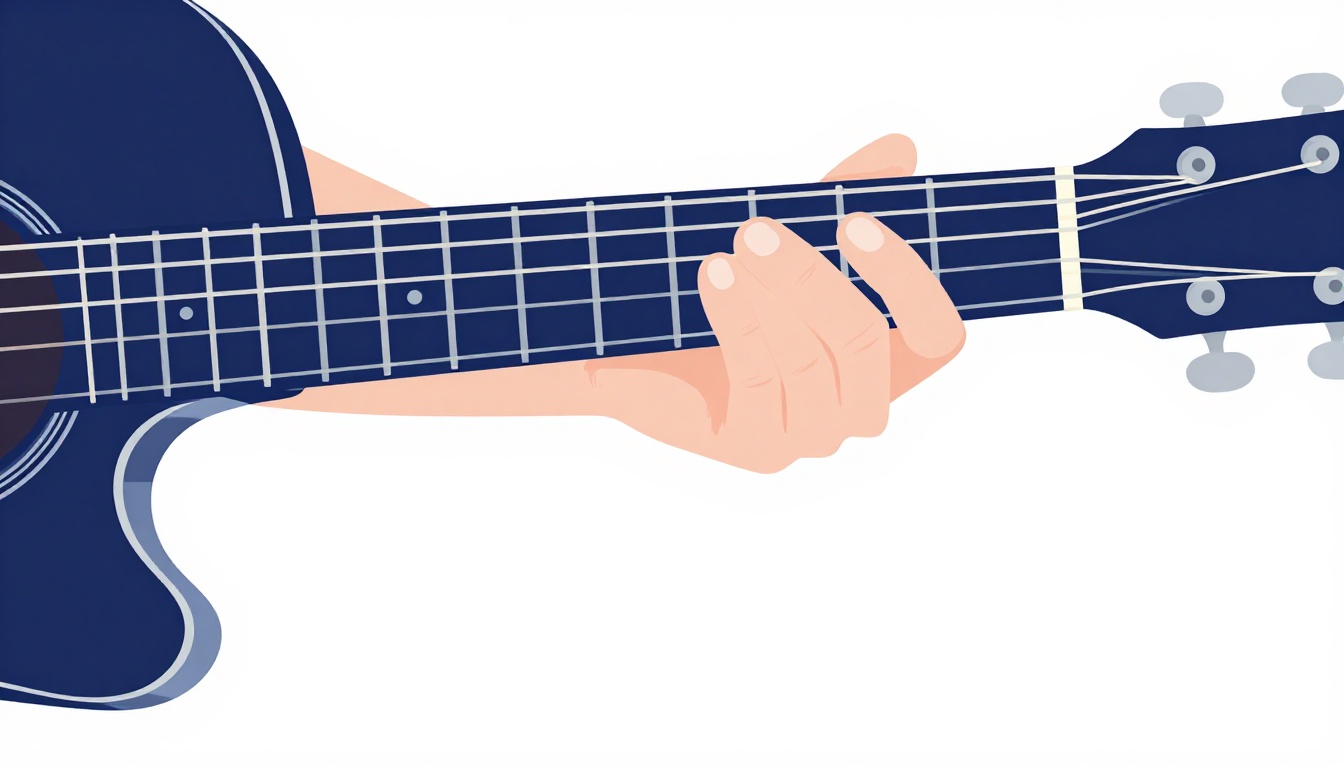
There is no scientific ranking of sadness, and any list like this depends on genre, tempo and voicing. But across guitar teachers, music theory writers and the forum threads guitarists have been arguing this out in for years, the same handful of chords keep coming up as the saddest on their own, independent of any progression around them.
| Chord | Notes (relative to root) | Why it reads as sad |
|---|---|---|
| Minor triad (e.g. Am) | 1, b3, 5 | The baseline. Minor third instead of major third. |
| Minor 7th (e.g. Am7) | 1, b3, 5, b7 | Adds reflection and openness on top of the minor color. |
| Minor 9th (e.g. Am9) | 1, b3, 5, b7, 9 | Widely cited as the single saddest common chord shape. |
| Half-diminished (m7b5, e.g. Bm7b5) | 1, b3, b5, b7 | The lowered fifth makes it darker and less stable than a plain minor chord. |
| Minor add9 (e.g. Am(add9)) | 1, b3, 5, 9 | Same ache as a minor 9th without the extra seventh, slightly lighter. |
| Sus4 over a minor context | 1, 4, 5 | No third at all, so it hovers rather than settles. Sad by suggestion, not by definition. |
Two things worth noting before you build a song around this table. First, the minor 9th tops most of these lists not because it is "more minor" than a plain triad, but because the ninth interval is dissonant enough to keep your ear waiting for a resolution that never fully arrives. Second, context matters more than any single chord. A half-diminished chord sitting inside a jazz standard reads as sophisticated melancholy. The same chord dropped into a simple strummed folk song can sound like a mistake. The progressions later in this post are where these chords actually earn their reputation.
Minor Chord Shapes You Need First
Before anything more elaborate, you need the three open minor chords fluently under your fingers, because every progression below is built from them.
A minor (Am)
| String | Fret | Finger |
|---|---|---|
| 6 (low E) | Muted | - |
| 5 (A) | Open | - |
| 4 (D) | 2 | 2 |
| 3 (G) | 2 | 3 |
| 2 (B) | 1 | 1 |
| 1 (high E) | Open | - |
D minor (Dm)
| String | Fret | Finger |
|---|---|---|
| 6 (low E) | Muted | - |
| 5 (A) | Muted | - |
| 4 (D) | Open | - |
| 3 (G) | 2 | 2 |
| 2 (B) | 3 | 3 |
| 1 (high E) | 1 | 1 |
E minor (Em)
| String | Fret | Finger |
|---|---|---|
| 6 (low E) | Open | - |
| 5 (A) | 2 | 2 |
| 4 (D) | 2 | 3 |
| 3 (G) | Open | - |
| 2 (B) | Open | - |
| 1 (high E) | Open | - |
Em is the easiest of the three because only two fingers move. Am and Dm both take three fingers and a bit more stretch, particularly Dm, where your ring finger has to reach the 3rd fret on the B string while your other two fingers stay close together one fret apart. If Dm buzzes, it is almost always that ring finger not pressing hard enough, not a problem with the shape itself.
The Andalusian Cadence: Am, G, F, E
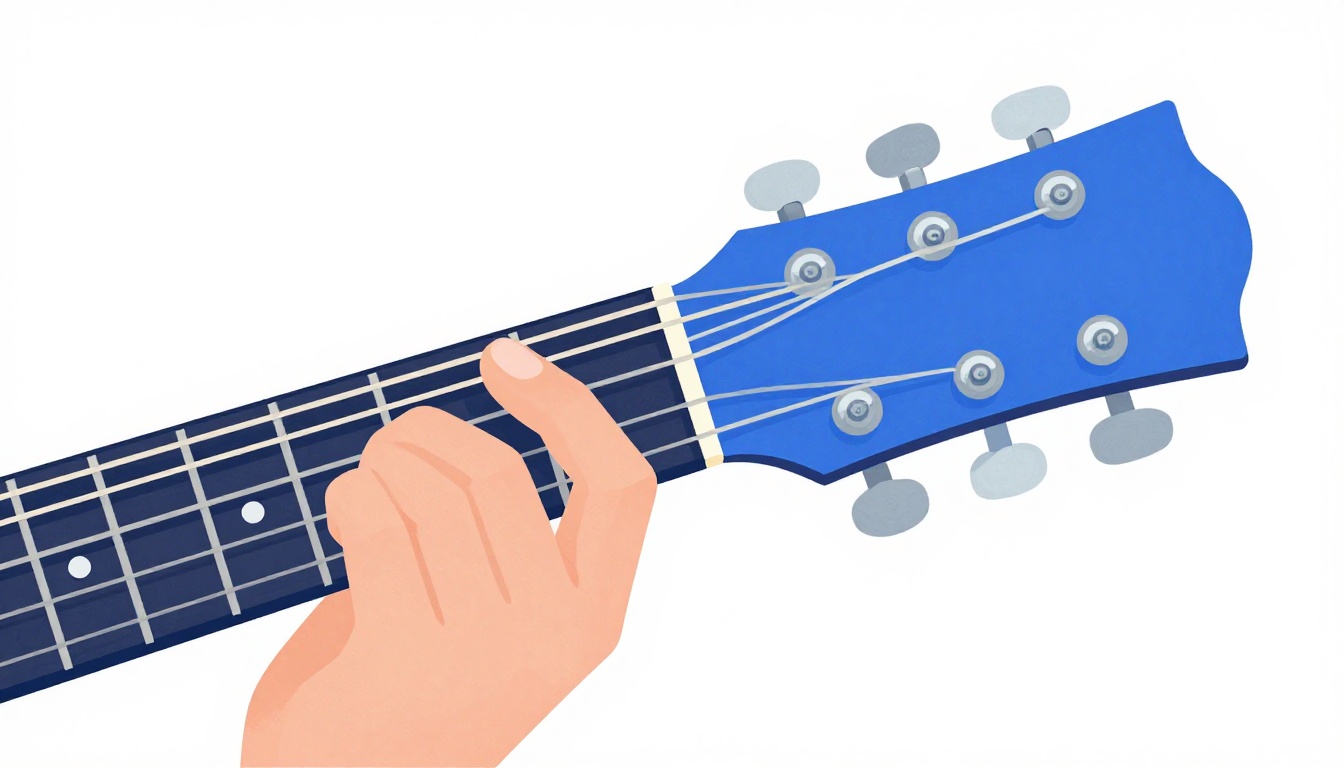
If one progression owns the reputation for "saddest chords in guitar music," it is this one: Am, G, F, E, or in roman numerals in the key of A minor, i, VII, VI, V. It descends step by step through the natural minor scale, from Am down through G and F and lands on E, and that stepwise descent is a large part of why it feels inevitable rather than random, like something falling rather than something chosen.
| Chord | Shape (low E to high E) |
|---|---|
| Am | x-0-2-2-1-0 |
| G | 3-2-0-0-0-3 |
| F | 1-3-3-2-1-1 (barre) or x-x-3-2-1-1 (easy) |
| E | 0-2-2-1-0-0 |
You can play F as a full barre chord across all six strings, or use the simplified version that only strums the top four strings, which is far easier for a beginner and still carries the harmony you need since the root and third are both present in the top four strings.
The reason this specific sequence gets singled out over other minor progressions is the ending. E is the dominant chord of A minor, meaning it wants to resolve back to Am, and a slow, repeated loop of Am, G, F, E creates a cycle that never quite lets you rest, because just as your ear expects the return to Am, the progression can either deliver it and start the fall again, or hang on the E and let the tension sit. Both choices sound sad in different ways: the loop feels trapped, the held E feels grieving.
This progression, or close variants of it, shows up across a wide range of well-known songs, most famously the descending intro pattern of Led Zeppelin's "Stairway to Heaven" and the verse of Ray Charles's "Hit the Road Jack," which strips the same descending idea down to its simplest possible form.
The Sad Pop Progression: Am, F, C, G
If the Andalusian cadence is the classical, folk-adjacent sad progression, Am, F, C, G (vi, IV, I, V in the key of C major) is its modern pop equivalent. It is the same chord family as the extremely common I, V, vi, IV pop progression, just started on the minor chord instead of the major one, and that single change in starting point moves the emotional center of the whole loop from bright to wistful.
| Chord | Shape (low E to high E) |
|---|---|
| Am | x-0-2-2-1-0 |
| F | x-x-3-2-1-1 (easy) or 1-3-3-2-1-1 (barre) |
| C | x-3-2-0-1-0 |
| G | 3-2-0-0-0-3 |
Every chord in this loop uses shapes most beginners already have, which is exactly why it is so widely used in slower ballads: the emotional weight comes from the sequence and the tempo, not from any individual chord being unusual. Play it fast and it can sound anthemic. Play it slow, fingerpicked, with space between the chord changes, and it sounds like grief. This exact rotation, or a very close variant of it, is commonly pointed to behind ballads such as Adele's "Someone Like You" and Linkin Park's "Numb," where a minor first chord over an otherwise major-key set of chords creates that same "floats between sadness and hope" quality.
Fingerpicking is worth practicing specifically for this progression. Instead of strumming all six (or five, or four) strings at once, pick the bass note first, then roll through the remaining strings one at a time. It slows the harmony down and lets each note of the chord ring out separately, which is a large part of what makes a slow sad progression sound intentional instead of just quiet.

The Circular Minor Progression: Dm, Am, Gm, Dm
Where the two progressions above move forward and land somewhere, Dm, Am, Gm, Dm (i, v, iv, i in D minor) does the opposite. It starts and ends on the same chord, which gives it a closed, circular feel that a lot of guitarists describe as claustrophobic rather than wistful, more introspective than devastated.
| Chord | Shape (low E to high E) |
|---|---|
| Dm | x-x-0-2-3-1 |
| Am | x-0-2-2-1-0 |
| Gm (barre) | 3-5-5-3-3-3 |
| Dm | x-x-0-2-3-1 |
Gm is the chord that trips people up here, since it is the first barre chord in this list without an easier open alternative that keeps the same root. Barre it at the 3rd fret using the E-minor shape: index finger flat across all six strings at the 3rd fret, ring finger on the 5th fret of the low E string, pinky on the 5th fret of the A string. Press your index finger close to the fret wire rather than in the middle of the fret, which is the single biggest fix for barre chord buzz.
This progression works well under a repetitive picking pattern rather than a strum, because the point of a circular chord sequence is the repetition itself. Let it loop for sixteen or thirty-two bars under a vocal or a single-note melody line and the "stuck" feeling becomes the emotional content, rather than something to rush past.
Borrowing the Minor iv: C, Em, F, Fm
This is the progression theory writers tend to describe as the most "devastating" move on this whole list, and it works through a trick called modal borrowing. You start in C major with a completely ordinary I, iii, IV sequence, C to Em to F, and then instead of resolving back to C, you play F minor, which does not belong to the key of C major at all. It is borrowed from C minor.
| Chord | Shape (low E to high E) |
|---|---|
| C | x-3-2-0-1-0 |
| Em | 0-2-2-0-0-0 |
| F | x-x-3-2-1-1 (easy) or 1-3-3-2-1-1 (barre) |
| Fm (barre) | 1-3-3-1-1-1 |
The reason F to Fm hits so hard is that only one note changes between them, the A dropping to Ab, but that one note pulls the entire chord and the harmony around it into a different, darker world. Your ear has just spent three chords in a stable major key and the fourth chord quietly tells it that stability was temporary. This exact move, F major sliding into F minor, is the harmonic backbone of Radiohead's "Creep," and versions of the same borrowed-minor-iv idea appear in songs as different as David Bowie's "Space Oddity" and the jazz standard "My Funny Valentine."
Fm is a full barre chord at the 1st fret, using the same E-minor shape as the Gm chord above, just two frets lower. It is a difficult chord for new players specifically because it sits so close to the nut, where the strings have more tension and buzzing is more common. Move slowly into it from the F chord immediately before it. Since your index finger is already barring for F, going to Fm is really just a ring-and-pinky adjustment, not a full chord change.
Half-Diminished Chords: The Darkest Chord in Any Key
Every major key contains one chord that is neither major nor minor: the chord built on the seventh degree of the scale, which comes out as a half-diminished chord, written m7b5 or with the ø symbol. In the key of C major that chord is Bm7b5, built from B, D, F and A.
| String | Fret | Finger |
|---|---|---|
| 6 (low E) | Muted | - |
| 5 (A) | 2 | 2 |
| 4 (D) | Open | - |
| 3 (G) | 2 | 3 |
| 2 (B) | Open | - |
| 1 (high E) | 1 | 1 |
A half-diminished chord is built from a minor third, a diminished fifth (a fifth flattened by a half step, rather than the "perfect" fifth in a normal minor chord) and a minor seventh. That flattened fifth is the key difference from a regular minor 7th chord, and it is why this chord sounds noticeably darker and less settled than Am7 or Dm7, even though all three share the same basic minor-seventh structure.
You will rarely build a whole song around a half-diminished chord the way you might around Am or Dm. It works best as a single darker step inside a longer progression, most commonly as the ii chord in a minor-key ii, V, i sequence (in A minor, that is Bm7b5 to E7 to Am), where it sets up tension that the following chords then resolve. Think of it as the harmonic equivalent of a held breath right before the progression exhales into the tonic minor chord.

Ninth Chords and the Ache of Am9
Minor ninth chords come up again and again in lists of the saddest chords in music, and Am9 is the most accessible one to learn on guitar because it can be played close to the open position without a barre.
| String | Fret | Finger |
|---|---|---|
| 6 (low E) | Muted | - |
| 5 (A) | Open | - |
| 4 (D) | 2 | 2 |
| 3 (G) | 4 | 4 |
| 2 (B) | 1 | 1 |
| 1 (high E) | 3 | 3 |
That shape stacks the root, minor third, fifth, minor seventh and ninth all inside five strings, which is a wide finger spread for a new player. If your hand cannot comfortably reach the 4th fret on the G string while your first finger is still on the 1st fret of the B string, drop back to Am7 first (shape: x-0-2-0-1-0) and add the ninth back in once the stretch feels natural rather than forced.
What makes the ninth specifically "ache" rather than just "sound minor" is that a ninth is a second, an octave up, and a second is a dissonant interval on its own. Stacked on top of an already-minor chord, it keeps a small amount of tension present even while the rest of the chord sounds settled. That unresolved edge is why producers and songwriters reach for minor 9th (and major 9th) chords in slow, reflective sections rather than choruses that need to land decisively. If you want the same ache with a slightly lighter, less jazzy character, drop the seventh and play a minor add9 instead, which keeps the ninth's color without the extra layer of the flattened seventh underneath it.
Movable Minor Shapes Once You Leave Open Position
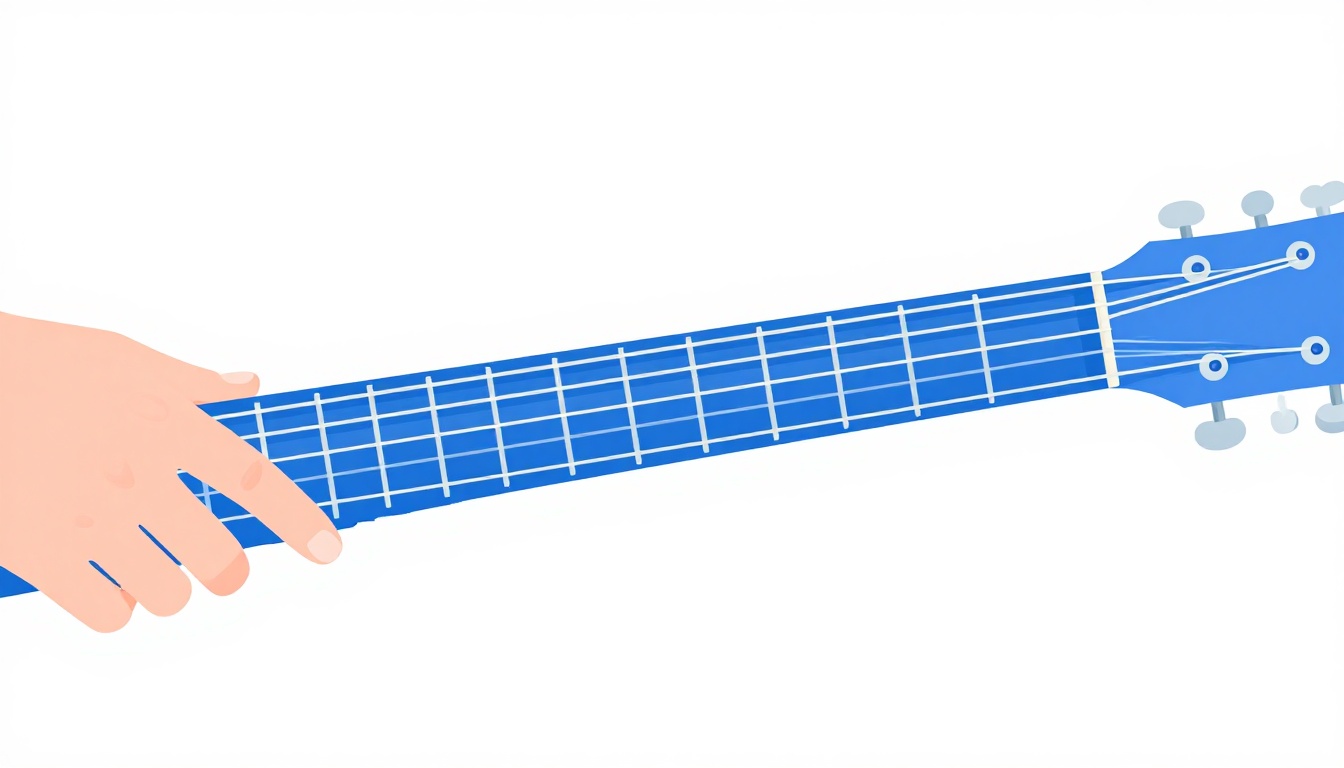
Every open minor chord covered so far, Am, Dm, Em, has a movable barre version built from the same underlying shape, and knowing those shapes means you are not limited to the handful of minor chords that happen to fall in open position. Two shapes cover almost everything you need.
The E-minor shape, barred, gives you a minor chord with its root on the 6th string wherever you place the barre. You already used it for Gm (3rd fret) and Fm (1st fret) earlier in this post. Move the same shape to the 5th fret and you get Am, to the 7th fret and you get Bm, and so on up the neck.
The A-minor shape, barred, gives you a minor chord with its root on the 5th string instead. Bm is the most commonly needed version of this shape.
| Chord | Shape (low E to high E) | Root string | Barre fret |
|---|---|---|---|
| Fm (E-shape) | 1-3-3-1-1-1 | 6th string | 1 |
| Gm (E-shape) | 3-5-5-3-3-3 | 6th string | 3 |
| Bm (A-shape) | x-2-4-4-3-2 | 5th string | 2 |
Once one of these shapes is comfortable, you can find the minor chord for almost any root note without learning a new fingering, just by locating that note on the 6th or 5th string and barring there. This matters for this post specifically because several of the darker progressions above, the borrowed minor iv, the half-diminished substitution, work in any key, not only the ones with convenient open chords, and a movable shape is what lets you actually use them once you move a progression to fit a vocal range or a different key.
Suspended Chords: Sus2, Sus4 and Unresolved Sadness
Suspended chords remove the third from a triad entirely, replacing it with either the second (sus2) or the fourth (sus4). Because the third is what makes a chord major or minor in the first place, a suspended chord is neither happy nor sad on its own. It is unresolved, which is a different feeling, closer to waiting than to grieving.
Dsus2
| String | Fret | Finger |
|---|---|---|
| 6 (low E) | Muted | - |
| 5 (A) | Muted | - |
| 4 (D) | Open | - |
| 3 (G) | 2 | 1 |
| 2 (B) | 3 | 3 |
| 1 (high E) | Open | - |
Dsus4
| String | Fret | Finger |
|---|---|---|
| 6 (low E) | Muted | - |
| 5 (A) | Muted | - |
| 4 (D) | Open | - |
| 3 (G) | 2 | 1 |
| 2 (B) | 3 | 2 |
| 1 (high E) | 3 | 3 |
Used correctly, a suspended chord's job is to sit right before a sad chord resolves, so the release into the minor chord lands harder. Play Dsus2 or Dsus4 for a beat, then let it fall to D major or, more usefully for this post, use a sus chord as a passing step from a major chord into its relative minor. That brief moment of "neither happy nor sad" makes the arrival at the minor chord immediately after feel like a decision the song made rather than something that just happened to be next in the chord chart.
Slowing Everything Down: Tempo, Dynamics and Fingerpicking
The chords and progressions above are the raw material. Tempo and dynamics decide how much of the sadness in them actually reaches a listener, and this is the part most chord-focused articles skip entirely.
Tempo matters more than chord choice. The same Am, F, C, G loop played at a brisk 130 beats per minute reads as driving or even hopeful. Slow it down toward 60 to 75 beats per minute and the identical chords, in the identical order, read as heavy and reflective. If a progression you are playing does not sound as sad as you expected, check your tempo before you second-guess the chords.
Arpeggiate instead of strumming. Strumming plays every note in a chord at once, which creates a single dense sound. Fingerpicking, or even a slow, deliberate down-strum broken into individual notes, lets each note of the chord ring out in sequence. That separation is what lets a listener actually hear the minor third, the flattened fifth, or the ninth doing its work, instead of hearing a wall of sound that could be almost any chord.
Leave space between chord changes. A common mistake when a progression is supposed to sound sad is rushing the changes to keep time perfectly, which can make the progression sound anxious rather than mournful. A slight, consistent hesitation right before each new chord, sometimes called a "breath," gives the previous chord room to decay and lets the new one land with more weight.
Play lower on the neck. Open chords and low barre chords, close to the nut, resonate with more low-frequency content than the same chord played as a movable shape further up the neck. A Dm chord in open position sounds heavier than the identical Dm triad played as a barre shape at the 10th fret. If a chord in this post is sounding thinner than expected, check whether there is a lower voicing of it available first.
Drop D and a Lower Root
One more tool worth knowing, separate from any specific chord shape: drop D tuning. Standard tuning is E, A, D, G, B, E from the low string to the high string. In drop D, you tune only the lowest string down a whole step, from E to D, giving you E, A, D, G, B, E becoming D, A, D, G, B, E.
| String | Standard tuning | Drop D tuning |
|---|---|---|
| 6 (lowest) | E | D |
| 5 | A | A |
| 4 | D | D |
| 3 | G | G |
| 2 | B | B |
| 1 (highest) | E | E |
With the low string dropped to D, a D minor chord gains an extra low root note underneath it, which thickens the bottom end of the chord without changing any of your fretting hand shapes above the 4th string for most simple progressions. It is a small, low-effort change, one string, one turn of the tuning peg, and it noticeably deepens any progression built around D or D minor, which makes it worth trying on the circular Dm, Am, Gm, Dm progression covered earlier in this post.
A Minor Key Song vs. a Borrowed Minor Chord
It is worth separating two different things this post has been mixing together on purpose: a song written entirely in a minor key, and a major-key song that borrows one or two minor chords for effect.
A song in A minor treats Am as home. Every chord in it, including the G, F and E from the Andalusian cadence, belongs naturally to that key, and the whole piece can sit in a minor mood from the first bar to the last without anything sounding out of place. This is how most of the Andalusian cadence and circular-progression songs in this post work.
A major-key song that borrows a minor chord, like C to Em to F to Fm, is doing something more targeted. The song is still fundamentally happy or neutral in C major, and the Fm is a single deliberate dip into darkness, made noticeable precisely because everything around it is major. This is a more advanced songwriting tool than simply writing in a minor key, because the contrast is doing the emotional work rather than the overall key.
Neither approach is more legitimate than the other, and most genuinely sad songs use a mix of both: a minor key as the general environment, with the occasional borrowed chord, like a half-diminished ii chord or a major IV where a minor iv would be expected, adding texture on top. If you are choosing between them for something you are working on, a full minor key gives you a consistent mood across an entire song, while a single borrowed chord gives you one sharp emotional moment inside an otherwise different mood.
Why These Chords Aren't Working For You
Sad chords rely on subtlety, minor thirds, flattened fifths, unresolved ninths, and subtlety is exactly what a poorly fretted string destroys. If a chord on this page is not sounding the way it should, the cause is almost always one of these.
The barre chord buzzes or sounds muted
F, Fm and Gm all require a barre, and a weak barre is the single most common reason a "sad" progression sounds thin instead of heavy. Press your index finger close to the fret wire, not in the center of the fret, and roll it very slightly onto its side rather than laying it completely flat. A flat index finger has less muscle behind it than the edge of the finger does.
The half-diminished or ninth chord sounds like noise instead of a chord
Both Bm7b5 and Am9 pack several notes close together across five strings, and if even one finger is not pressing firmly, the string it touches goes dead rather than muted cleanly, which reads as noise. Play the chord one string at a time, checking each note rings clearly, before strumming the whole shape.
The progression sounds aimless rather than sad
This is rarely a fingering problem. It usually means the tempo is too fast, the chords are being strummed rather than picked, or there is no space between the changes. Revisit the dynamics section above before touching the chord shapes again.
A suspended chord never resolves and just sounds unfinished
That is the suspended chord doing its job. If it sounds unsatisfying on its own, that is correct. A sus chord is meant to move somewhere else within a bar or two, not to be the final chord of a phrase.
Your fretting hand cramps on the wider ninth chord shapes
Am9's shape spans four frets across five strings, which is a genuine stretch for a hand that has not built up that range yet. Practice it slowly at a fraction of tempo, releasing the hand fully between attempts rather than holding the shape and forcing through discomfort.
Easier Versions for Beginners and Small Hands
Every chord on this page has a simpler substitute that keeps most of the emotional color while asking less of your hand.
| Instead of | Try | Why it is easier |
|---|---|---|
| Full barre F (1-3-3-2-1-1) | Easy F (x-x-3-2-1-1) | No barre required, same top four notes |
| Full barre Gm (3-5-5-3-3-3) | Gm7 (3-x-3-3-3-x) | Smaller stretch, still clearly minor and dark |
| Full barre Fm (1-3-3-1-1-1) | Fm7 (1-x-1-1-1-x) | Same relief as Gm7, keeps the borrowed-minor color |
| Am9 (x-0-2-4-1-3) | Am7 (x-0-2-0-1-0) | Drops the ninth stretch, keeps the minor seventh ache |
| Bm7b5 (x-2-0-2-0-1) | Bm7b5 without the high E (x-2-0-2-0-x) | Removes the one finger most players catch on the strum |
None of these substitutions are a lesser version of the "real" chord. A minor seventh chord played cleanly and with intent will always sound sadder than a ninth chord played with a muted or buzzing string. Get the simpler shape ringing clearly first. The fuller voicings above are worth returning to once the easier versions feel automatic, not before.
Changing Between These Chords Without Losing the Mood
None of the chords in this post are difficult in isolation once your hand knows the shape. The real skill, and the thing that separates a sad-sounding chord from a sad-sounding song, is moving between them without a gap.
Look for shared fingers first. Moving from F to Fm only requires your ring and pinky fingers to slide, since your index finger is already barring the fret you need. Moving from Am to Am7 only requires lifting one finger, your ring finger off the G string. Whenever two chords in a progression share a finger position, plan your fingering around keeping that finger still rather than lifting your whole hand off the neck and resetting.
Where no fingers are shared, such as the move from Am to G in the Andalusian cadence, practice the change on its own, back and forth, slowly, before adding it to the full progression. Four beats per chord, then two, then one, is a reliable way to build a smooth change without ever needing to consciously think about where each finger goes mid-song.
Keep your strumming or picking hand moving in tempo even while your fretting hand is mid-change. A slight buzz or a muted note during the half-beat where your fingers are still moving into position matters far less to how the progression sounds than a hesitation in the rhythm. Listeners forgive an imperfect chord. They notice a stalled beat immediately, and in a slow, sad progression, a stalled beat reads as a mistake rather than an interpretive choice.
Songs Built on These Chords and Progressions
Hearing how these shapes function inside a real song is worth more than any amount of chord theory on its own. A few widely cited examples, organized by which progression from this post they lean on.
The descending Andalusian cadence, Am to G to F to E, drives the intro of Led Zeppelin's "Stairway to Heaven," where the descending bass line under the chords is what most listeners actually remember, even before the chords themselves register. Ray Charles's "Hit the Road Jack" strips the same descending idea down to its simplest possible form, looping it under a call-and-response vocal instead of a fingerpicked intro, which is a useful reminder that the same four chords can carry either a slow, mournful arrangement or a brisk, driving one.
The minor-start pop rotation, Am to F to C to G, sits underneath ballads such as Adele's "Someone Like You" and Linkin Park's "Numb," both of which use the same trick of starting the loop on the minor chord rather than the major tonic, so the ear registers the whole progression as wistful even though three of its four chords are major.
The borrowed minor iv move, F sliding to Fm inside an otherwise major key, is the defining harmonic moment of Radiohead's "Creep," where that single chord change lands right under the word "so" in the chorus and is widely credited as the moment the song turns from self-deprecating to genuinely bleak. A close relative of the same idea appears in David Bowie's "Space Oddity" and the jazz standard "My Funny Valentine," both of which lean on a major chord briefly turning minor to darken a phrase without changing key outright.
Tight, circular minor loops close to the one used with Dm, Am, Gm, Dm show up in the verse of Metallica's "Nothing Else Matters" and Gary Jules's stripped-down version of "Mad World," where the repetition itself, rather than any single chord, is what carries the resigned, closed-in mood of the song.
Listen to any of these with the chord shapes from this post in hand and follow along on your own guitar. Matching a shape you have just learned to a recording you already know is one of the fastest ways to make a new chord feel like part of your vocabulary instead of an exercise.
Writing Your Own Sad Progression
If you are working toward writing something of your own rather than just playing through examples, the progressions in this post are templates, not fixed songs. A few practical ways to build a new one out of the same material.
Start from a minor chord you already like the sound of, and move to its relative major. Every minor chord has a relative major a minor third above it, Am and C, Dm and F, Em and G, and moving between a chord and its relative gives you an instant, natural-sounding pair to build a verse around, since the two chords already share most of their notes.
Borrow one chord, not four. The Fm inside "Creep" works because it is rare. If every chord in a progression is unexpected, nothing stands out, and the progression can start to sound aimless instead of purposeful. Pick one moment, usually right before a chorus or a key line in a lyric, and put the borrowed or half-diminished chord there.
Let the bass note descend. The Andalusian cadence works partly because Am, G, F, E has a bass line that walks down one note at a time. You do not need the exact same chords to borrow the same trick. Any progression where the lowest note steps downward, even under different chord qualities, tends to read as falling, and falling reads as sad.
Resolve, or deliberately do not. A progression that lands back on its starting minor chord feels settled, even if sad. A progression that ends on a suspended chord, or on the dominant chord without returning home, like ending on the E in the Andalusian cadence instead of looping back to Am, leaves the listener hanging, which reads as grief or longing rather than settled sadness. Both are valid choices. Decide which effect you want before you decide where the progression stops.
A Practice Routine for Today
You do not need all fourteen chord shapes in this post under your fingers before you can start using them. Fifteen focused minutes gets you moving.
- Five minutes: play Am, Dm and Em cleanly, one strum each, checking every string rings before moving to the next chord. Fix any buzz before adding speed.
- Five minutes: loop the Andalusian cadence, Am, G, F, E, at a slow, even tempo, using the easy F shape if the barre version is not clean yet. Focus on the change into F, which is usually the weak link.
- Three minutes: fingerpick the Am, F, C, G progression instead of strumming it. Pick the bass note, then roll through the remaining notes. Notice how much slower and heavier the same chords feel.
- Two minutes: try Am7 in place of Am somewhere in a progression you already know, and Bm7b5 in place of a plain minor chord if you have a slower minor-key song to practice on. Listen for the extra weight the substitution adds.
Repeat this most days and the barre chords, the ninth chord stretch, and the timing on the changes will all improve together, since they are really the same underlying skill: a relaxed, well-placed fretting hand moving in time.
If fifteen minutes stretches into a longer session, spend the extra time on the movable minor shapes rather than adding more progressions. A single E-shape barre chord, practiced slowly at three or four different frets in a row without stopping, builds the exact hand strength that every other chord in this post depends on, and that strength transfers to Fm, Gm, and every barre chord you learn afterward, not just the ones covered here.
Frequently Asked Questions
What is the single saddest chord on guitar?
There is no universal answer, but minor 9th chords are the most commonly cited "saddest" individual chord shape, with half-diminished (m7b5) chords close behind for a darker, more unstable version of the same idea.
Is a minor chord always sadder than a major chord?
Usually, but not always. Context, tempo and voicing can make a major chord sound melancholic, particularly when it appears somewhere a listener expects a minor chord, and can make a minor chord sound almost peaceful when played slowly and warmly. The chord type sets the baseline; everything around it adjusts from there.
What is the Andalusian cadence?
It is the descending progression i, VII, VI, V, in A minor that means Am, G, F, E. It gets its name from its long use in Spanish and flamenco music and is widely considered one of the most reliably sad-sounding progressions in Western music.
Do I need to know music theory to play sad chord progressions?
No. Every shape and progression in this post can be learned by fret position alone. The theory explains why they work, which helps you build your own progressions later, but it is not required to play any of the examples here today.
Can I use these chords in a major key song?
Yes. Borrowing a single minor or half-diminished chord into an otherwise major-key progression, the way "Creep" moves from F to Fm, is a common and effective way to add a moment of sadness without rewriting the whole song around it.
Why does my minor chord sound thin instead of sad?
Almost always tempo, register or technique rather than the chord itself. Play it lower on the neck if a lower voicing exists, slow down, and arpeggiate the notes instead of strumming them all at once.
What is the difference between a half-diminished and a fully diminished chord?
A half-diminished chord (m7b5) has a minor third, a flattened fifth and a minor seventh. A fully diminished chord goes one step further, flattening the seventh again into what is technically a double-flat seventh but sounds like a major sixth, giving it an even more unstable, tense character. Half-diminished chords are far more common in sad ballads and jazz standards; fully diminished chords tend to show up as brief passing chords rather than a resting point.
What tuning works best for sad, heavy-sounding chords?
Standard tuning covers every chord in this post. Drop D, where only the lowest string is tuned down a whole step, adds extra low-end weight to anything built around D or D minor, but it is optional, not required.
Are half-diminished chords too advanced for a beginner?
The shape itself, Bm7b5 at x-2-0-2-0-1, is no harder than a standard open chord. What makes it feel advanced is knowing where to use it. Start by dropping it in as a single substitution inside a progression you already play comfortably, rather than building a whole new song around it.
Learning how to restring a guitar is worth doing before you spend serious practice time on these shapes, since old, dead strings mute exactly the low-frequency resonance that makes a minor chord sound heavy in the first place. And if the barre chords in this post are your first barre chords, working through the C chord and its common changes first will build the hand strength that makes F, Fm and Gm far less of a fight.
GuitarLowKey
Ready for fifteen focused minutes?
Open the web app and train the change that is blocking your song.