
How to Play the D7/A Guitar Chord (Open and Barre Shapes)
The D7/A guitar chord in two shapes, the easy open-position version and the movable barre, plus why the A bass note is already built into D7.

D7/A is a D7 chord (D, F#, A, C) played with A as the lowest note instead of D. The fastest way to play it is the open D7 shape you may already know, just let the open A string ring instead of muting it: index finger on the 1st fret of the B string, middle finger on the 2nd fret of the G string, ring finger on the 2nd fret of the high E string, and both the A and D strings left open. Mute only the low E string. That is the whole chord.
The D7/A Chord Shape
Here is the open-position voicing as a table. "Finger" uses standard numbering: 1 is your index finger, 2 is your middle finger, 3 is your ring finger, 4 is your pinky.
| String | Fret | Finger |
|---|---|---|
| 6 (low E) | Muted, do not play | - |
| 5 (A) | Open | - (this is your bass note) |
| 4 (D) | Open | - |
| 3 (G) | 2 | 2 (middle) |
| 2 (B) | 1 | 1 (index) |
| 1 (high E) | 2 | 3 (ring) |
Strum from the open A string down through the high E string, five strings in total. The low E string is the only one you have to keep quiet, and it is the same string you already mute for plain open D and D7, so if you have played either of those chords before, your fretting hand already knows most of this shape. The only change is a habit you have to unlearn: stop muting the A string with the side of your thumb or the pad of a finger, and let it ring.
This shape assumes standard tuning, low to high: E, A, D, G, B, E. Nothing about D7/A requires an alternate tuning, and everything in this article is written for a guitar tuned normally. You will most often reach for this chord if you already play open D, D7 or G major chords and have come across "D7/A" written into a chart, a hymnal, or a songbook, usually as a connector between two other chords rather than as a chord you would choose on its own.
What "D7/A" Actually Means
The slash in a chord name separates the chord itself from the bass note underneath it. Read "D7/A" as "D7 over A": play a D7 chord, but put A in the bass instead of D. The letter before the slash tells you the chord and its quality (D7, a dominant seventh chord). The letter after the slash tells you which note has to be the lowest, loudest note you hear, regardless of what the chord above it is doing.
This notation shows up whenever a songwriter or arranger wants a specific note underneath a chord that would not naturally put that note on the bottom. A plain D7 chord, played normally, puts D on the bottom. D7/A asks for the same four notes, D, F#, A and C, but rearranged so A is the one your ear locks onto first when the chord lands.
Slash chords are common in written music (lead sheets, hymnals, songbooks) because they describe exactly what the bass has to do without forcing a bass player or a guitarist's low strings into unison. On guitar, since you are usually playing the chord and the bass note at the same time, a slash chord just means: keep the chord shape, change which string is your lowest sounding one.
Say it out loud as "D seven over A" or "D seven, A bass," both are common ways players and chart-readers speak it, and both mean the same thing described above. It is never read as a fraction or as two separate chords played one after another, the slash is a single instruction about one chord's bass note, not a cue to switch chords mid-beat.
Why A Is Already Inside a D7 Chord
Some slash chords ask for a bass note that is a total stranger to the chord above it, borrowed from outside for color or for a smooth walking bass line. D7/A is not one of those. Look at the notes again: D7 is built from D, F#, A and C. A is the fifth of the chord, already sitting inside it. Putting A in the bass does not add anything foreign, it just reorders which note you hear first.
That is why D7/A is so much easier to play than it sounds on paper. You are not hunting for a new note somewhere on the neck and squeezing it into an already-full chord shape. You are taking a shape you likely already know and simply not muting a string that used to be silent. In music theory terms this is called the second inversion of D7: root position has D on the bottom, first inversion has F# (the third) on the bottom, second inversion has A (the fifth) on the bottom, and third inversion has C (the flat seventh) on the bottom. D7/A is the second inversion.
Contrast that with a slash chord like D/C or G/F#, where the bass note is not part of the chord above it at all, and getting it right means finding an extra fretted note that has nothing to do with the chord shape you already know. D7/A never asks you to do that. Every note you need is already sitting in a D7 shape, waiting for you to stop damping one of the strings.
The Movable D7/A Barre Shape (5th Position)
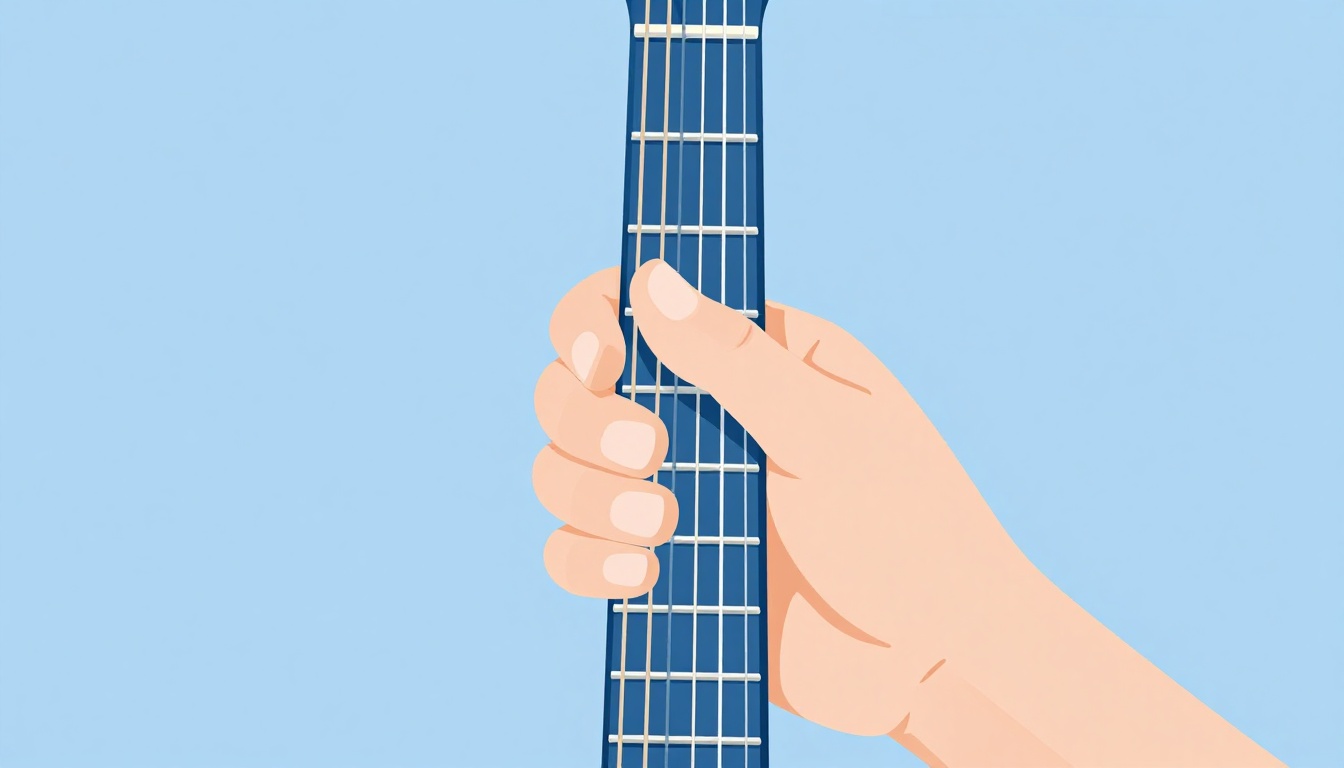
There is a second, more useful way to land on D7/A, and it happens almost by accident to anyone who barres a D7 chord using the open A7 shape as a template. Barre your index finger flat across all six strings at the 5th fret, then add your ring finger on the D string at the 7th fret and your pinky on the B string at the 7th fret.
| String | Fret | Finger |
|---|---|---|
| 6 (low E) | 5 | 1 (index, barre) |
| 5 (A) | 5 | 1 (index, barre) |
| 4 (D) | 7 | 3 (ring) |
| 3 (G) | 5 | 1 (index, barre) |
| 2 (B) | 7 | 4 (pinky) |
| 1 (high E) | 5 | 1 (index, barre) |
Strum all six strings. Work out the notes and you get A, D, A, C, F# and A from low to high, the same four D7 tones as the open shape, doubled up, with A sitting on the bottom because your barred low E string is voicing an A note at the 5th fret (E plus five frets lands on A).
This is the shape most guitarists learn as "the D7 barre chord," usually with an instruction to mute the low E string so the chord comes out as plain root-position D7. If you skip that muting step and let the barred low E string ring along with everything else, you get D7/A automatically, with no extra fingers and no extra thinking. It is one of the few cases where the "wrong" way to play a barre chord and the "right" way to play a slash chord are the exact same shape.
The tradeoff is difficulty. This version needs a full barre and an independent ring finger and pinky reaching two frets past it, which is a stretch for a lot of players, especially early on. Use the open-position shape from the first section for everyday playing, and come back to this one once barre chords feel comfortable, or when a song specifically needs D7/A in a higher register.
Some players who already barre this shape for plain D7 use a thumb-over technique instead of a full six-string barre, wrapping the fretting-hand thumb over the top of the neck to fret the low E string at the 5th fret while the index finger only needs to cover the A, G, B and high E strings. This trims the barre down to four strings, which is easier for a lot of hands, and it produces the same D7/A voicing as long as the thumb is actually fretting the low E string rather than muting it. Not every neck profile allows a comfortable thumb wrap, a wider or thicker neck can make it awkward, so treat this as an option to try rather than a requirement.
D7/A vs. Plain D7: The Only Difference
If you already know open D7, you already know D7/A. The fingering does not change at all. The only thing that changes is what your fretting hand or thumb does to the A string.
- Plain D7: mute both the low E string and the A string. Strum from the D string down. The lowest note you hear is D.
- D7/A: mute only the low E string. Let the A string ring open along with everything else. Strum from the A string down. The lowest note you hear is A.
That is genuinely the entire difference. Because A is already a chord tone, there is no version of this where letting the A string ring "clashes" with the rest of the chord, the way it would if you accidentally let a wrong open string ring on, say, an open C or F chord. If your fretting hand knows D7, your ears already know what D7/A is supposed to sound like, you have probably heard it plenty of times without knowing it had its own name.
D7/A vs. A7: Don't Mix Them Up
Because both chords put A on the bottom and both have "A" in their name somewhere, it is easy to confuse D7/A with a plain A7 chord. They are not the same chord, and the difference is one note.
| Chord | Notes | Bass note | Quality |
|---|---|---|---|
| D7/A | D, F#, A, C | A | D dominant 7th, inverted |
| A7 | A, C#, E, G | A | A dominant 7th, root position |
A7 has C# in it (the major third of A). D7/A has a natural C, not C#. Play them back to back and the difference is obvious once you know to listen for it: A7 sounds like it wants to resolve to a D chord as its own dominant, while D7/A still sounds and functions like a D7 chord, just voiced with a different note underneath. If a chart calls for D7/A and you substitute a plain A7 because they share a bass note, you will hear the mismatch, particularly against a melody or a bass line that expects the natural C.
A quick ear-training check: play open A7 (x02020), then play D7/A from the first section of this article. Both put A on the bottom, but where A7's upper strings ring bright and settled, D7/A's upper strings carry the slightly unresolved, still-moving quality described later in this article. The fastest way to tell them apart on the fretboard is the B string: A7 frets it at the 2nd fret for the C#, D7/A frets the same string one fret lower, at the 1st fret, for the natural C. If you are ever unsure which chord a chart or a recording wants, that single fret is the difference.
D7/A vs. Dm/A, Dm7 and Dmaj7: Don't Mix Up the D Chord Family
D7/A is easy to mix up with several other D chords that look similar on paper but come from different shapes entirely. Sorting them out now saves you from playing the wrong one when a chart just says "D" followed by a superscript you skim past.
D7/A vs. Dm/A. These share a name pattern and a bass note but are different chords. Dm/A is a D minor triad (D, F, A) with A in the bass, played from the open Dm shape with the A string added. D7/A is a D dominant 7th chord (D, F#, A, C) with A in the bass, played from the open D7 shape with the A string added. The giveaway on paper is the "m" and the "7." On the fretboard, the giveaway is your middle finger: Dm/A puts it on the 2nd fret of the G string same as D7/A, but Dm/A's index finger sits on the 1st fret of the high E string while D7/A's index sits on the 1st fret of the B string, and D7/A's ring finger takes the 2nd fret of the high E string where Dm/A leaves that string open.
D7/A vs. Dm7. Dm7 is a completely different chord family, D minor with a flat seventh added (D, F, A, C), not a dominant chord at all. Root-position Dm7 already has its own open shape with the low E and A strings muted. If you add an open A string underneath a Dm7 shape you get Dm7/A, which is a real and useable chord in its own right, but it is not the same thing as D7/A. The "m" again is the tell: minor seventh chords and dominant seventh chords sound and function differently, even when three of their four notes overlap.
D7/A vs. Dmaj7. Dmaj7 swaps the dominant chord's flat seventh (C) for a major seventh (C#), which changes the chord's character from bluesy and unresolved to smooth and jazzy. Dmaj7's open shape looks close to D7's at a glance, both use the top four strings, but the note on the high E string is different, and that one-note difference is the entire distinction between a dominant seventh sound and a major seventh sound. Adding an open A bass underneath Dmaj7 would give you Dmaj7/A, again a different chord from D7/A.
The pattern across all three comparisons is the same: check the letters after the chord name before you touch the fretboard. "m," "7," "maj7" and a slash bass note each change one specific thing about the shape, and D7/A only means one of them, dominant seventh quality with A in the bass.
Why It's Not Working
D7/A fails in a small number of predictable ways. Work through these one at a time rather than guessing.
The A String Won't Ring
This is the single most common problem, and it is not really a technique problem, it is a habit problem. If you have spent any time playing plain D or D7, your fretting hand has learned to mute the A string automatically, usually with the underside of your index finger or the edge of your thumb creeping over the top of the neck. Watch your thumb and your index finger specifically when you fret the shape. If either one is touching the A string, even lightly, it will not ring. Pull your thumb back down behind the neck and check that your index finger, fretting the B string at the 1st fret, is arched enough that its base does not lean onto the string next to it.
The Low E String Buzzes or Rings
The flip side of the same habit: some players, once told to "let the A string ring," accidentally stop muting the low E string too, and it either buzzes against the fret or rings out a wrong note. The low E string still needs to be silent. Rest the underside of your fretting-hand index finger lightly against it, or angle your thumb just far enough over the top of the neck to deaden it without touching the A string next to it. You are aiming to mute exactly one string while leaving its neighbor completely free, which takes a few days of deliberate attention before it becomes automatic.
The G String Is Muted By Accident
Your middle finger on the 2nd fret of the G string is doing real work in this chord, it supplies the C note. If that finger is flat instead of arched, its underside can press against the B string below it and deaden your index finger's note, or its tip can drift and mute the string it is supposed to be fretting cleanly. Curl your fingers so each one contacts only the string it is assigned to, and check with a slow, string-by-string pluck that every note in the shape actually sounds.
The Barre Version Buzzes
If you are working on the 5th-fret barre shape, buzzing almost always comes from one of three places: the barre finger is not close enough to the fret wire (aim for right behind it, not in the middle of the fret space), the barre is not applying even pressure across all six strings (a slight roll of the index finger toward its outside edge usually fixes uneven pressure), or your ring finger and pinky are collapsing flat and muting the strings on either side of the ones they are supposed to fret. Isolate the barre by itself first, without the other two fingers, and get it ringing clean on all six strings before adding the ring finger and pinky on top.
Your Guitar's Setup Is Fighting You
If you have checked your hand position carefully and an open string still buzzes even when nothing is touching it, the problem may not be your fretting hand at all. A nut slot cut too low, or action set too low at the first few frets, lets an open string vibrate close enough to a fret to rattle against it, and no amount of fretting-hand adjustment fixes that because the fretting hand is not involved. Fret the string at the 1st fret instead of playing it open, if the buzz disappears, the open-string buzz is a setup issue rather than a technique issue, and it is worth having a guitar tech check the nut and the action rather than assuming you are doing something wrong.
Your Fretting Hand Cramps Reaching for the Pinky
The 7th-fret stretch for your pinky, two frets past a 5th-fret barre, is a real reach for a lot of hands, especially early on. If your hand is cramping, check your thumb position first, it should sit roughly behind your first and second fingers, low on the back of the neck, not hooked over the top. A thumb that is too high forces your fingers to reach further than they need to. If it still feels tight after that, it is a strength and flexibility issue, not a technique mistake, and it will ease with repetition. There is no shame in sticking to the open-position shape until it does.
The Chord Sounds Right Alone but Wrong in the Progression
Sometimes every note rings clean and the chord still sounds off the moment you play it after G or before Bm. This is rarely a fretting problem, it is usually a timing problem: the change is landing a fraction late, so the bass note arrives after the beat instead of on it, and a slash chord's entire purpose is to put a specific note on the beat. Slow the whole progression down until the change lands exactly on the click of a metronome, even if that means playing well under tempo for a few passes. A D7/A that arrives late defeats the smooth bass line it exists to create, even when the shape itself is fretted correctly.
Muting the Low E String Cleanly
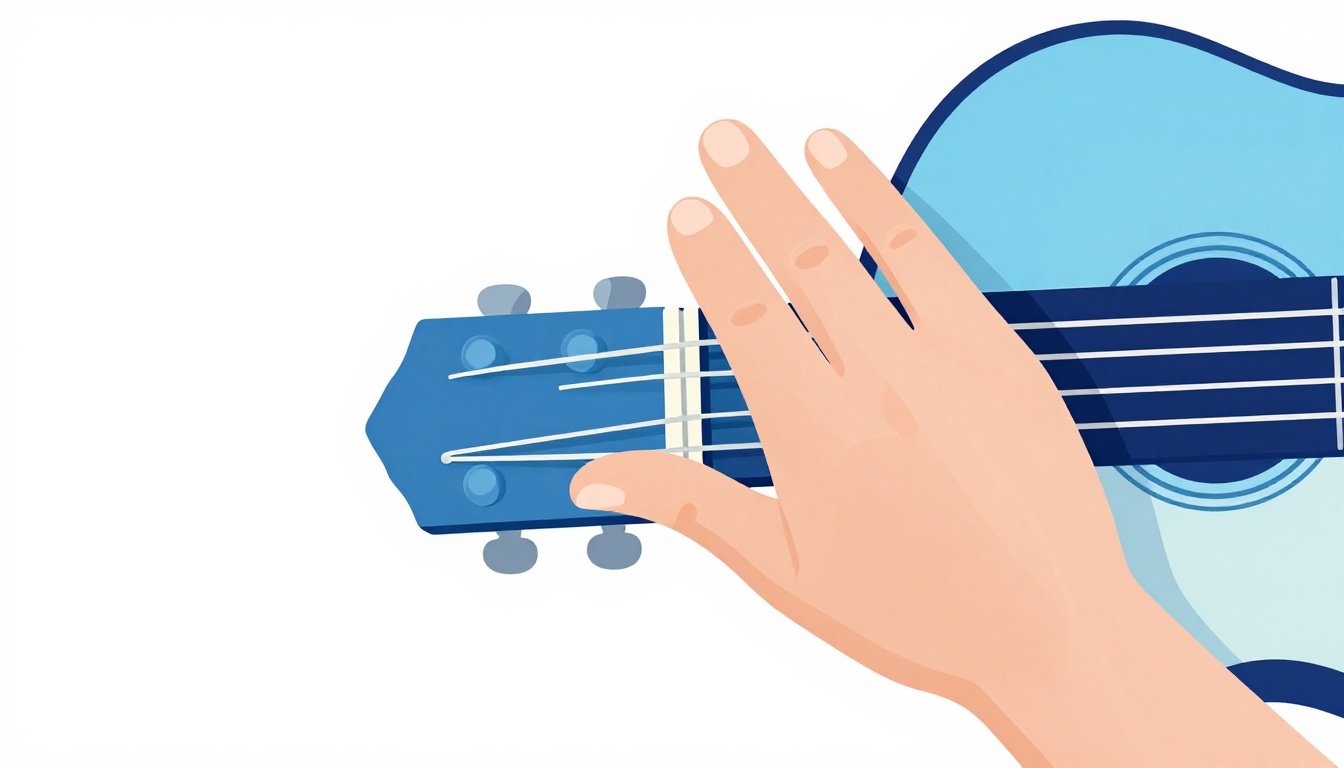
Because both D7/A shapes depend on the low E string staying silent while everything around it rings, it is worth isolating this one skill on its own. Two techniques work, and most players end up using a blend of both without thinking about it.
The first is thumb muting: bring your fretting-hand thumb up and slightly over the top edge of the neck so its pad rests lightly against the low E string, just enough to deaden it without applying enough pressure to fret a note. This works best in open position, where your thumb is already sitting relatively high on the neck.
The second is index-finger muting: let the underside of your fretting-hand index finger, the part between the knuckle and the fingertip, brush against the low E string as it reaches over to fret the B string. This happens almost automatically once your hand is in the right shape, and it is the more reliable method for the barre version, where your thumb is lower and further from the low string.
Whichever method you use, the test is the same: strum all six strings hard, on purpose, and listen. A clean D7/A sounds like a full, ringing chord with nothing rattling on the bottom. If you hear a dull thud or a buzz under the chord, you are muting the string but not deadening it fully, usually because the contact point is too light or in the wrong spot. If you hear an actual pitch under the chord, the string is not muted at all and you are hearing an unwanted low E.
How a Second-Inversion Dominant Seventh Actually Sounds
Root-position D7, with D on the bottom, sounds settled underneath itself even while it pulls hard toward resolving to G. It is a stable-sounding chord that happens to want to move somewhere else. D7/A, the same four notes with A on the bottom, sounds noticeably less settled. Musicians sometimes describe second-inversion chords in general as sounding like they are "still in motion," passing through rather than arriving, because the bass note is no longer reinforcing the chord's own root.
You can hear this directly by playing plain D7 and letting it ring, then playing D7/A and letting it ring. Root-position D7 sounds like a complete musical thought even before it resolves. D7/A sounds like the middle of a sentence, it wants to keep going, either forward to G or, just as often, onward to wherever the bass line is headed next. That "still moving" quality is exactly why arrangers reach for second-inversion chords like D7/A in the middle of a phrase and almost never at the start or end of one. It is also why, if you try to end a song on D7/A instead of a plain D or G, it tends to sound unfinished rather than resolved, even though every note in the chord is technically correct for the key.
Where D7/A Fits in a Chord Progression
D7/A does not usually show up as a chord you would choose to start or end a song on. It shows up in the middle of a progression, doing a specific job: keeping a bass line moving smoothly while the chord above it still functions the way a D7 is expected to function.
In the key of G major, D7 is the dominant seventh built on the fifth scale degree, the chord that wants to resolve back to G. A plain D7 in that role jumps the bass from wherever it was straight down to D. D7/A softens that jump. If the chord before it has G in the bass, moving to D7/A first (A in the bass) and then to G (back to G in the bass) turns one big leap into two smaller steps, G up to A, then A back down to G, while the chord itself still does its job of pulling the ear toward G.
D7 also turns up outside the key of G, as what is called a secondary dominant. In the key of C major, for instance, D7 is sometimes used to lead into G7 the same way G7 leads into C, borrowing the "dominant pulling to the next chord" trick and applying it one step earlier in the progression. D7/A can do the same job in that context, with the added benefit of the same smoother bass motion described above, since the same slash-chord logic applies regardless of which key the D7 chord is functioning inside of.
The same idea appears constantly in hymnals, folk songbooks and worship music, where slash chords are used specifically to spell out a bass line the arranger wants, rather than leaving it to chance. If you come across D7/A in a chart like that, it is worth playing the bass notes of the surrounding chords by themselves first, just the lowest note of each shape in sequence, to hear the line the arranger was going for before you add the full chords back on top.
Here is one common shape this takes over a full phrase, with the bass note spelled out under each chord so you can see the line it traces:
| Bar | Chord | Bass note |
|---|---|---|
| 1 | G | G |
| 2 | D7/A | A |
| 3 | Bm | B |
| 4 | C | C |
| 5 | G/B | B |
| 6 | D7/A | A |
| 7 | G | G |
| 8 | G | G |
Read just the bass note column on its own: G, A, B, C, B, A, G, G. That is a bass line that walks up four steps and back down four steps while the chords above it move through a full progression, and D7/A is doing exactly one job in that line, sitting on the A between G and B on the way up, and again between C and G on the way back down.
Using D7/A for a Walking Bass Line
The broader technique D7/A belongs to is called a walking or connecting bass line, and it is one of the most useful tricks a solo guitarist has for making a simple progression sound arranged rather than just strummed. Because a single guitarist is usually playing the chords and the bass at the same time, slash chords are how you sneak a moving bass line in without needing a second instrument.
Try this in the key of G: play G, then D7/A, then Bm. On the guitar, that walks the bass note from G up to A up to B, three notes in a row, while the chord above it moves from a G major sound through a D7 sound and lands on Bm. Play it slowly, focusing only on the lowest note of each chord, and you will hear a genuine bass melody underneath the changes, not just a series of unrelated strums.
The same principle runs in the other direction. A descending line built from something like G/B, then D7/A is what to reach for whenever a progression feels like it is jumping around in the bass and you want it to feel like it is walking instead. This is the entire reason slash chords exist as a notation, and D7/A is one of the easiest ones to use for it, precisely because you do not have to learn a new shape to get there.
The Same Trick Works on Other Chords, Not Just D7
Once the D7/A idea clicks, the pattern generalizes to almost any dominant seventh chord you already know, and recognizing that pattern is more useful long-term than memorizing D7/A alone. A dominant seventh chord's fifth is always a comfortable open string away on guitar more often than you would expect, which is exactly what makes D7/A easy in the first place, and the same coincidence shows up elsewhere on the neck.
G7, for instance, has a D in it, the open D string. Adding that open string underneath a G7 shape that already uses the low E string as its root would not change anything since G7 usually roots on the low E string already, but the general skill, checking whether a chord's fifth happens to be an open string you are currently muting, is the same skill you just used to find D7/A. E7 has a B in it, sitting right there as the open B string in the standard open E7 shape, which is one reason open E7 already sounds full without much effort: the fifth of the chord is doing quiet work in the middle of the voicing rather than the bottom.
The broader habit worth building is this: whenever you learn a new open dominant seventh shape, look at which strings are muted and ask whether one of them, left open instead, would add a chord tone rather than a wrong note. Sometimes it will, and you have just found a slash-chord voicing for free. Sometimes it won't, and muting that string was necessary all along. D7/A happens to be one of the clearest, most beginner-friendly examples of the first case, which is exactly why it is worth learning as a concept and not just a shape.
Changing Into and Out of D7/A
The shape is not the hard part. Getting into it and back out of it without stalling the song is. Practice these transitions slowly, chord to chord, well before you try them at tempo.
From open G to D7/A. Your G chord likely has your ring finger on the low E string, middle finger on the A string, and index finger on the high E string (or a similar variant). Moving to D7/A, your middle finger slides down to the G string, your index finger moves to the B string, your ring finger jumps to the high E string, and your ring finger lifts off the low E string entirely so it can be muted instead. The biggest time-saver is noticing that your middle finger barely has to travel, string to string, one fret over.
From D7/A to G. Reverse the motion above. Because both shapes keep at least one finger in roughly the same area of the neck, this change gets fast quickly with repetition.
From D7/A to Bm. Bm is a barre chord (2nd fret, full barre, with your ring finger, and sometimes pinky, adding the 4th fret on the G string). If you are using the open D7/A shape, this is a bigger jump, since your hand has to form a barre from a spread-open shape. Practice landing the barre alone first, then add the open D7/A before it, so your hand learns the barre shape independent of anything else.
From D7/A to plain D7 or plain D. This one is nearly free. Since the fretted fingers do not move at all, you only need to start muting the A string again, with your thumb or the side of your index finger. Practice this specifically, since it is easy to forget to re-mute the string and end up playing D7/A when the song actually wants root-position D7.
Work each pair slowly with a metronome, one chord change per four clicks at first, then two, then one, before you try stringing a full progression together at speed.
Playing D7/A with a Capo
A capo does not change the shape you are fretting, it changes what pitch that shape produces, which makes D7/A a useful chord to know even when a song is not literally in the key of G. Clip a capo on the 2nd fret and play the exact same D7/A shape described above, and you are now sounding E7/B, a whole step higher, with zero change to your fingers. This is the standard way singers use a familiar shape to reach a key that suits their voice, rather than learning a new fingering for every key a song might be sung in.
The relationships between chords stay the same wherever the capo sits. If a song uses G, D7/A and Bm without a capo, and a singer needs the whole thing a step higher, a capo on the 2nd fret combined with the same three shapes produces A, E7/B and C#m without anyone having to relearn a single finger position. This is one of the more practical reasons to learn D7/A as a shape rather than memorizing "D7 with an A bass" as a fact about the key of G specifically, the shape travels with the capo, the underlying chord name is the only thing that changes.
Easier Versions for Small Hands or New Players
The open-position D7/A shape is already about as accessible as this chord gets, since it only asks for three fingers spread across three neighboring strings, but a couple of adjustments help if the standard fingering feels cramped, particularly for players still building the finger independence that chords like this one require.
| Version | Change | Trade-off |
|---|---|---|
| Standard open D7/A | Index on B string fret 1, middle on G string fret 2, ring on e string fret 2 | Full four-note chord, most common voicing |
| Two-finger simplified | Drop the ring finger, leave the high E string open instead of fretting it at the 2nd fret | Loses the F# note on top, keeps D, A and C, still functions as a D7-family sound with A bass, useful as a stepping stone |
| Wide-hand spacing | Same fingering, but angle the wrist slightly forward so the fingers approach the fretboard more from above than from the side | Easier for players with larger fingers who find the standard angle cramped between the B and G strings |
The two-finger simplified version is worth knowing even once you can play the full shape. It drops the ring finger entirely, which is useful the moment your hand needs to move fast into or out of a neighboring chord and the full four-finger version is costing you time.
For the barre version, there is no real shortcut, the stretch between the barre and the 7th-fret notes is inherent to the shape. If it is not comfortable yet, stick with open position and revisit the barre once your hand strength catches up. There is no penalty for playing the easier voicing; both shapes are the same chord.
Fingerstyle vs. Strumming D7/A
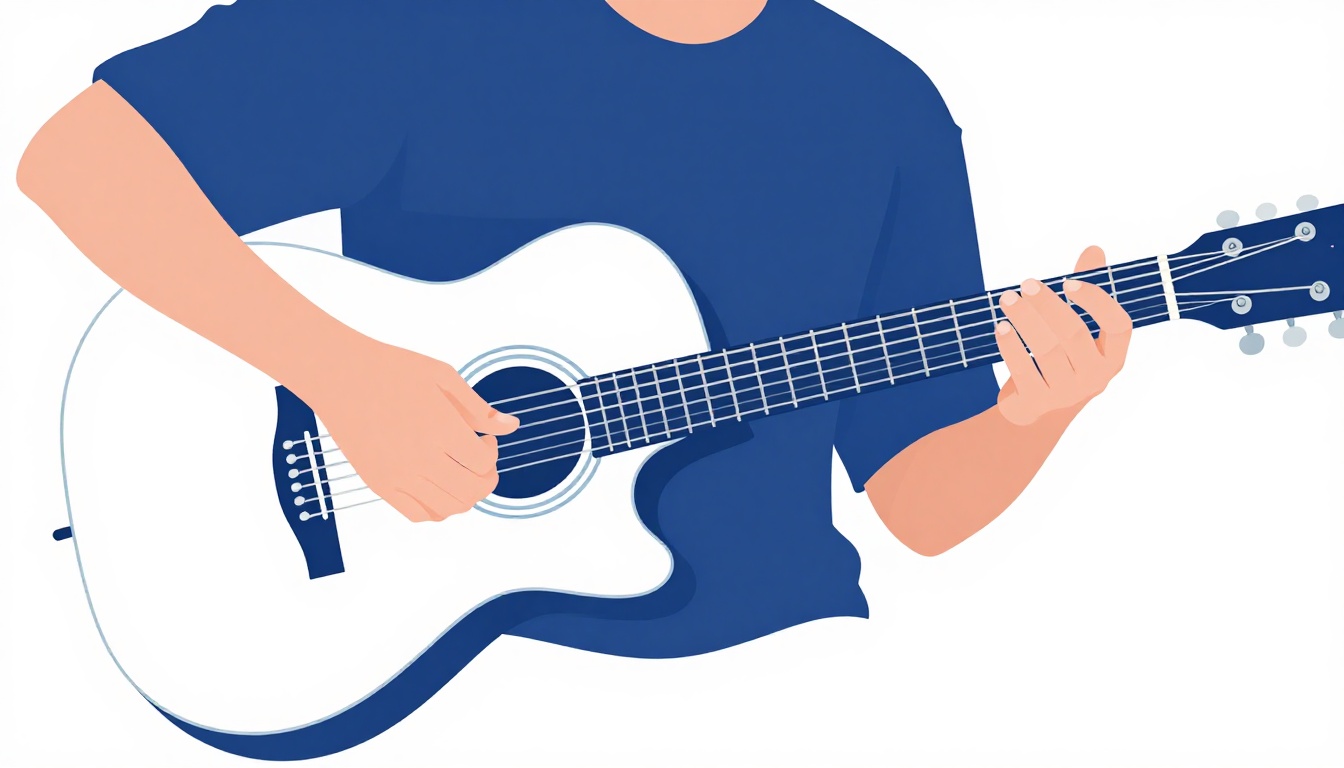
Strummed, D7/A works exactly like any other open chord, run your pick or thumb down from the A string through to the high E string, keeping the low E string out of the strum entirely by starting your downstroke from the A string rather than sweeping across all six.
Fingerstyle brings out what makes this chord interesting more clearly than strumming does. Because the bass note (A, played with your thumb) is a different note from the chord's actual root (D), picking the bass note first, letting it ring, and then filling in the rest of the chord with your fingers makes the "inversion" character of the chord audible in a way a fast strum can blur past. A simple pattern, thumb on the A string, followed by your first three fingers picking the G, B and high E strings together or in sequence, lets a listener hear the A bass note clearly before the rest of the chord arrives on top of it, which is often exactly the effect a slash chord is written to create.
A slower alternating pattern also works well over D7/A specifically: thumb on the A string, then your index, middle and ring fingers picking the G, B and high E strings one at a time rather than together, moving through the chord note by note instead of all at once. Because every note in D7/A is a genuine chord tone, there is no wrong order to pick them in, which makes this an easy chord to build a simple fingerstyle arrangement around without worrying about a stray note clashing.
A Practice Routine for Today
- Isolate the shape. Fret D7/A and pluck each string one at a time, low E through high E. Confirm the low E string is silent and every other string rings clean. Repeat until this is consistent five times in a row.
- Strum it slowly. Strum from the A string down, four slow strums, listening specifically for the A bass note underneath the chord.
- Compare it to plain D7. Alternate between plain D7 (A string muted) and D7/A (A string ringing) four times each, so your ear locks onto the difference the bass note makes.
- Walk the bass line. Play just the lowest note of G, then D7/A, then Bm, slowly, four times through, before adding the full chords back in.
- Practice the transitions. Work G to D7/A to G for two minutes, then D7/A to Bm for two minutes, with a metronome at a slow, comfortable tempo.
- Put it in context. Play a full slow progression, G, D7/A, Bm, G, four times through, focusing on smoothness over speed.
Ten minutes on this routine, done for a few days in a row, is enough for the shape and the transitions into it to stop requiring conscious thought.
Spread the six steps across a few short sessions rather than one long one. The first day or two, most of your ten minutes will go into step one and step two, just getting the shape to ring cleanly and consistently. Once that stops taking conscious effort, usually by day three or four, the same ten minutes can shift toward steps four through six, the walking bass line and the transitions, which is where D7/A actually earns its place in a song. Trying to rush straight to fast chord changes before the shape itself is reliable is the most common way this practice routine stalls, slow down a step rather than pushing through a shape that is still buzzing.
Common Mistakes With D7/A
Most of the trouble with this chord traces back to a handful of repeat offenders, worth checking against directly once the shape itself is memorized.
- Confusing it with A7. They share a bass note and nothing else. Check for the C versus C# before assuming they are interchangeable.
- Muting the A string out of habit. The most common mistake by far, carried over directly from plain D7 muscle memory.
- Forgetting to re-mute the low E string. Letting the A string ring is correct, letting the low E string ring along with it is not.
- Treating the barre version as mandatory. The open-position shape is not a simplified substitute, it is the standard voicing. Use the barre version only when the song specifically calls for it or when you want the fuller, higher-register sound.
- Strumming all six strings on the open-position shape. Doing this includes the muted low E string in the strum, which invites buzz even when your muting technique is otherwise solid. Start your strum from the A string.
- Rushing the chord change instead of the shape. A D7/A that lands late in a progression undercuts the smooth bass line it is there to create, even when every note in the shape rings clean. Practice the change itself, not just the fingering, slowly enough that it lands exactly on the beat.
FAQ
Is D7/A the same chord as D7? Yes, in terms of notes, both are built from D, F#, A and C. The only difference is which note is on the bottom. Plain D7 has D in the bass, D7/A has A in the bass. The fingering on guitar is identical except for whether the A string is muted or left open.
Do I need to learn a new shape to play D7/A? No, if you already know open D7, you already have the shape. The only change is technique: stop muting the A string and let it ring, while continuing to mute the low E string.
Why does D7/A show up in songbooks instead of just A7? Because it is a different chord. A7 has a C# in it and functions as its own dominant chord. D7/A keeps the natural C and still functions as a D7, just with a different bass note underneath. A songbook that wants a D7 sound with a walking bass line will write D7/A specifically because A7 would not produce the same harmony.
What is the difference between D7/A and Dm/A? Dm/A is a D minor chord with A in the bass. D7/A is a D dominant seventh chord with A in the bass. They share a bass note and a similar open-position shape, but different fingers land on different frets because the chords themselves are different.
Can I play D7/A higher up the neck? Yes, the barre shape at the 5th fret (a full barre plus your ring finger and pinky two frets higher on the D and B strings) gives you the same chord in a higher, fuller-sounding register. It requires a full barre and is harder than the open-position version.
Why does letting the A string ring not clash with the rest of the chord? Because A is already one of the four notes in D7 (it is the chord's fifth). Adding it to the bass does not introduce a new note, it just changes which note you hear first. That is different from some slash chords, where the bass note is borrowed from outside the chord entirely.
Is D7/A hard to strum cleanly? Not especially, once the low E string is reliably muted. The main skill is muting exactly one string (low E) while leaving its neighbor (A) completely open, which takes some deliberate practice if your hand has learned the opposite habit from plain D7.
Where would I actually use this chord in a song? Most often as a connecting chord in a progression that wants a smooth, stepwise bass line, commonly moving between a chord with G in the bass and a chord with B in the bass, using D7/A's A bass note as the stepping stone between them.
Can I use a capo with D7/A? Yes. A capo does not change the shape, only the pitch it produces. The same fingering with a capo on the 2nd fret sounds as E7/B rather than D7/A, which is useful for matching a song to a singer's range without learning a new shape.
Should I strum all six strings or just five? Just five. Start your strumming motion from the open A string and strike down through the high E string. Striking the low E string on purpose defeats the muting you worked to set up and reintroduces the note the chord is not supposed to have.
GuitarLowKey
Ready for fifteen focused minutes?
Open the web app and train the change that is blocking your song.