
How to Play the Dsus4 Guitar Chord (No Buzzing)
The open Dsus4 shape, the barre version, why it buzzes, and the one-finger trick that moves you between D and Dsus4 without stopping the song.

To play Dsus4 on guitar, put your index finger on the 2nd fret of the 3rd string (G), then barre your ring finger across the 1st and 2nd strings (high E and B) at the 3rd fret. Strum only the top four strings, the 4th (D), 3rd (G), 2nd (B) and 1st (high E), and leave the 6th (low E) and 5th (A) strings out entirely. That is the whole open shape. Everything below covers the barre version, why this chord buzzes when it does not sound right, the trick that lets you slide in and out of it in half a second, and where it actually shows up in real songs.
The open Dsus4 shape, string by string
Here is the full shape as a table. "Finger" uses standard numbering: 1 is your index finger, 2 is your middle finger, 3 is your ring finger, 4 is your pinky.
| String | Fret | Finger |
|---|---|---|
| 6 (low E) | Muted, do not play | - |
| 5 (A) | Muted, do not play | - |
| 4 (D) | Open | - |
| 3 (G) | 2 | 1 (index) |
| 2 (B) | 3 | 3 (ring) |
| 1 (high E) | 3 | 3 (ring, same finger as B string) |
Build it from the top down. Put your index finger on the 2nd fret of the G string first, since it is the lower of the two frets and sets the rest of your hand's position. Then lay your ring finger flat across the B and high E strings at the 3rd fret, forming a small two-string barre. Your ring finger only needs to cover those two strings, not the whole neck, so keep it close to the edge of the fretboard rather than flattening it all the way across.
The D string is left open. It is not muted, not fretted, just allowed to ring. Between the open D string and the three fretted or barred notes above it, this shape gives you the three notes that make Dsus4 what it is: D, G, and A.
Which strings to strum, and which to leave out
Strum from the 4th string (D) down through the 1st string (high E). That is four strings total. The 6th string (low E) and 5th string (A) are not part of this chord and need to be left out of the strum entirely, not just played quietly.
If the low E and A strings ring along with the chord, you will hear a low, out-of-key rumble underneath it, because neither E nor A (in that low register) belongs to the D, G, A set that makes up Dsus4. It will not sound like a wrong note exactly, more like a chord that never quite settles, and that vague wrongness is a common reason beginners think they are fretting Dsus4 incorrectly when the shape is fine and the strumming is what needs fixing.
Two ways to keep those two strings out of the sound:
- Anchor your strum on the D string. Aim your downstroke so the first string your pick or thumb touches is the D string, not the low E. This takes some deliberate aim for the first week or two and becomes automatic after that.
- Rest your fretting-hand thumb over the top of the neck slightly, enough that its underside brushes the low E string and deadens it, while your index and ring fingers handle the fretted notes below. This only works for the low E, not the A string, so pair it with aiming your strum to skip both.
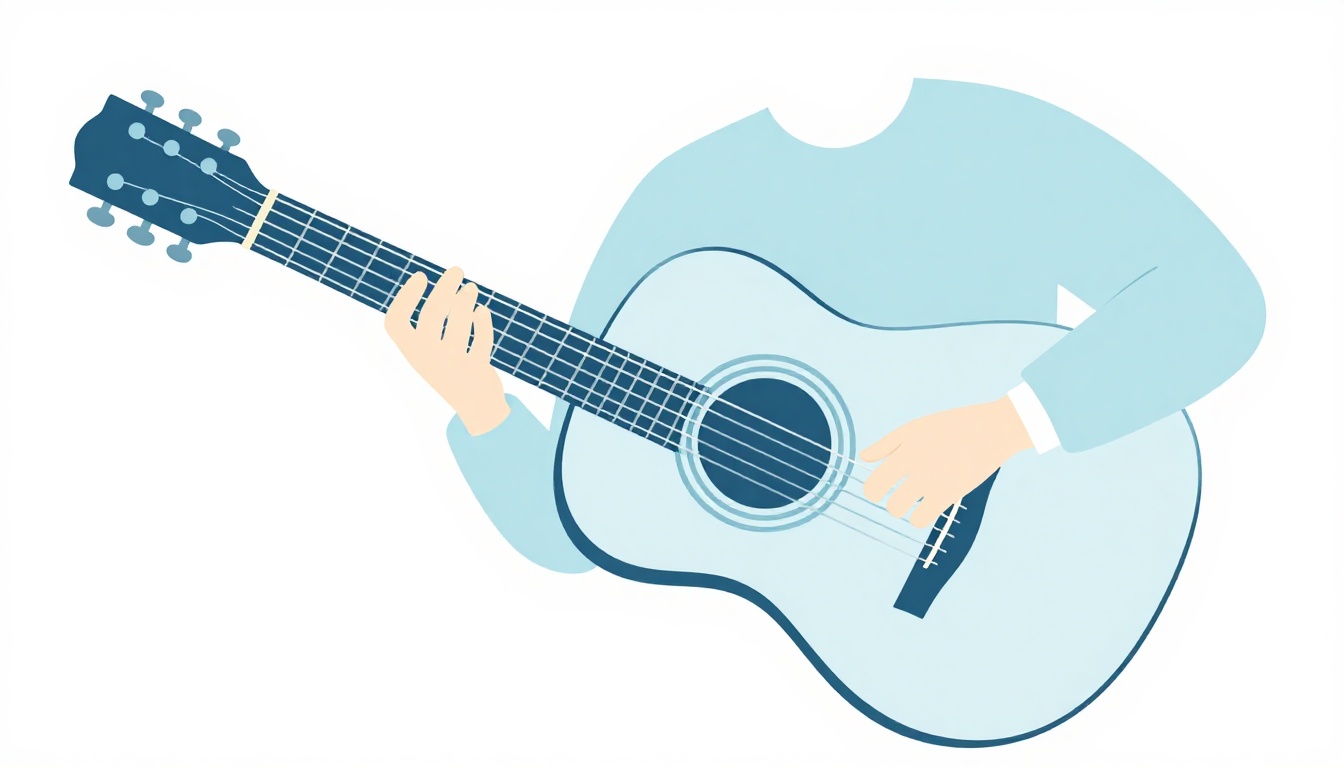
Test this deliberately rather than assuming it works. Strum slowly and listen to the very first sound your pick makes contact with. If you hear a low, dull thud before the rest of the chord rings out, that is the low E string sneaking into the strum, and it is worth isolating before you build speed around a bad habit.
What makes a chord "suspended", and why Dsus4 sounds the way it does
A regular D major chord is built from three notes: D (the root), F# (the major 3rd), and A (the perfect 5th). That middle note, the 3rd, is what tells your ear whether a chord is major or minor. Drop it out and put the 4th degree of the scale in its place instead, and you get a suspended chord, in this case D, G, and A. There is no F#, no third of any kind, which is why Dsus4 sounds neither happy nor sad on its own. It sounds unresolved, like a question waiting for an answer.
That "waiting" quality is not an accident of how it is fretted, it is the entire reason suspended chords exist. Musically, the 4th degree (G, in the key of D) wants to resolve down a half step to the 3rd (F#), which is exactly what happens when you play Dsus4 and then move to D. Your ear hears the G note pulling toward F#, and the D chord immediately after gives it exactly that resolution. This single interval relationship is why almost every practical use of Dsus4 pairs it with a D chord right next to it, either just before or just after.
Because it has no 3rd, Dsus4 is also neither major nor minor. The same three notes, D, G, and A, would resolve into D minor just as naturally as D major, since D minor's 3rd (F) is close to G too, though in practice Dsus4 resolves to D major the overwhelming majority of the time in guitar music.
| Scale degree | Note | Semitones from D | Role in Dsus4 |
|---|---|---|---|
| 1st | D | 0 | Root |
| 3rd | F# | 4 | Replaced (not present) |
| 4th | G | 5 | Suspended note, in place of the 3rd |
| 5th | A | 7 | Perfect 5th |
Laid out this way, the "suspension" is literally one semitone: G sits a single half step above F#, which is why moving from Dsus4 to D feels like such a small, satisfying resolution even though it changes the character of the whole chord. Your fretting hand mirrors that same one-fret distance, since the only string that differs between the two open chord shapes is the high E string, at the 2nd fret for D and the 3rd for Dsus4.
An even easier version, if the barre feels early
If barring two strings with your ring finger is not comfortable yet, you do not need the full three-note shape to get a real Dsus4.
| String | Fret | Finger |
|---|---|---|
| 6 (low E) | Muted | - |
| 5 (A) | Muted | - |
| 4 (D) | Open | - |
| 3 (G) | 2 | 1 (index) |
| 2 (B) | Muted or not strummed | - |
| 1 (high E) | 3 | 2 (middle) |
Drop the B string out of the strum and you only need two fingers: index on the G string, 2nd fret, and middle finger on the high E string, 3rd fret. Strum the D, G, and high E strings only, skipping the B string with a light touch of whichever finger is nearest it, or simply aim your pick to skip it. This still gives you all three notes of Dsus4, just with the D and A notes each represented once rather than the A note doubled the way the full barre version does it. It sounds a little thinner but is unmistakably the same chord, and it buys you time to build the two-string barre at your own pace.
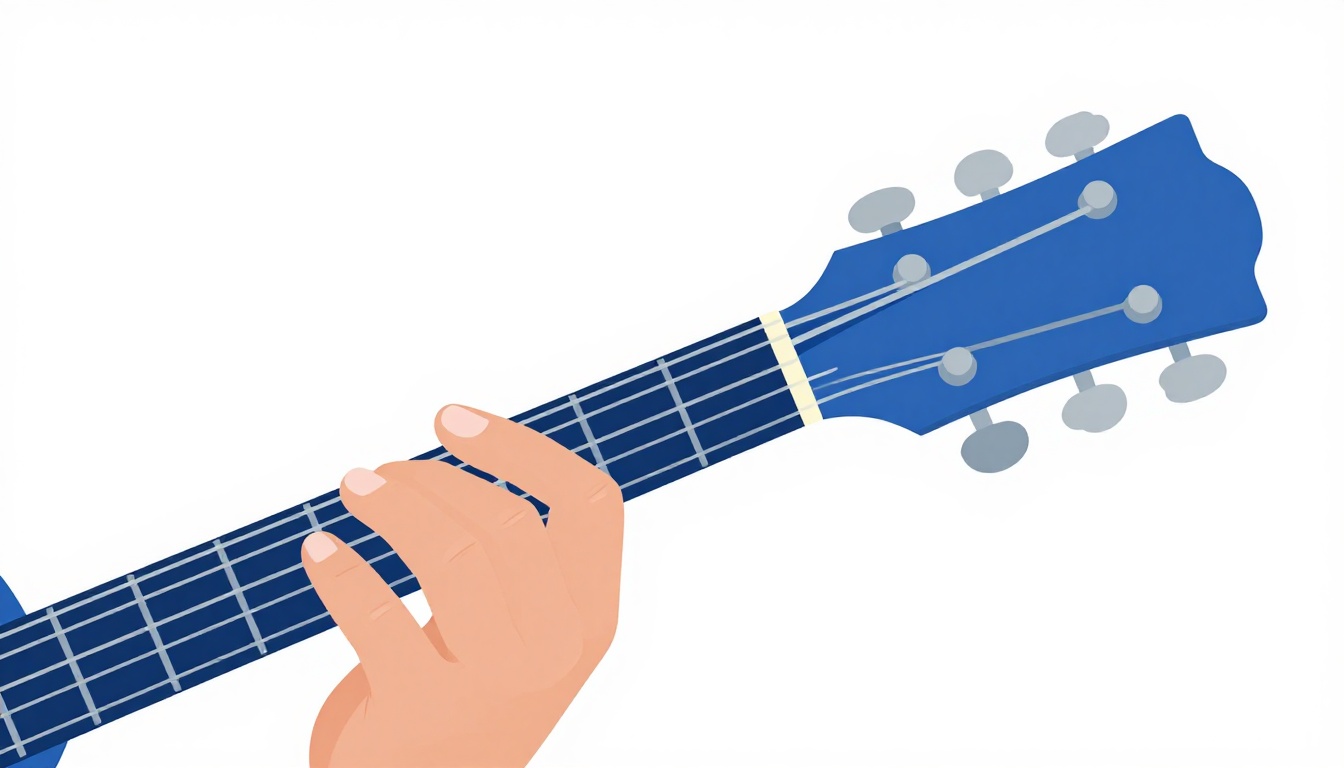
Dsus4 vs Dsus2 vs D major
These three chords share two of their three notes and get confused constantly, so it helps to see them side by side.
| Chord | Notes | Interval that replaces the 3rd | Open shape |
|---|---|---|---|
| D major | D, F#, A | (has a 3rd: F#) | xx0232 |
| Dsus4 | D, G, A | Perfect 4th (G) | xx0233 |
| Dsus2 | D, E, A | Major 2nd (E) | xx0230 |
D and A stay put in all three. The only string that moves is the high E string: 2nd fret for D major, 3rd fret for Dsus4, open for Dsus2. Dsus2 tends to sound brighter and more open because of that ringing high E string, while Dsus4 sounds tighter and more tense because the 4th degree sits so close to the 3rd it is straining to resolve into.
A common beginner mix-up is assuming "sus" always means the same interval. It does not. Sus4 replaces the 3rd with the 4th degree of the scale, sus2 replaces it with the 2nd. Say the full name, sus2 or sus4, out loud when you are practicing so your fingers and your ear learn to associate each shape with its correct name rather than a vague "sus chord" category.
The moveable barre version, for playing Dsus4 anywhere on the neck
Once the open shape feels solid, the barre version lets you play the same chord quality, root, 4th, 5th, from a shape you can slide up and down the neck. The most common form sits at the 5th fret.
| String | Fret | Finger |
|---|---|---|
| 6 (low E) | Muted, do not play | - |
| 5 (A) | 5 | 1 (index, part of the barre) |
| 4 (D) | 7 | 2 (middle) |
| 3 (G) | 7 | 3 (ring) |
| 2 (B) | 8 | 4 (pinky) |
| 1 (high E) | 5 | 1 (index, part of the barre) |
Barre your index finger across all six strings at the 5th fret, but mute the low E string with the underside of that same finger rather than pressing it firmly. Add your middle finger on the D string at the 7th fret, your ring finger on the G string at the 7th fret, and stretch your pinky up to the 8th fret on the B string. Strum from the A string down through the high E string.
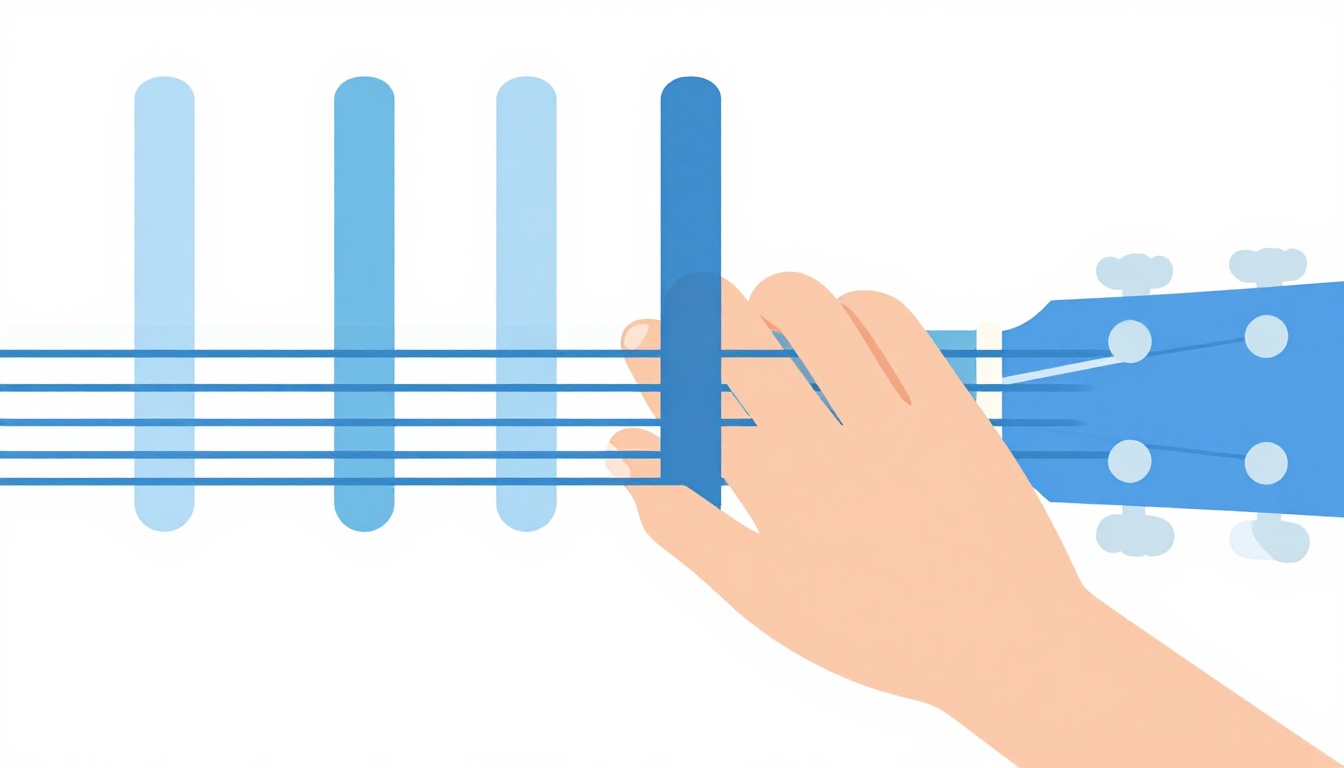
Notice that the pinky sits one fret higher than the middle and ring fingers. This is the detail that most often gets fretting charts wrong for this chord, because it is one fret off from the standard D major barre shape at the same position, where that same string would sit at the 7th fret rather than the 8th. Moving only that one note up by a single fret is what turns a D major barre chord into a Dsus4 barre chord, in the same way that the open shapes differ by exactly one fret on the high E string. If your barre version sounds like plain D with an odd, muddy overtone rather than a clean suspended sound, check that pinky placement first.
This shape is moveable. Slide the whole hand shape up two frets to the 7th position and you get Esus4, up two more to the 9th position and you get F#sus4, and so on, the root note always sitting on the fret your index finger barres on the A string.
Why your Dsus4 is buzzing or sounds dead
A buzz or a muted, thuddy note in Dsus4 almost always comes from one of six specific causes. Work through them one at a time.
Your index finger is lying too flat
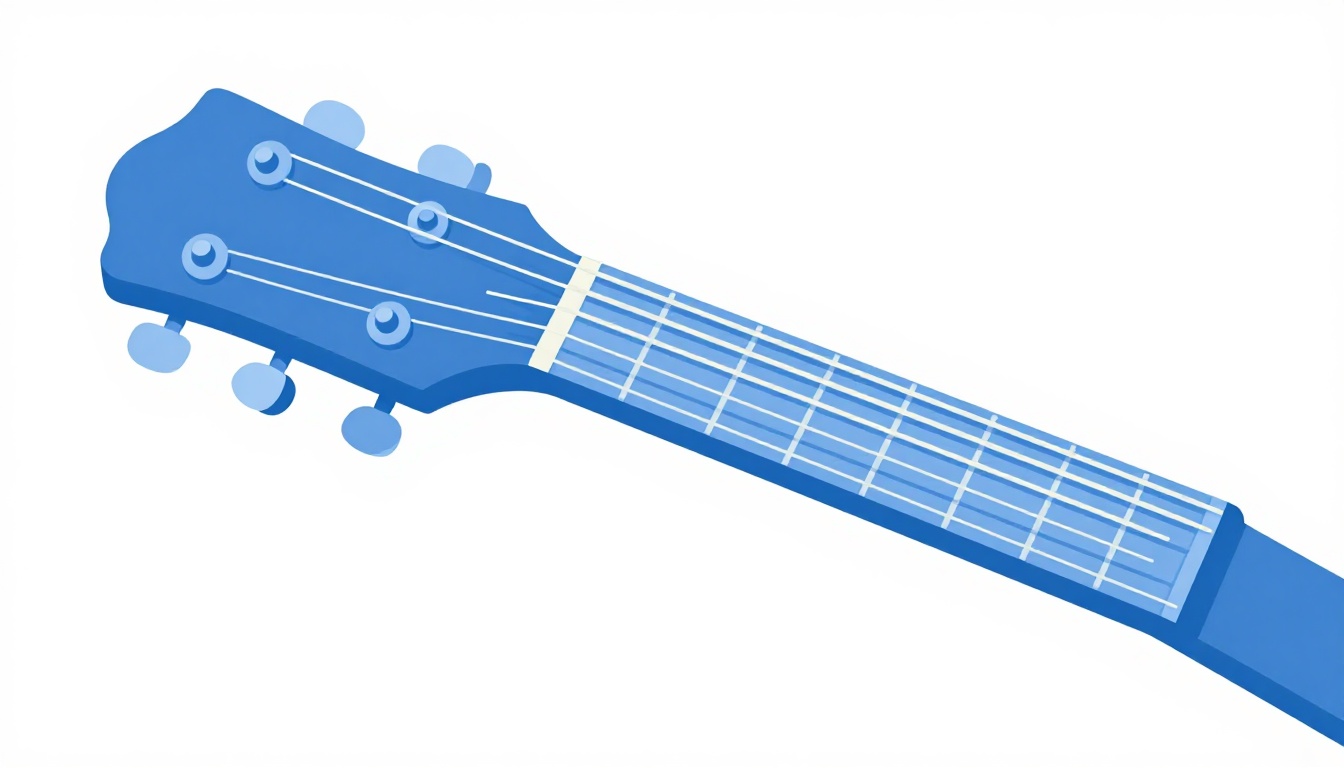
If your index finger rests flat instead of coming down close to vertical on its tip, the pad of that finger can brush against the B string next to it and deaden a note your ring finger is trying to produce two strings over, or worse, choke the open D string right below it. Curl the finger more so it contacts the G string only at the tip, arching up and away from its neighbors.
The ring finger barre is uneven
Barring two strings sounds simple, but a barre only works if the finger applies even pressure across both strings at once. New players often press harder on the string closer to the palm (the B string) and let the high E string go slack, or the reverse. Roll your ring finger very slightly toward its outer edge, which is flatter and firmer than the fleshy center of the fingertip, and you will get a more even bite on both strings.
You are pressing in the middle of the fret space instead of behind the wire
Fret numbers count the space between two metal fret wires, not the wire itself. A finger pressed in the middle of that space, or up near the wire behind it, needs noticeably more force to avoid a buzz than one pressed right up against the fret wire on the side closer to the guitar's body. Move both the index finger and the ring finger barre until each sits just behind its fret wire, and check whether the same amount of pressure now produces a clean note.
Not enough downward force on the barre
Even with good placement, the ring finger barre needs real, continuous pressure across both strings, and that pressure has to hold steady the entire time you strum, not just for the first instant. New players' hands tire quickly holding a barre because the muscles used for it are not yet built up. Fret the two-string barre on its own, pick each string individually, and add pressure gradually until both ring out clean. This is a strength and habit problem, not a technique problem, and it improves with repetition alone.
Your thumb has crept over the top of the neck
If your thumb rides up and over the top edge of the neck instead of staying behind it, it pulls your whole hand's angle flatter to compensate, which flattens your index finger and your barre at the same time. Keep your thumb low on the back of the neck, roughly behind the gap between your index and middle fingers, and both the index finger and the barre naturally arch more without you having to think about either one separately.
The open D string is getting muted by accident
Because the index finger sits on the string directly above the open D string, it is easy for the side of that finger to lean back and mute the D string without you noticing, especially while you are still getting used to the shape. Pick the open D string on its own while your hand holds the Dsus4 shape and confirm it rings exactly as it does with your fretting hand off the guitar. If it sounds shorter or duller, straighten the angle of your index finger slightly until the D string clears completely.
The one-finger trick: moving between D and Dsus4
Here is the detail that makes Dsus4 worth learning in the first place: in almost every song that uses it, Dsus4 exists purely to move into or out of a plain D chord, often within the same strum pattern, sometimes multiple times in a single bar. Finger the two chords the right way and that movement takes a single finger.
Finger your D major chord with your index finger on the G string (2nd fret) and your ring finger on the B string (3rd fret), the same as always, but use your pinky rather than your middle finger for the high E string at the 2nd fret. Now, to move to Dsus4, all you do is slide that same pinky one fret higher, from the 2nd fret to the 3rd fret on the high E string, while your index and ring fingers do not move at all. Slide it back down and you are in D major again.
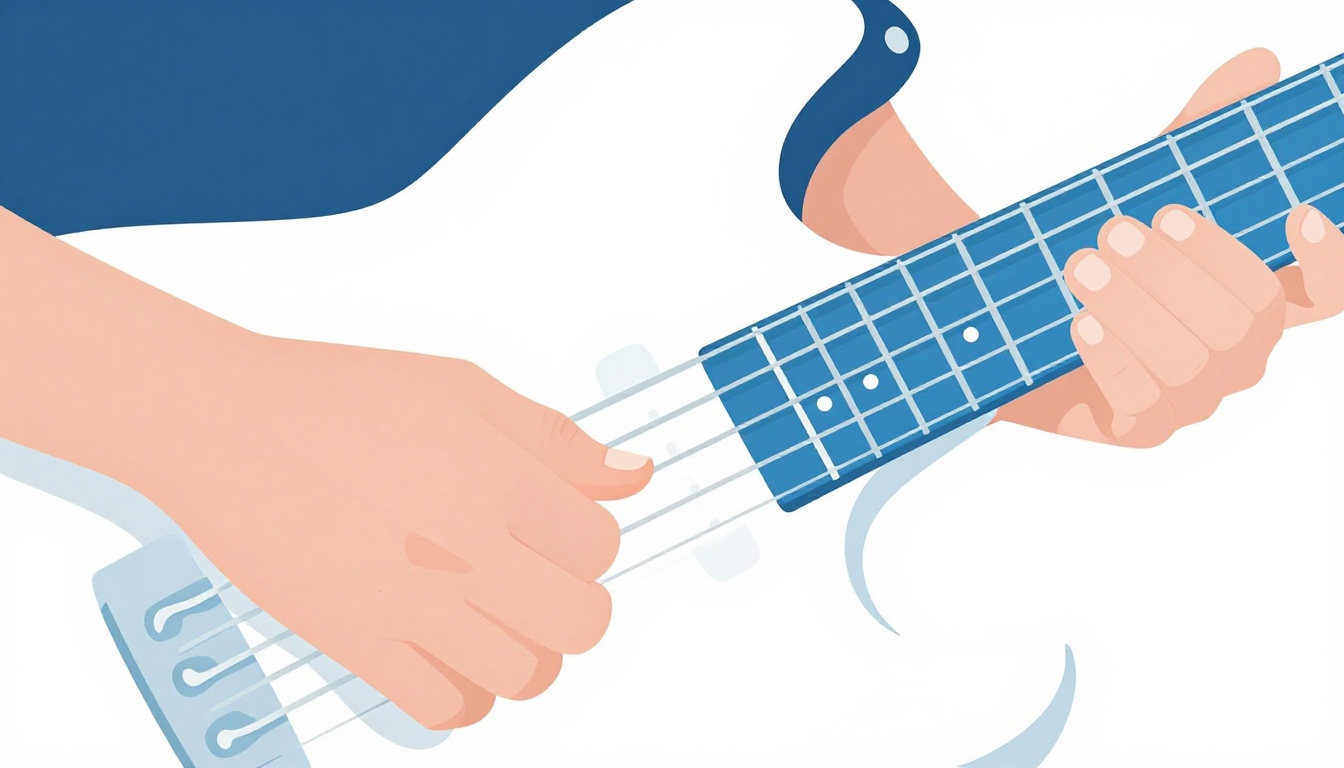
Because the movement is so small, one finger sliding one fret, you can do it as a clean slide, or as a hammer-on and pull-off if you lift the pinky off the string entirely between the two positions rather than sliding along it. Both sound correct; a slide gives a smoother, connected feel between the two chords, while a hammer-on and pull-off gives a slightly more percussive, rhythmic accent, which is closer to how the move is usually played in the songs that made this chord pairing famous. Try both and use whichever fits the feel of what you are playing.
Practice this movement on its own, away from any full song, until your pinky can find both frets without you having to look at your hand. Strum once on D, then hammer the pinky down for Dsus4, strum again, then pull it off back to D, strum a third time. That three-strum pattern, D, Dsus4, D, is the exact shape this trick takes in most of the songs that use it.
Dsus2, for comparison and because it uses the same trick
Since Dsus2 sits on the other side of D major using the identical finger-movement idea, it is worth learning at the same time.
| String | Fret | Finger |
|---|---|---|
| 6 (low E) | Muted | - |
| 5 (A) | Muted | - |
| 4 (D) | Open | - |
| 3 (G) | 2 | 1 (index) |
| 2 (B) | Open | - |
| 1 (high E) | Open | - |
From the same D chord fingering above, index on the G string and ring on the B string, simply lift your pinky off the high E string entirely and let it ring open. That single change, dropping the F# down to an open E string, turns D major into Dsus2. Between the two, you now have a full D, Dsus2, Dsus4 triangle available from one basic hand position, moving only the pinky: lifted off for Dsus2, on the 2nd fret for D, on the 3rd fret for Dsus4.
Changing from Dsus4 into other chords
Outside of its relationship with D major, Dsus4 shows up as a passing or connecting chord on the way to several other common shapes. A few of the moves worth drilling on their own:
Dsus4 to G. Your ring finger barre on the B and high E strings has to release completely, and your index finger slides from the G string over to the low E string, 3rd fret, becoming the root of the G chord. This is a bigger hand reshuffle than the D-Dsus4 move, so slow it down and isolate it before trying it inside a full strum pattern.
Dsus4 to A. The index finger stays roughly in the same area of the neck, moving from the G string to the D string at the 2nd fret, while your other fingers rebuild the A shape around it. Because both chords share the note A as their 5th and root respectively, this change tends to feel more connected than it looks on paper.
Dsus4 to Em. Almost the entire hand relaxes. Em only needs two fingers, on the A and D strings at the 2nd fret, both lower down the neck than anything Dsus4 uses. Most players find this one of the easiest transitions in this whole chord family, since you are moving from a busier shape to a simpler one.
Dsus4 to Bm. This is the hardest of the four, since Bm is itself a barre chord and asks you to reposition your whole hand up the neck while changing every finger. Practice it in isolation, slowly, well before trying to play it inside a song at tempo.
Dsus4 to C. The ring finger barre releases, your index finger slides down from the G string to the B string, and your other fingers build the rest of the C shape around it. Because the index finger's target string changes but stays close to the same area, this move settles in faster than the jump to G.
Dsus4 to F#m. This pairing turns up in the same key of D major progressions that already use Em and Bm, since F#m is the iii chord built from that scale. F#m itself is a barre shape, so if you have not learned it yet, the full F#m fingering and its no-barre alternative are worth working through on their own before trying to chain it after Dsus4 at any real tempo.
For any of these, practice the change alone first: fret Dsus4 clean, strum once, then move to the target chord and strum once, without the pressure of any surrounding rhythm. Once that jump is reliable at a slow, steady pace, add the rest of the song's chords back in around it.
Where Dsus4 fits in the key of D
In the key of D major, the chords built from the scale are D, Em, F#m, G, A, Bm, and F#°, the I through vii° chords. Dsus4 is not one of those seven scale chords in the traditional sense, since it is built by altering the D chord itself rather than stacking thirds on a different scale degree. Instead, think of it as a variation of the I chord (D) that borrows its color note, the 4th, from the IV chord (G) built on the same scale.
That borrowed relationship is exactly why Dsus4 sits so comfortably next to both D and G in a progression. A common pattern in the key of D goes D, Dsus4, D, G, letting the suspended chord act as a brief detour on the way from the tonic to the subdominant, without ever really leaving D major's harmonic space. You will also see Dsus4 substituted directly in place of D at the start or end of a progression, as a way of delaying the full, settled sound of the major chord by a beat or two before it resolves.
Playing Dsus4 fingerstyle
Everything above assumes a strum, but this chord works just as well plucked note by note, and the shape does not change at all, only how your picking hand approaches it.
A simple pattern to start with: thumb on the open D string, then index finger on the G string, middle finger on the B string, ring finger on the high E string, played one after another rather than all at once. Repeat that four-note pattern twice per chord, so it fills a full bar at a moderate tempo. Because the shape only asks for two fretting-hand contact points, the index finger and the ring-finger barre, both hands are free to move independently of each other, the picking hand keeping its own steady pattern while the fretting hand only has to change once per chord.
The pinky-slide trick from earlier works exactly the same way inside a fingerpicked pattern. Play the four-note thumb-index-middle-ring pattern once on D, then slide the pinky up to the 3rd fret on the high E string exactly as your ring finger plucks that string on the next repeat, so the slide and the pluck land together. This produces a small, deliberate accent right on the note that changes, which is a large part of why this movement sounds so natural in fingerpicked arrangements, the ear catches the one note that moves against a pattern that otherwise repeats.
If the full barre-style Dsus4 fingering feels like too much to manage while fingerpicking, the two-finger version covered earlier works just as well here. Drop the B string out of the picking pattern entirely, thumb on D, index on G, ring or middle on the high E string, and you keep all three notes of the chord with one less finger to coordinate against your picking hand.
Progressions that use Dsus4 well
A few chord progressions come up often enough with Dsus4 that they are worth having under your fingers as complete patterns, not just the two-chord D-Dsus4 move in isolation.
| Progression | Chords | Feel |
|---|---|---|
| Resolving turnaround | D, Dsus4, D | The classic single-finger move, tension added and released within one chord |
| Delayed resolution | D, Dsus4, G, A | Dsus4 delays the move to G rather than resolving straight back to D |
| Borrowed subdominant | G, D, Dsus4, D | Dsus4 sits as a brief detour on the way back to D after visiting the IV chord |
| Descending drift | Em, Dsus4, D, A | Common in folk and pop verses, the suspended chord smoothing the step down from Em to D |
None of these need anything beyond the shapes already covered on this page and elsewhere on this site. What changes from one progression to the next is only the timing, how many beats each chord gets before the next change, and that timing is worth working out by ear against whatever recording or song you are actually trying to learn, rather than assuming every Dsus4 gets exactly one beat.
Songs that lean on Dsus4
Dsus4 is common enough in folk, pop, and rock guitar parts that you have almost certainly heard it before recognizing it by name.
Tom Petty's "Free Fallin'" is played with a capo on the 3rd fret, and its verse progression runs D, Dsus4, then Dsus4, D, Dsus2, repeating that same D-based movement across almost the entire song. It is close to the purest possible example of the pinky-slide trick above put into an actual recording, since the chord shapes barely change, just that one finger sliding up and down between D, Dsus2, and Dsus4.
Oasis's "Wonderwall" is played with a capo on the 2nd fret, and its verse cycles through Em7, G, Dsus4, and A7sus4, in that order, before repeating. Here Dsus4 is not resolving straight back to D at all, it is a step inside a longer four-chord loop, which shows that the "tension wanting to resolve" quality described earlier does not always have to resolve immediately. Sometimes it just adds a bit of drift to a chord that comes right after, in this case A7sus4, before the loop starts over.
Both songs are worth learning specifically because they use the chord the way it is meant to be used, as a passing color next to nearby chords rather than a chord that sits on its own for a long stretch. Learning either one is a good way to turn the finger-movement drill above into something that actually sounds like music rather than an exercise. Since both recordings use a capo, remember that the shapes you are fretting are still D, Dsus4, Dsus2, and so on, only the pitch that actually sounds has been shifted up by the capo.
How Dsus4 looks in a chord chart or tab
Chord charts and diagrams describe this shape in a few different ways, and it helps to recognize all of them, since you will run into each one eventually.
A six-character string of frets, read left to right for the 6th string down to the 1st, is the most compact way to write it: x x 0 2 3 3. The two "x" characters mean the low E and A strings are muted or not played, the "0" means the D string rings open, and "2 3 3" gives the frets for the G, B, and high E strings in that order, which matches the table at the top of this page exactly.
A vertical chord diagram, the kind printed in most songbooks, shows the same information as a small grid: six vertical lines for the strings, horizontal lines for frets, dots where you press down, and an "x" or "o" above each of the two lowest strings to show muted or open. Reading one is really just reading the same table above turned sideways, string by string, fret by fret.
In a tab (the numbers-on-lines format used for single-note lines and riffs rather than strummed chords), you would see the same three fretted notes stacked as a chord hit, written as a small vertical group of numbers at one point in the timeline rather than spread across a full measure, since a strummed chord in tab notation is just several notes played at the same instant.
A simple strumming pattern that uses the D-Dsus4 move
Free Fallin's verse pattern, D, Dsus4, Dsus4, D, Dsus2, translates well into a basic folk strum you can use on any song built around this same movement: down, down-up, up-down-up, repeated once per chord change. Land the downstroke of beat one on the chord change itself, whether that is the pinky sliding up into Dsus4 or back down into D, so the strum and the finger movement land together rather than the strum happening slightly ahead of or behind the fret change.
Start slower than feels natural, at a tempo where you can clearly hear each of the three chords ring before moving to the next, and only speed up once the pinky slide happens without you having to think about where it is going. Rushing this pattern before the slide is automatic is the most common reason it turns muddy, since a late or early slide makes the strum land on a half-muted, half-clear string.
Using a capo with Dsus4
Every fingering on this page is a shape, not a fixed pitch, so putting a capo on the neck changes what note actually sounds without changing anything about how your hand moves. Clip a capo on the 2nd fret and play the exact same open Dsus4 shape covered at the top of this page, and you get Esus4 at concert pitch, since the capo has raised every open string by two semitones.
This matters most when you are playing along with a recording in a key that does not have a comfortable open Dsus4 shape of its own. Rather than learning a new, harder fingering for a different suspended chord, capo up or down to the fret that puts the song in D, and use the shape you already know. Count the number of frets between the recording's actual key and D to figure out where the capo needs to sit.
This is exactly what both songs referenced above are doing. "Free Fallin'" sits at a capo 3 position, so the fretting hand is playing D, Dsus2, and Dsus4 the whole way through, while the pitch that actually sounds is F, Fsus2, and Fsus4. "Wonderwall" sits at capo 2, so the same open shapes covered on this page sound a whole step higher than written. In both cases, learning the D-family shapes on this page is directly transferable, since the capo is doing the work of changing pitch and your hand never has to learn a new shape for a new key.
Common mistakes with suspended chords in general
Beyond the specific buzzing causes already covered, a few habits trip up players learning sus chords as a category, not just Dsus4 specifically.
Holding the suspended chord too long. Because a sus chord has no 3rd, it does not commit to major or minor, and letting it ring on its own for several full bars starts to sound unresolved in a way that reads as unfinished rather than intentional. Most uses of Dsus4 in real songs last a beat or two before resolving back to D, not a full measure or more.
Treating every "sus" chord as interchangeable. As covered above, sus2 and sus4 are different intervals with different sounds, and a chord chart that says "Dsus" without specifying which one is leaving out real information. If you are working from a chart that just says "sus," check a recording to hear which one is actually being played before you guess.
Forgetting which notes moved. The fastest way to learn any new sus chord on a different root is to compare it to the major chord you already know, and identify exactly which single note changes and by how much. That comparison is what makes the D, Dsus2, Dsus4 family fast to learn as a set, rather than three unrelated shapes memorized separately.
Practicing the shape only in isolation. A sus chord that sounds perfect on its own, held indefinitely while you check each string, can still fall apart the moment it has to arrive on beat one of a real strum pattern, because the fretting-hand movement that gets you there was never rehearsed at tempo. Once the static shape is clean, the next step is always practicing the specific move into it, whether that is the pinky slide from D or a bigger jump from somewhere else on the neck, at the actual speed the song needs.
Left-hand position and thumb placement, the fundamentals underneath every shape above
Every fix in this page assumes a few basics about how your fretting hand sits on the neck, and it is worth checking these directly if more than one chord in this family feels consistently difficult rather than just one specific finger.
Keep your thumb low on the back of the neck, roughly opposite the gap between your index and middle fingers, rather than high near the top edge or wrapped over it. A low thumb gives your fingers a more open angle to come down on the strings from above, which is what lets them arch onto their tips instead of lying flat.
Angle your wrist very slightly outward, away from the body of the guitar, rather than keeping it perfectly straight. A completely straight wrist tends to flatten the fingers as they reach for higher strings, while a small outward angle opens up the hand's natural curl.
Keep your fretting-hand elbow reasonably close to your side rather than winging outward. An elbow that drifts away from the body pulls the whole forearm's angle out of line with the neck, which then has to be compensated for somewhere in the wrist or fingers, usually at the cost of a clean arch.
None of these are specific to Dsus4, but a barre shape like the two-string ring finger barre in this chord exposes bad hand position faster than a simple single-finger chord does, since a barre has no room for even slight flatness before a string chokes.
A short warm-up for the ring-finger barre
If the two-string barre on the B and high E strings is the one part of this chord that will not cooperate, a short dedicated warm-up before you attempt the full shape tends to help more than repeating the whole chord over and over.
Start with just the ring finger, off the guitar entirely, and press its tip against your thumb, feeling which part of the fingertip makes first contact. That same contact point, closer to the outer edge than the fleshy center, is what you want touching the strings.
Then, on the guitar, lay the ring finger flat across only the B and high E strings, at the 3rd fret, with no other fingers involved yet. Pick both strings together and listen for two clean notes rather than one clean note and one buzz. Roll the finger slightly toward its outer edge until both ring out, then relax the hand completely and repeat the whole motion from scratch, rather than holding the position and just adding pressure. Building the barre fresh each time trains the placement itself, not just the strength to force a bad placement into working.
Do ten of these clean, deliberate repetitions before adding the index finger and forming the complete Dsus4 shape. Most players find the barre noticeably easier within the same practice session once it has been isolated like this, since the index finger and the rest of the hand are no longer distracting from the one part that actually needs the work.
A practice routine for today
Fifteen minutes is enough to make real progress on this chord if the time is spent deliberately rather than strumming through it and hoping it improves.
- Two minutes: Fret the open Dsus4 shape, strum once, hold, and listen. Check each string individually, low E and A muted with no sound at all, D ringing open and clear, G, B and high E all clean with no buzz. Reset your hand and repeat ten times.
- Three minutes: Practice the D to Dsus4 pinky slide in isolation. Strum D, slide the pinky up for Dsus4, strum, slide back down, strum. Repeat slowly, focusing on keeping the index and ring fingers completely still while only the pinky moves.
- Five minutes: Pick one transition from the "changing into other chords" section, whichever one you find hardest, and drill just that single change, back and forth, at a slow, steady pace with one strum per chord.
- Five minutes: Play through "Free Fallin'" or "Wonderwall" at a slow tempo, using the D-Dsus4 movement in context rather than in isolation, even if you have to stop and restart at the hard parts.
Repeating this same fifteen minutes daily for one to two weeks is usually enough for the open shape to stop needing conscious thought, at which point the barre version becomes the next thing worth spending that same daily quarter hour on.
Frequently asked questions
Is Dsus4 hard to play? The open shape is easier than most beginner chords, since it only needs two contact points, an index finger and a two-string ring finger barre, and no big stretches. The barre version at the 5th fret is harder, roughly on par with any other full barre chord, and is worth learning only after the open shape and a handful of full barre chords elsewhere feel comfortable.
Why does Dsus4 sound unfinished? Because it has no 3rd, the note that normally tells your ear whether a chord is major or minor. Without it, your ear hears the 4th degree pulling toward the 3rd it is replacing, which creates the sense of tension and expectation that gives suspended chords their name.
Do I always have to resolve Dsus4 to D? No, but it is by far the most common use, and the reason the chord exists in most guitar parts. Some songs use Dsus4 as a standalone color without resolving it at all, but if you are learning it for the first time, practicing the resolution to D first will make the chord's purpose click faster.
What is the difference between Dsus4 and Dadd4? Dsus4 replaces the 3rd (F#) with the 4th (G) entirely, so the chord has no 3rd at all. Dadd4 keeps the 3rd and adds the 4th on top, giving you both F# and G in the same chord, a denser and more dissonant sound than Dsus4's cleaner, three-note structure.
Can I strum all six strings for Dsus4? Not for the open shape. Strumming the low E and A strings adds notes that are not part of the chord and will sound muddy. The barre version at the 5th fret is built to use all six strings safely, since the barre itself mutes or correctly notes the low strings as part of the shape.
Why does my barre version sound wrong even though my fingers are in the right place? Double-check the pinky's fret. The most common error in barre Dsus4 charts online places the pinky at the same fret as the middle and ring fingers, which actually produces a D major barre chord, not Dsus4. The pinky needs to sit one fret higher than the middle and ring fingers for the chord to be correct.
Is Dsus4 the same on every string set or tuning? No. Everything on this page assumes standard tuning, E-A-D-G-B-E from the 6th string to the 1st. In any alternate tuning, the same finger shape will produce different notes, so treat these fingerings as standard-tuning specific unless you have separately worked out the shape for whatever tuning you are using.
How do I tell sus2 from sus4 when I'm listening to a recording rather than reading a chart? Listen to the top note of the chord relative to the D chord you already know. If it sounds a little higher and brighter than plain D, almost like an open, ringing extra note, that is usually Dsus2. If it sounds a little tighter and more urgent, like it is pulling toward the D chord that follows it, that is usually Dsus4. This gets easier fast once you have practiced sliding your own pinky between all three positions, since your ear starts to recognize the sound from having produced it yourself.
What is the fastest way to learn this chord if I already know D major? Learn the pinky slide first, before anything else on this page. Since Dsus4 differs from D by exactly one finger moving one fret, treating it as a modification of a chord you already know is faster than learning it as an entirely new shape, and it immediately shows you the musical relationship that makes the chord useful in the first place.
If you are still building your basic open chord vocabulary before tackling shapes like this one, Dmaj7 and Dm/A round out the same family of D-based shapes, and GuitarLowKey's daily lessons are built around the same fifteen-minutes-a-day approach used in the practice routine above.
GuitarLowKey
Ready for fifteen focused minutes?
Open the web app and train the change that is blocking your song.