
The Guitar Capo Chart: Every Shape, Every Fret, Explained
The full guitar capo chart for frets 1 to 7, major and minor shapes, how to read it in either direction, and why higher frets stop working.

A guitar capo chart tells you what chord actually sounds when you clamp a capo on a fret and play a familiar open shape. Put the capo on the third fret and strum a C shape, and you are not hearing a C, you are hearing an Eb. The chart below maps every open shape to every fret from 1 to 7, in both directions, so you can go from chord name to shape or from shape back to chord name without doing the semitone math yourself every time.
The Guitar Capo Chart for Major Shapes
Each row is a capo fret. Each column is the open chord shape your left hand is actually forming. The cell where they cross is the chord you hear.
| Capo Fret | C Shape | D Shape | E Shape | G Shape | A Shape |
|---|---|---|---|---|---|
| 1 | C#/Db | D#/Eb | F | G#/Ab | A#/Bb |
| 2 | D | E | F#/Gb | A | B |
| 3 | D#/Eb | F | G | A#/Bb | C |
| 4 | E | F#/Gb | G#/Ab | B | C#/Db |
| 5 | F | G | A | C | D |
| 6 | F#/Gb | G#/Ab | A#/Bb | C#/Db | D#/Eb |
| 7 | G | A | B | D | E |
So a capo on fret 5 with an open G shape sounds like a C. A capo on fret 2 with an open D shape sounds like an E. The shape under your fingers never changes, only what comes out of the sound hole.
The Guitar Capo Chart for Minor Shapes
Minor shapes shift by the exact same math. If a shape is minor before the capo goes on, it is minor after.
| Capo Fret | Am Shape | Em Shape | Dm Shape |
|---|---|---|---|
| 1 | A#m/Bbm | Fm | D#m/Ebm |
| 2 | Bm | F#m/Gbm | Em |
| 3 | Cm | Gm | Fm |
| 4 | C#m/Dbm | G#m/Abm | F#m/Gbm |
| 5 | Dm | Am | Gm |
| 6 | D#m/Ebm | A#m/Bbm | G#m/Abm |
| 7 | Em | Bm | Am |
These two tables cover the five major shapes and three minor shapes almost every open-chord song is built from: the CAGED major shapes plus Am, Em and Dm.
What a Capo Actually Does to Your Guitar
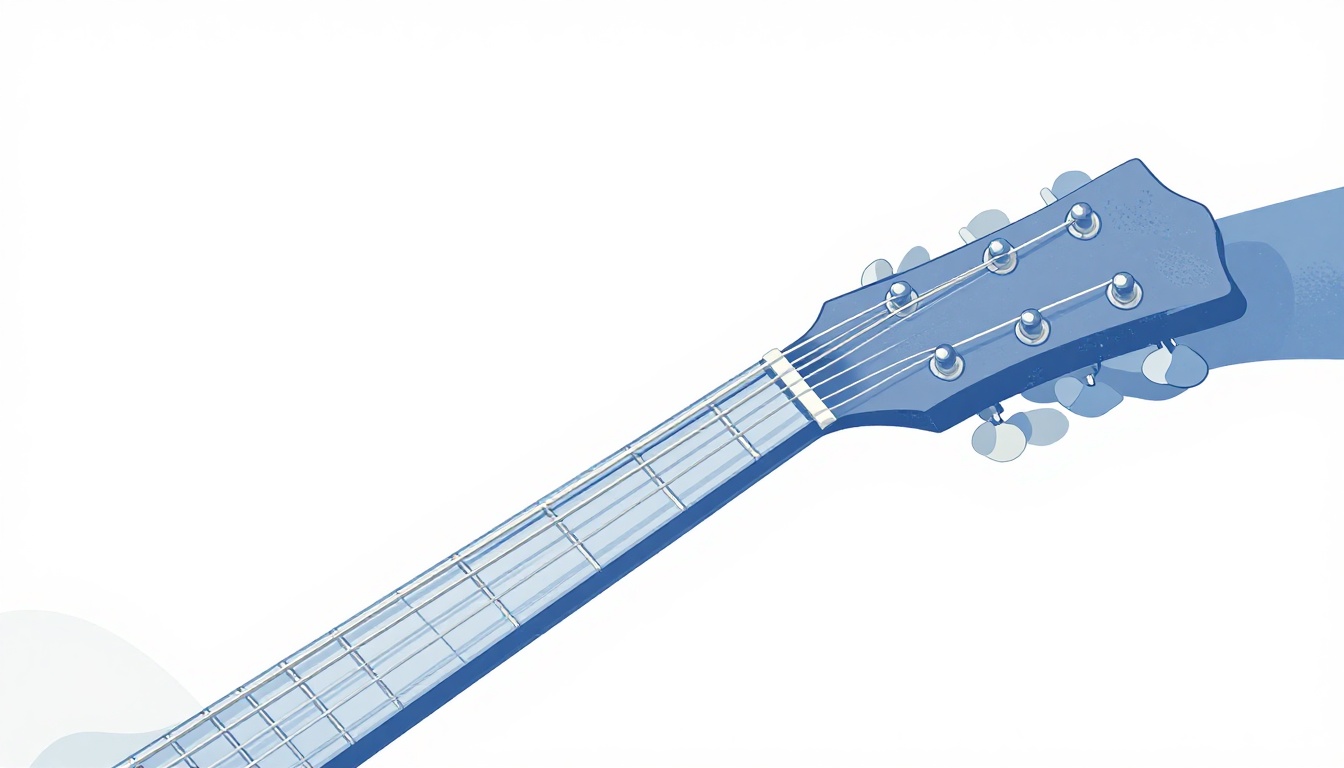
A capo is a clamp that presses all six strings down against one fret, the same way your index finger does in a barre chord, except it never gets tired and never buzzes if it is seated correctly. It does not retune the guitar. It does not change any string's pitch relative to the others. What it does is move the effective start of the fretboard, the point strings vibrate from, up to wherever the capo sits.
Standard tuning is E-A-D-G-B-E from the 6th string (low E, the thickest) to the 1st string (high E, the thinnest). Every fret raises every open string by one semitone. A capo on fret 3 means your six open strings are no longer E-A-D-G-B-E, they are G-C-F-A#-D-G, a semitone stack for each string, three frets up. Play a C shape against that new baseline and the chord that comes out is a C shape's worth of semitones higher than C itself, which lands on Eb.
This is why the chart works for any shape, not just the eight listed above. If you know a shape's letter name with no capo, add the capo fret number in semitones to find the new name. Fret 1 adds one semitone, fret 2 adds two, and so on up the chromatic scale: C, C#/Db, D, D#/Eb, E, F, F#/Gb, G, G#/Ab, A, A#/Bb, B, then back to C at the octave.
The Full Chromatic Reference
The two tables above only need the twelve-note cycle repeated for as many frets as a capo can reasonably sit on. This is the underlying reference they are both built from, the number of semitones each fret adds and where that lands on the musical alphabet, starting from any open string or open shape.
| Frets Above Open | Semitones Added | Note Reached From C |
|---|---|---|
| 0 (no capo) | 0 | C |
| 1 | 1 | C#/Db |
| 2 | 2 | D |
| 3 | 3 | D#/Eb |
| 4 | 4 | E |
| 5 | 5 | F |
| 6 | 6 | F#/Gb |
| 7 | 7 | G |
| 8 | 8 | G#/Ab |
| 9 | 9 | A |
| 10 | 10 | A#/Bb |
| 11 | 11 | B |
| 12 | 12 | C (one octave up) |
Swap in any starting shape and the same row of semitone additions applies. This is the entire mechanism behind both tables above, and it is also how you would extend the chart yourself past fret 7 if a specific song genuinely needed it, by continuing the same count past 11 back to C and starting the cycle again.
What About 7th, Sus and Add9 Shapes?
The two tables only list plain major and minor triads, but the same semitone math applies to every extended shape a song might ask for, a Cadd9, a G7, a Dsus4. The chord's modifier, add9, 7, sus4, sus2, maj7, never changes when a capo goes on. Only the root letter shifts, by exactly the same amount the plain triad chart already shows.
| Extended Shape | Capo 2 | Capo 4 |
|---|---|---|
| Cadd9 | Dadd9 | Eadd9 |
| G7 | A7 | B7 |
| D7 | E7 | F#7/Gb7 |
| Asus4 | Bsus4 | C#sus4/Dbsus4 |
To transpose any extended shape not listed here, find its root note in the plain major or minor table (a Cadd9's root is C, a G7's root is G), read off the transposed root at the capo fret you are using, and keep the modifier exactly as it was.
How to Read the Chart in Either Direction
A capo chart answers two different questions, and mixing them up is the most common way people misread one.
Question one: what shape gets me a chord I want
You already know the chord you need. A song is in F major, but you do not want to hold a full barre chord for the whole song. Look across the "F" answers in the major table: capo 1 with an E shape gives F, and capo 5 with a C shape also gives F. Either works. Pick the one whose shape you already play cleanly.
Question two: what am I actually playing
Someone hands you a guitar with a capo already on fret 4 and says "play a G shape." You are not hearing a G. Look at the Capo Fret 4 row, G Shape column: the chord ringing out is B. This direction matters most when you are jamming with someone who calls out a capo fret and a shape, and you need to know what key you are all actually in together.
Worked Example: Playing a Song in F Without Barre Chords
F major is one of the first chords that pushes new players toward barre chords, because the open-position F shape asks for a partial barre across two strings that new hands have not built the strength for yet. A capo removes that requirement entirely.
Say a chord sheet gives you F, Dm, Bb and C, the I-vi-IV-V of F major. None of those are comfortable open shapes on their own. Scan each fret's row in both tables for one that produces all four:
- Capo 5: C shape gives F, G shape gives C, Am shape gives Dm. Three of four solved in one fret.
- Bb is the holdout. No entry in either table at capo 5 produces Bb, because the shape it would need, an open F shape, does not exist among C, D, E, G and A.
- Checking every other fret turns up the same gap: capo 1 solves F (E shape) and Bb (A shape) but not Dm, capo 3 solves F (D shape), Bb (G shape) and C (A shape) but not Dm either.
No single fret from 1 to 7 turns all four chords into open shapes, because Bb has no open-position equivalent at any of them. That is a normal, common outcome, not a mistake in the chart. The practical fix is capo 5 for the C, F and Dm shapes, with Bb formed as a small E-shape barre one fret above the capo, rather than hunting for a fret that does not exist.
Worked Example: Figuring Out What Key You Are Really In
A friend is playing rhythm guitar with a capo on fret 2, strumming what looks like a G, C, D, Em progression. To sing along or work out the actual key, run each shape through the Capo Fret 2 row:
- G shape at capo 2 = A
- C shape at capo 2 = D
- D shape at capo 2 = E
- Em shape at capo 2 = F#m/Gbm
The song is actually in the key of A, using the I-IV-V-vi progression (A, D, E, F#m) that shows up constantly in pop and folk music, just played with G-C-D-Em shapes because they are easier under a capo than A-D-E-F#m would be as open shapes without one.
Worked Example: A Minor-Key Progression Under a Capo
The same lookup works exactly the same way for minor progressions, using the minor shape table instead of the major one. Say someone in a jam calls out "capo 3, Dm, Am, Em" without naming the actual chords. Read the Capo Fret 3 row of the minor table:
- Dm shape at capo 3 = Fm
- Am shape at capo 3 = Cm
- Em shape at capo 3 = Gm
The progression is really Fm, Cm and Gm, the i, v and ii chords of F minor, a real minor-key movement rather than three unrelated minor chords. Nothing about the method changes between major and minor shapes, only which table you read from.
Verifying the Chart Yourself With a Tuner
Every table in this guide assumes a capo adds exactly one semitone per fret with no error, and that assumption is easy to check on your own guitar in under a minute rather than trusting it blindly.
Clip a chromatic tuner to the headstock. Play the open 6th string (low E) with no capo and confirm the tuner reads E. Place the capo on fret 1 and pluck the same string again: the tuner should read F, exactly one semitone up, with no sharp or flat warning either way. Move the capo to fret 2 and confirm F#/Gb, then fret 3 and confirm G. If any reading is off by more than a few cents, the issue is the capo's seating or tension on your specific guitar, not an error in the chart, and the fixes are the placement and pressure checks covered later in this guide.
Reading "Capo 2" Notation on a Chord Sheet
Printed and online chord sheets use two different conventions, and confusing them is the second most common way to misread a capo chart, right after mixing up the two reading directions covered above.
Shape notation prints a line like "Capo 2" above the song, then lists chords as G, C, D and Em throughout. Those letters are the shapes to finger, not the pitch you will hear. Run each one through the Capo Fret 2 row of the major and minor tables to find the sounding chords: A, D, E and F#m.
Concert pitch notation skips the capo instruction entirely and lists the song already resolved to what the listener actually hears, so the same song would show A, D, E and F#m directly with no capo note at all. This version is correct for a horn player or a second guitarist playing without a capo, but it gives no hint that an easier, capoed version exists.
Some sites split the difference and print both, something like "Capo 2 (sounds in A): G, C, D, Em", which removes the guesswork entirely. When a sheet gives only a capo instruction and shapes, or only sounding chords with no capo note, the tables above convert between the two in either direction.
Worked Example: Two Guitarists, Two Capo Frets, One Song
A capo chart also explains a common arranging trick: two guitarists playing the same song can use completely different capo frets and shapes and still sound like they are in the same key, because they are chasing the same target chord from two different directions.
Take a song in A major. One guitarist capos at fret 2 and plays the familiar G-shape family, G, C, D and Em, which the Capo Fret 2 row confirms sound as A, D, E and F#m. A second guitarist skips the capo entirely and plays A, D, E and F#m as their native open and barre shapes. Both guitarists are producing the identical chord names throughout the song, but not the identical sound: the capoed G shapes ring open strings that the native A-shape chords do not, and vice versa, so the two parts stack into a fuller, doubled texture rather than a duplicate of each other. This is the same reason a capo chart matters for arranging, not only for finding an easy chord shape.
Matching a Capo to Your Guitar's Neck
A capo chart assumes the capo actually clamps evenly across the neck it is on, and neck width varies enough between guitar types that a capo sized for one will not sit correctly on another.
| Guitar Type | Typical Nut Width | What to Match |
|---|---|---|
| Steel-string acoustic | About 1.6875 to 1.75 inches | Standard curved capo sized for a slightly radiused fretboard |
| Electric | About 1.65 to 1.69 inches | Narrower capo, often flatter to match a tighter fretboard radius |
| Classical or nylon-string | About 1.875 to 2.04 inches, flat fretboard | Wide, flat-profile capo with lower clamp tension for nylon strings |
Classical necks run noticeably wider and flatter than steel-string or electric necks, which is why a capo bought for a steel-string acoustic often will not seat flat across a classical fretboard, and why the type comparison above lists screw-style capos as the more reliable match for nylon strings specifically.
Choosing the Best Capo Fret for a Song
More than one capo fret can usually solve the same chord problem, so pick with a few practical filters, in order:
- Fewest new shapes to learn. If a song written in Eb can be played with capo 1 and C-shaped chords, or capo 3 and A-shaped chords, and you already know C-family shapes better, take capo 1.
- Comfortable strumming hand position. Frets 1 through 4 keep your strumming hand close to its normal position over the sound hole. Past fret 5, the guitar starts to feel and sound noticeably different, brighter and tighter, which is sometimes exactly the tone a song wants and sometimes not.
- Vocal range. If a singer is straining at the original key, the capo fret is the fastest way to shift the whole song up without relearning a single chord shape, covered in its own section below.
- What the original recording used. If you are trying to match a specific record, search for the capo fret that artist used. Many published tabs list it directly under the song title.
Matching a Song's Written Key to a Comfortable Capo Fret
Chord-by-chord lookups work, but most songs stay in a single key from start to finish, and once you know the key you can pick a capo fret for the whole song in one step instead of checking every chord separately. C, D, E, G and A major are already comfortable without a capo. These are the keys that are not:
| Song Key | Capo Fret | Open Shape to Play |
|---|---|---|
| Db (C#) | 1 | C shape |
| Eb (D#) | 1 | D shape |
| F | 1 | E shape |
| F# (Gb) | 2 | E shape |
| Ab (G#) | 1 | G shape |
| Bb (A#) | 1 | A shape |
| B | 2 | A shape |
Every one of these lines up with the major shape chart above. F#, for example, is what an E shape sounds like with the capo on fret 2, which you can confirm directly in the Capo Fret 2 row. If a song sits in one of these keys throughout, capo at the listed fret and play the whole thing in the shape family you already know, checking individual chords against the full chart only if the song borrows a chord from outside its main key.
The Nashville Number System and a Capo
Session players and worship musicians often write chords as scale-degree numbers instead of letters, so a progression works in any key without rewriting it: 1 for the root chord, 4 and 5 for the chords built a fourth and fifth above it, 6m for the relative minor, and so on. G, C, D and Em in the key of G are written as 1, 4, 5 and 6m.
A capo chart and the number system solve two different problems that stack together cleanly. The number system tells you the relationship between chords regardless of key. The capo chart tells you which physical shapes reproduce a given key's chords. Put together: if a chart says "Capo 2, play 1-4-5-6m in the shapes of G", you already know from the key-matching table above that capo 2 with G-family shapes sounds like the key of A, and the numbers tell you which four chords in that key to expect, G, C, D and Em as shapes, sounding as A, D, E and F#m.
This is why bands with multiple guitarists frequently agree on numbers and a single capo fret before a song starts, rather than naming every chord out loud. One player calls "Capo 2, key of G shapes," and everyone can find 1, 4, 5 and 6m in their own preferred voicings without a single chord name being spoken.
Capo Charts and Drop D Tuning
Drop D tuning lowers only the 6th string (low E) down one whole step to D, leaving the other five strings at standard pitch: D-A-D-G-B-E low to high. A capo still does the same job in drop D that it does in standard tuning, shifting every open string up by one semitone per fret, including the dropped 6th string. The math from the semitone table above still applies without any change.
What does change is which shapes are worth transposing. The C, D, E, G and A shapes in the main chart assume standard tuning throughout, and most drop D playing centers on a different shape entirely, a two-finger power chord barred across the 6th, 5th and 4th strings, which in drop D with no capo sounds like a D5 power chord. Add a capo at fret 2 and that exact shape, unchanged under your fingers, now sounds like an E5, two semitones higher, following the identical logic as every other example in this guide.
Partial capos, covered above, are popular specifically because they let a standard-tuned guitar fake this drop-D droning low string without retuning at all, which is why the two topics usually come up together.
Why Capo Charts Stop Around Fret 7
Most printed capo charts, including the two above, stop at fret 7, and that is not an arbitrary cutoff. Three real problems show up as you move higher:
The frets get physically smaller
Fret spacing shrinks the further you go up the neck, since each fret is a fixed fraction of the remaining string length. By fret 7, the gaps are noticeably tighter than at fret 1, and a capo needs more precise placement to clamp cleanly without muting a string.
Intonation drifts
A guitar's frets are cut for a specific scale length assuming the nut is at position zero. A capo is not manufactured to the same tolerance as a factory nut, and the higher up the neck it sits, the more any small placement error compounds into audibly sharp or flat notes, especially on wound strings.
The shapes stop being useful
The entire reason to capo instead of just moving a barre chord up the neck is to keep open strings ringing. Past fret 7, you are close enough to the body join on most acoustics that fingerpicking and full strums become awkward, and at that point a barre chord played in position, with no capo at all, is usually easier than reaching a cramped capoed shape.
What to do when a song's math points past fret 7
If working through the chart genuinely points to a capo fret above 7, there are three better options than forcing it. Tune the whole guitar down a step and use a lower, more comfortable capo fret to land on the same pitch, since a whole-step-down tuning plus capo 5 reaches the same sounding chord as standard tuning plus capo 7. Use a partial capo, which handles many of the same droning, open-string effects without needing an extreme fret. Or simply play the required shape as a barre chord in position, with no capo at all, which is usually the more comfortable choice by the time the math calls for fret 8 or higher.
Capo or Barre Chord? When to Skip the Capo
A capo and a barre chord solve the same problem, moving a shape's pitch up the neck, but they are not interchangeable in every situation.
Use a capo when you want the ringing, slightly jangly sound of open strings, when a song changes key but keeps the same chord shapes throughout, or when your fretting hand needs a rest from full barre chords during a long set.
Skip the capo and use a barre chord when the song needs to change key or capo position mid-song faster than you can physically move a capo, when you need the darker, more controlled tone barre chords give compared to the ringing openness of a capo, or when the arrangement calls for a chord shape at a fret with no capo attached, like a barred F at the 1st fret while the rest of the band stays uncapoed.
How a Capo Changes Your Guitar's Tone, Not Just Its Pitch
The chart tells you the note name, but it does not tell you that the same chord sounds different depending on where the capo sits, and that difference is often the real reason a song calls for a capo instead of just transposing on paper.
Lower frets, 1 through 3, sit closest to the nut, where the strings are longest and loosest per note, giving a fuller, slightly darker ring that is close to the guitar's natural open-string sound. Higher frets, 5 through 7, shorten the vibrating length of every string more aggressively, which tightens the tone into something brighter and thinner, closer to a mandolin or a smaller-bodied guitar. Neither is more correct, but a song arranged for a capo at fret 7 will sound noticeably different transposed to an uncapoed open-position chord in the same key, even though the note names match exactly.
This also changes how the guitar feels under your fingers. String tension per fret does not change with a capo, since it is not retuning anything, but the shorter vibrating length past fret 5 makes strings feel slightly stiffer and more responsive to light picking, which is part of why fingerstyle arrangements often specify a higher capo fret even when a lower one would produce the same chord names.
Common Capo Placement Mistakes
A capo chart only works if the capo is actually in tune with itself. These are the mistakes that make an in-tune guitar sound wrong the moment the capo goes on.
Placing it too far from the fret wire
A capo belongs directly behind the fret wire, the same spot your finger goes for a clean note, not in the middle of the fret space. Placed too far back, toward the previous fret, it either buzzes or pushes the string sharp because it is stretching the string slightly as it clamps.
Squeezing harder than the strings need
Once a string rings clearly, more pressure only pulls it sharper. Spring and trigger capos apply a fixed amount of force by design, but screw-style capos let you overtighten. If open strings sound noticeably sharper than the fretted notes higher up the neck, the capo is clamped too hard.
Capoing over a nut extender or zero fret without checking
Some guitars have unusual nut setups. Always strum all six open strings after placing the capo and listen for one string sounding dead or muted before playing further, rather than finding out mid-song.
Leaving it on an angle
A capo pressed on crooked touches some strings more firmly than others. Lay it on parallel to the fret wire, and if your guitar's fretboard is radiused (slightly curved), check that a capo advertised for radiused necks is what you are using.
Using a capo built for the wrong neck width
Classical and nylon-string necks are noticeably wider than steel-string acoustic or electric necks. A capo sized for a narrow electric neck will not sit flat across a classical neck, and the outer strings often buzz or fall outside the clamp's padded surface entirely. Match the capo's stated width range to the guitar it is going on.
Why Your Guitar Sounds Out of Tune After You Capo
This is the complaint behind almost every "my capo is bad" search, and it is rarely the capo's fault alone.
The guitar was already slightly out before the capo went on
A capo makes any existing tuning error more audible, because it adds a second clamped point close to where you are also fretting notes. Tune with a clip-on or pedal tuner immediately before placing the capo, not just at the start of a practice session an hour earlier.
Wound strings need a slightly different touch
The 6th, 5th and 4th strings (low E, A and D) are wound, and they compress differently under clamp pressure than the plain 1st, 2nd and 3rd strings. If the wound strings sound consistently sharp with the capo on, ease off the clamp tension slightly if your capo has an adjustable screw.
Retune after the capo is on, not just before
Placing a capo can shift a guitar's tuning by a few cents even when it is seated correctly, because it adds tension at a new point on the neck. Touch up the tuning with the capo already clamped on, especially for recording or anything picky like fingerstyle.
The capo is too old or too cheap to hold consistent pressure
Spring tension in trigger-style capos weakens over years of use. If a capo that used to sound fine now consistently pulls strings sharp no matter how carefully you place it, the spring itself may be the problem, not your technique.
The Different Types of Capos and What They Are For
Every capo does the same basic job, clamp all strings at one fret, but they get there in different ways, and each style trades off speed, tone and control differently.
| Capo Type | How It Clamps | Best For |
|---|---|---|
| Spring trigger | Squeeze-and-release lever, fixed spring tension | Fast changes mid-song, most common style for beginners |
| Screw or wrap | Manual screw tightens a strap or bar across the neck | Precise, adjustable pressure, good for classical and nylon-string necks |
| Cam or toggle lever | Lever locks over-center once closed | Adjustable tension with one-handed speed once set |
| Partial capo | Clamps only some strings, leaving others open | Alternate-tuning sounds without retuning the guitar |
Spring trigger capos
This is the style most players reach for first, a scissor-like clamp with a fixed spring that snaps shut around the neck in one motion. Because the tension is preset by the manufacturer, there is nothing to adjust between placements, which is exactly why it is the fastest option for changing capo position between songs in a set. The tradeoff is that the fixed tension is a compromise across many neck shapes and string gauges, so it is sometimes slightly more or less than a given guitar actually needs.
Screw or wrap capos
A strap or curved bar tightens across the neck with a manual screw, giving full control over exactly how much pressure the strings feel. This makes it the more forgiving choice on a classical guitar, where nylon strings need less clamping force than steel and an overly firm spring-trigger capo can pull them audibly sharp. The cost is speed, since dialing in the screw takes noticeably longer than a squeeze-and-release capo.
Cam or toggle lever capos
A middle ground between the two: a screw or dial sets the tension once for a given guitar, and after that a lever locks and releases the capo in a single motion, similar in speed to a trigger capo but with adjustable force. Useful for a player who owns guitars with different neck widths or string gauges and wants one capo tuned correctly for each, without the full screw-and-unscrew routine every time.
Partial capos
Covered in more detail below, these clamp only some of the six strings, which is a fundamentally different job from the other three types rather than just another way of doing the same clamp.
None of the full six-string types change what the transposition chart tells you. A trigger capo at fret 3 and a screw capo at fret 3 both shift a C shape to Eb. The only difference is how quickly and precisely you can get there, and how gently the clamp treats your strings and neck finish over time.
Partial Capos and Alternate Tunings
A partial capo clamps three, four or five strings instead of all six, which lets you fake the sound of an open tuning without retuning a single string. A common example: clamp a partial capo across strings 5 through 1 (A, D, G, B, high E) at fret 2, leaving the 6th string (low E) open and unclamped. Strum all six strings and you get a droning low E under chords that are otherwise shifted up, a texture usually associated with dropped or open tunings.
This is a different tool from the standard six-string capo the charts above describe, and it does not follow the same simple transposition math, since some strings shift and others do not. If you want the sound of an alternate tuning without a partial capo, retuning the guitar itself, the way baritone-guitar-tuning covers for lower registers, is the more predictable route, and a standard capo still works normally on top of a retuned guitar if you need to shift the whole thing again afterward.
Which Playing Styles Lean on a Capo Most
A capo shows up far more in some styles than others, and knowing why helps decide whether reaching for one fits what you are playing.
Folk, singer-songwriter and acoustic pop lean on capos constantly, both for the brighter, chiming tone higher frets give and because these styles are built almost entirely from open-position chords rather than barre or power chords. Worship and CCM guitarists use capos heavily for a more practical reason: songs get led in whatever key fits the lead singer that week, and a capo lets a guitarist keep the same familiar shapes while the actual sounding key moves to match. Classic rock and blues use capos more selectively, usually to brighten a specific song rather than as a default habit, since the genre's core vocabulary of barre chords and power chords does not need one. Metal and hard rock rarely use a capo at all, since the style depends on the lower, heavier tone of the open strings at full length, which a capo directly works against by shortening them.
None of this changes what the chart says. A capo on fret 3 shifts a C shape to Eb identically whether the song is a folk ballad or a worship set. The style only changes how often the tool gets reached for.
Matching a Capo Position to a Singer's Range
A capo's most practical daily use has nothing to do with chord shapes at all, it is range matching for a voice. If a song in G feels too low to sing comfortably, moving the capo up shifts the entire pitch of the guitar without touching a single chord shape you already know.
Try this in order: play the song at capo 0. If it sits too low, add the capo one fret at a time, singing the first line each time, until the melody sits in a comfortable part of your voice. Because the shapes never change, you can find the right fret by ear in under a minute rather than working out a new key on paper first.
Tie It Back to Changing Between Chords
None of this matters if the changes between chords under a capo fall apart. The capo does not make transitions easier on its own, the shapes are exactly as hard to move between as they were without it. A G-to-C change is still a G-to-C change whether the capo turns it into A-to-D or D-to-G.
What the capo does change is which shapes you are moving between, and that is worth choosing deliberately. If a song's chord sheet uses shapes you already switch between smoothly, like C-chord to G to Am, capo placement is close to free. If it forces you into a shape pairing you have never practiced, the capo has just traded one problem (a hard chord) for a different one (an unfamiliar change), and that trade is not always a win.
Before deciding a capo fret is the right one for a song, play the actual chord changes it requires, capo on, at a slow tempo with no strumming pattern, just landing cleanly on each new shape one at a time. If a specific change keeps catching, that is the thing to drill on its own for a few minutes, the same way you would drill it without a capo, rather than assuming the capo itself is the source of the difficulty.
Practice: Learn the Chart by Ear, Not by Memorizing
Memorizing the table is slower than training your ear to hear the shift, and it does not transfer to songs the table does not cover.
Pick one shape, an open C, and play it with no capo. Note the sound. Add the capo at fret 1 and play the same C shape again. Say the resulting note out loud before checking the chart: it should be C#/Db. Move the capo to fret 2, play the same shape, guess again, then check. Work through frets 1 to 7 this way with one shape before moving to the next.
Once a single shape feels automatic across all seven frets, apply the same drill to an actual song from the easiest beginner guitar songs list, playing it at capo 0 first, then again with the capo on fret 2, and naming the new chord names before you strum a single one.
A second drill trains the jamming skill directly. Put the capo on a fret you did not choose in advance, pick two shapes at random from C, D, E, G and A, and say out loud which chords you are actually playing before checking the table. This is the exact task from the earlier worked example, figuring out what key a capoed guitar is really in, and it is the skill that matters most in a room with other musicians, where nobody hands you a chart.
Keeping a Capo in Good Condition
A capo is a simple tool, but a few habits keep it from becoming the reason a correct chart stops sounding correct. Wipe the rubber or foam pad after playing if your hands sweat noticeably, since buildup on the pad changes how evenly it grips over time. Store it unclamped rather than left squeezed shut on the guitar case handle or strap, which keeps constant tension on the spring even when the capo is not in use and shortens how long it holds consistent pressure. Check the pad periodically for cracking or flattening, since a worn pad is a common, overlooked cause of buzzing that gets blamed on placement or tuning instead. None of this is complicated, but a capo that is not maintained will slowly drift away from matching the chart, even though the chart itself never changes.
FAQ
Does a capo work the same way on electric guitar?
Yes. The transposition math is identical because it depends only on fret spacing and semitone steps, not on whether the strings are amplified. Electric necks are often narrower and can need a slightly different capo size for a clean clamp, but the chart itself does not change.
Can I leave a capo on my guitar overnight or for days?
A properly tensioned capo left clamped for long periods can leave a faint indentation on the strings over the fret it sits on, and on some finishes it can leave a mark on the neck. It is safer to remove it between practice sessions rather than leave it clamped indefinitely.
Why does my capo mute the low E string but nothing else?
Almost always uneven pressure from an angled placement, or a capo that is not wide or curved enough for your fretboard's radius. Loosen it, straighten it so it sits perfectly parallel with the fret wire, and retighten evenly.
Do I need a different capo for a 12-string guitar?
Yes. A 12-string has twelve strings crossing the neck instead of six, under noticeably more combined tension, and needs a capo rated for that extra string count and tension, not a standard six-string capo.
What capo fret matches a specific famous recording?
Search for the song title along with the word capo. Many chord and tab sites list the exact fret an artist used directly under the song title, since it is common practice to note it there.
Is there a difference between a capo chart and a transposition chart?
No, they describe the same table. "Capo chart" is the term used on guitar-specific sites, "transposition chart" is the more general music term for any tool mapping one key to another, and both refer to the same twelve-note relationship.
Why do some capo charts only go up to fret 5?
Some publishers cut the chart wherever the practical range of the capo they sell stops being comfortable to reach. The underlying math works identically through fret 11, it is a printing and usability choice, not a rule of the instrument.
Can I use a capo chart for a bass guitar?
The same semitone logic applies, but bass shapes and open-string names differ from six-string guitar, so a guitar capo chart's shape columns do not map directly onto bass fingerings without adjusting for the bass's own tuning.
Does a capo work the same way on a nylon-string classical guitar?
The transposition math is identical, but classical necks are wider and nylon strings need less clamping force than steel, so a capo built and tensioned for a steel-string acoustic is often too tight or too narrow to seat cleanly on a classical neck. A screw-style capo sized for a classical neck is the more reliable match.
Is a capo bad for beginners to rely on?
No. A capo does not skip any part of learning to play, since you are still forming the same shapes and still practicing the same chord changes, just at a different fret. It removes one specific obstacle, an early barre chord, without removing the actual skill of switching cleanly between shapes, which is covered above.
Does a capo chart work the same way for a left-handed guitar?
Yes. A left-handed guitar is strung and tuned as a mirror image of a right-handed one, but the strings still carry the same note names in the same order, and a capo still adds one semitone per fret regardless of which hand is doing the clamping. Every entry in both tables applies without any adjustment.
GuitarLowKey
Ready for fifteen focused minutes?
Open the web app and train the change that is blocking your song.