
Peaceful Easy Feeling Guitar Chords (Eagles, Full Breakdown)
The E, Esus4, A, B7 and F#m chords for the Eagles' 'Peaceful Easy Feeling,' the full song structure, the intro riff, and an easier capo version.

"Peaceful Easy Feeling" is played in the key of E major with five chords: E, Esus4, A, B7 and F#m. No capo on the original recording. The intro alternates E and Esus4, the verses move E to A to B7, and the chorus adds F#m before resolving back to E. All five shapes are open chords except F#m, and there is a capo trick further down that removes even that one.
If you already play a few open chords, you can be strumming a recognizable version of this song within an hour. The rest of this post covers every shape in a table, the exact order they fall in through the song, the pinky trick that makes the intro riff work, a capo-2 version that swaps the one barre chord for an open Em, and the changes that trip people up once the chords themselves stop being the hard part.
Peaceful Easy Feeling at a Glance
| Detail | Value |
|---|---|
| Written by | Jack Tempchin |
| Recorded by | Eagles |
| Album | Eagles (1972) |
| Key | E major |
| Capo | None on the original; capo 2 works as an easier alternative |
| Chords | E, Esus4, A, B7, F#m |
| Tempo | About 142 BPM measured, felt more relaxed in practice |
| Strumming pattern | Down, down, up, up, down, up |
| Time signature | 4/4 |
Everything in that table is covered in full below, chord by chord and section by section.
The E Chord
E major opens the song and is the chord you land on more than any other. Mute nothing. Every string rings.
| String | Fret | Finger |
|---|---|---|
| 6 (low E) | Open | - |
| 5 (A) | 2 | 2 (middle) |
| 4 (D) | 2 | 3 (ring) |
| 3 (G) | 1 | 1 (index) |
| 2 (B) | Open | - |
| 1 (high E) | Open | - |
Place your index finger on the 3rd string (G) at the 1st fret, your middle finger on the 5th string (A) at the 2nd fret, and your ring finger on the 4th string (D) at the 2nd fret. Strum all six strings. Four of them are open, which is why E rings louder and fuller than almost any other chord in standard tuning, and why it works so well as the tonic of a song built to sound relaxed rather than tense.
The Esus4 Chord and the Intro Riff
The song's opening riff, the four bars that make it recognizable before a single word is sung, is just E and Esus4 traded back and forth. Esus4 replaces E's third (G#) with a fourth (A), which is what "sus4" means on any chord.
| String | Fret | Finger |
|---|---|---|
| 6 (low E) | Open | - |
| 5 (A) | 2 | 2 (middle) |
| 4 (D) | 2 | 3 (ring) |
| 3 (G) | 2 | 4 (pinky) |
| 2 (B) | Open | - |
| 1 (high E) | Open | - |
You do not need to change your whole hand to get this chord. Hold a normal E shape, then add your pinky to the 3rd string (G) at the 2nd fret, one fret above where your index finger already sits. Because the higher fret is closer to the bridge, it takes over the pitch on that string regardless of what your index finger is doing underneath it, so you do not need to lift the index finger out of the way first. The whole move is: E, drop the pinky down for Esus4, lift it back off for E. That single motion, repeated, is the entire intro.
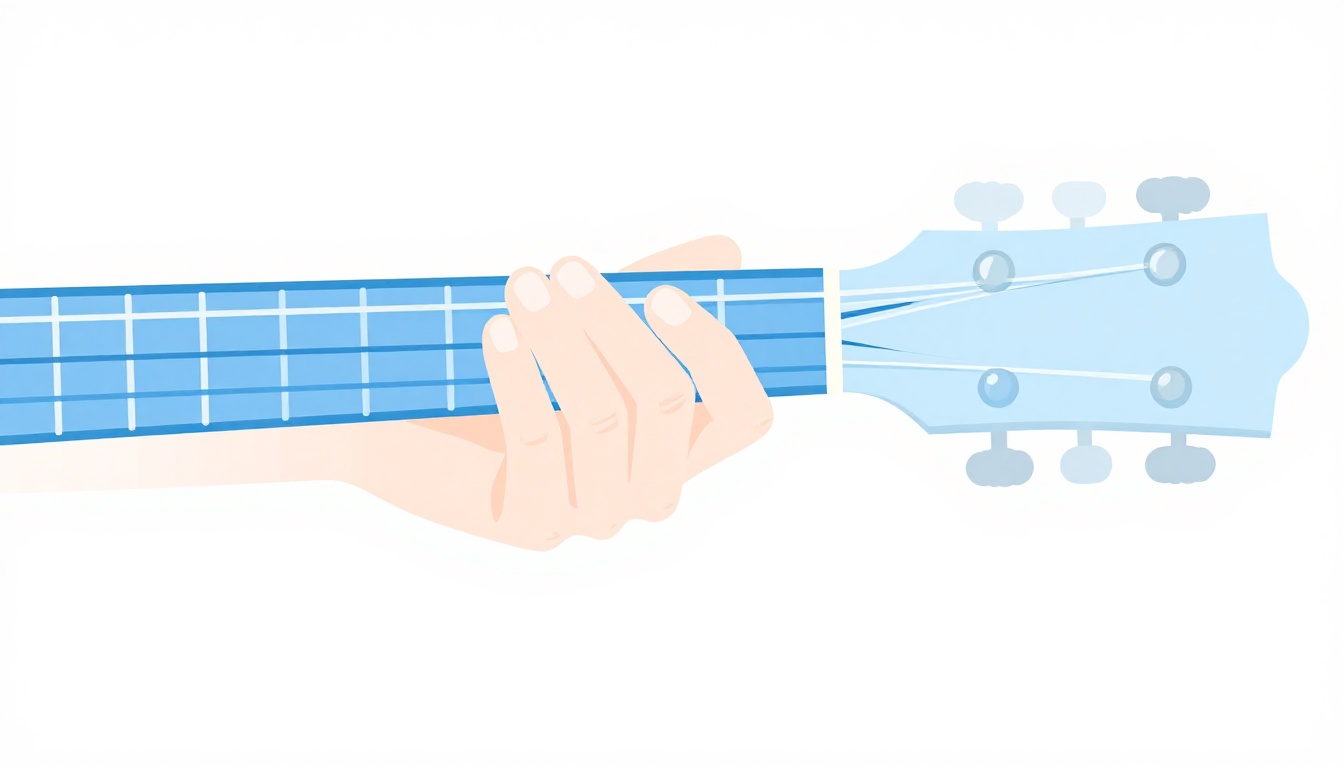
Play the intro as E for one bar, then Esus4 for one bar, back and forth. Keep your strumming hand moving in a steady rhythm through the whole thing rather than pausing to check your pinky placement. The chord change is small enough that your strumming arm should never actually stop.
The A Chord
A major follows E in both the verse and the chorus, and the two chords share enough of a shape that the change is one of the more natural ones on the neck.
| String | Fret | Finger |
|---|---|---|
| 6 (low E) | Muted | - |
| 5 (A) | Open | - |
| 4 (D) | 2 | 1 (index) |
| 3 (G) | 2 | 2 (middle) |
| 2 (B) | 2 | 3 (ring) |
| 1 (high E) | Open | - |
Mute the low E string, leave the 5th string (A) open as the root, and place your index, middle and ring fingers on the 4th, 3rd and 2nd strings, all at the 2nd fret. Some players prefer to lay the index finger flat across those same three strings as a mini barre instead of using three separate fingers. Either version is correct. Use whichever one lets you change chords faster while you are still learning the song.
The B7 Chord
B7 closes out most verse lines and sits inside the chorus too. It is the only chord in the song that uses all four fingers.
| String | Fret | Finger |
|---|---|---|
| 6 (low E) | Muted | - |
| 5 (A) | 2 | 2 (middle) |
| 4 (D) | 1 | 1 (index) |
| 3 (G) | 2 | 3 (ring) |
| 2 (B) | Open | - |
| 1 (high E) | 2 | 4 (pinky) |
Mute the low E string, place your middle finger on the 5th string (A) at the 2nd fret, your index finger on the 4th string (D) at the 1st fret, your ring finger on the 3rd string (G) at the 2nd fret, leave the 2nd string (B) open, and stretch your pinky onto the 1st string (high E) at the 2nd fret. It is a genuine stretch the first several times you form it, but none of the fingers are barring, which makes it more approachable than most four-finger shapes. B7 functions here as the V7 chord of the key, the chord that pulls the progression back toward E every time it appears. For more on how E, A and B7 work together as a set (they also form a standard 12-bar blues in E), see the E major chord guide.
The F#m Chord in the Chorus
F#m is the one chord in this song that is not an open shape. It shows up in the chorus, on the words "peaceful, easy feeling," and again in the outro.
| String | Fret | Finger |
|---|---|---|
| 6 (low E) | 2 | 1 (barre) |
| 5 (A) | 4 | 3 |
| 4 (D) | 4 | 4 |
| 3 (G) | 2 | 1 (barre) |
| 2 (B) | 2 | 1 (barre) |
| 1 (high E) | 2 | 1 (barre) |
Lay your index finger flat across all six strings at the 2nd fret, then add your ring finger on the 5th string (A) at the 4th fret and your pinky on the 4th string (D) at the 4th fret. This is the same E-shape minor barre used for Fm, Gm or Am at other frets, moved up to the 2nd fret to sound as F#m. It is the only chord in the song that will genuinely slow you down at first, and there is a full section below on both the fastest way to build it and a capo trick that skips the barre entirely. The F#m chord guide covers every version of this shape in more depth, including a mini three-string version for quick strumming.
The Asus2/F# Alternative to F#m
Some transcriptions of this song write the chorus using Asus2 with F# in the bass instead of a plain F#m barre. Written as a slash chord, that is Asus2/F#. It uses the same three notes that give the chorus its F#m color (F#, A and C#) but reaches them from an open A shape with the bass note shifted, rather than from a barre.
To play it, form your normal open A chord, then move your fretting so the lowest note played is F# rather than A. In practice, most guitarists playing this version fret the 4th string (D) at the 4th fret with their thumb or a spare finger for the F# bass note, keep the open A shape's upper strings, and strum from the 4th string down. It is a real alternative used in some arrangements of this song, not a simplification of F#m, and it sounds slightly different: brighter and less resolved than a plain minor chord, closer to the "suspended" color covered in the Esus4 section above. If the full F#m barre is still out of reach, the capo-and-Em trick two sections down is the more common beginner substitute; this slash-chord version is worth knowing mainly so it does not confuse you if you come across a chart that uses it.
The B7sus4 Variation Some Charts Use
Some transcriptions of the verse resolve onto B7sus4 for a beat before settling on plain B7, a small decoration on the same chord rather than a separate one to learn from scratch.
| String | Fret | Finger |
|---|---|---|
| 6 (low E) | Muted | - |
| 5 (A) | 2 | 2 (middle) |
| 4 (D) | 2 | 1 (index) |
| 3 (G) | 2 | 3 (ring) |
| 2 (B) | Open | - |
| 1 (high E) | 2 | 4 (pinky) |
Starting from your B7 shape, lift your index finger off the 4th string (D) at the 1st fret and set it back down one fret higher, at the 2nd fret, right alongside your ring finger. That single finger move replaces B7's third with its fourth, the same "sus4" relationship covered earlier with Esus4, and resolving from B7sus4 back to plain B7 by sliding the index finger back down a fret is a small, satisfying detail that some players add without ever writing it into their own chart. It is entirely optional. The song is complete and correct without it, and plain B7 throughout is not a simplified version, just a different valid way to play the same verse.
Full Section by Section: Every Chord in Order
Here is the whole song, section by section, with every chord in the order it falls. Play through this slowly with a metronome before trying to keep up with a recording.
Intro E - Esus4 - E - Esus4 (repeated twice)
Verse E - A - E - A - E - A - B7
Chorus A - E - F#m - B7 (repeated, resolving back to E)
Interlude (between verses, mirrors the intro) E - Esus4 - E - Esus4 (repeated twice)
Verse 2 and 3 Same as verse 1: E - A - E - A - E - A - B7
Final chorus Extended, with the F#m chord held under the repeated line "yes I'm already standing on the ground," before resolving to E
Outro E - F#m - A - B7, repeated and fading or ending cold on E
Nothing in that structure is unusual once you can see it laid out. It is five chords in a fixed rotation, repeated with only small variations, which is a large part of why the song feels as settled and unhurried as its title suggests.
Where This Song Came From
Jack Tempchin wrote "Peaceful Easy Feeling" in the early 1970s, sketching an early version of the lyric on the back of a promotional poster at a coffee shop in El Centro, California. He finished the verses later while rooming with other musicians in San Diego, drawing the imagery partly from watching people at bus stops and from a specific memory of a girl with turquoise earrings.
Glenn Frey heard the song and asked to develop it further with his newly formed band. The Eagles recorded it for their self-titled 1972 debut album, produced by Glyn Johns at Olympic Sound Studios in London. Frey sang lead and played acoustic guitar, Bernie Leadon added B-Bender electric guitar along with harmony vocals starting in the second verse, Randy Meisner played bass and sang backing vocals, and Don Henley played drums and sang backing vocals. Released as a single on December 1, 1972, it reached number 22 on the Billboard Hot 100 and became one of the band's most enduring songs. (For more on the recording, see the song's Wikipedia entry.)
None of that history changes a single chord shape, but it explains the arrangement you are playing. This was built as a plainspoken, acoustic-first song from the start, which is why the chord vocabulary stays so simple even as the harmony parts around it get more layered on the record.
The B-Bender Guitar Part You're Hearing
The pedal-steel-like sighing sound woven through the recording, especially behind the vocal in the second half of each verse, is not a pedal steel at all. It is Bernie Leadon playing electric guitar fitted with a B-Bender, a mechanical device built into the guitar's body that bends the B string up in pitch, usually a whole step, using a lever connected to the strap.
The B-Bender was invented in 1967 by Clarence White and Gene Parsons, initially built into White's 1954 Fender Telecaster so he could simulate a pedal steel's signature pitch-bend without a second instrument on stage. The mechanism works through the guitar strap itself: pushing down on the neck pulls the strap button upward, which activates a set of levers inside the guitar body and raises the B string's pitch while the player's fretting hand stays free to keep playing chords underneath. Leadon was among the earliest guitarists outside White's own circle to adopt the device, and the smooth, vocal-like bend it produces on "Peaceful Easy Feeling" is one of the record's most identifiable textures even though most listeners assume it is a pedal steel guitar.
You do not need a B-Bender, or even an electric guitar, to play this song well. Every chord and every note this post covers works on a standard acoustic guitar in standard tuning with no modifications. The B-Bender part is a separate instrumental layer on top of the chords, not a requirement for playing them, and it is worth knowing about mainly so the sighing sound in the recording does not leave you searching for a chord or technique that was never yours to reproduce on rhythm guitar in the first place.
Why It Sits in the Key of E
E major is a guitar-friendly key for the same reason C major is a piano-friendly one: the open strings do a lot of the work. E, A and B7 form the I, IV and V chords of the key, the same three-chord backbone used in a huge amount of folk, country and blues writing, and all three are available as open shapes that ring with at least one unfretted string.
F#m is the ii chord of E major, built on the second degree of the E major scale. Minor ii chords are common connective tissue in pop and rock progressions precisely because they sit a whole step above the tonic and lead smoothly back toward the V chord, which is exactly the role F#m plays here, bridging from A back down to B7 in the chorus. Esus4 is not a separate key-defining chord so much as a decoration on E itself, the suspended fourth resolving back to the major third a beat later, which is what gives the intro its gentle push-and-release feel rather than sounding like a full chord change.
The Chord Progression in Roman Numerals
Seeing the same progression written as scale degrees instead of chord names makes it easier to recognize this same shape in other songs later, since the pattern, not the specific key, is what repeats across folk and country-rock writing.
| Chord | Roman numeral | Role |
|---|---|---|
| E | I | Tonic, the home chord |
| F#m | ii | Minor, connective, leads toward V |
| A | IV | Subdominant, the most common chord to move to from I |
| B7 | V7 | Dominant, creates the pull back to I |
The verse leans almost entirely on I and IV (E and A), the two chords guitarists reach for first in any key because they share the most open strings and the smoothest hand movement. The chorus is where the ii chord appears, adding a moment of minor color before the V7 chord resolves everything back to the tonic. If you already know this I-ii-IV-V7 pattern from another song in a different key, you already know the shape of this one; only the specific chord names change.
Playing It on Electric or Acoustic
The recording layers an acoustic rhythm part, Glenn Frey's, under an electric B-Bender part, Bernie Leadon's, but every chord shape in this post plays identically on either instrument. Nothing about E, Esus4, A, B7 or F#m changes based on what you are holding.
What does change is feel. An acoustic guitar, strummed with the light down-down-up-up-down-up pattern covered above, gets you closest to the rhythm part actually on the record, since that is what Frey played. A clean electric tone with a touch of reverb will also work well and is a reasonable substitute if an acoustic is not what you have on hand, though you may want to back off the strumming intensity slightly, since electric pickups pick up pick attack more directly than an acoustic soundhole does. Either way, there is no need to chase the electric B-Bender texture on rhythm guitar. That part exists as a second layer on top of the same chords, not a different way of playing them.
Playing It With a Capo: The D-Shape Version
If the F#m barre is the one thing standing between you and playing this whole song cleanly, a capo removes it entirely. Clip a capo on the 2nd fret and every chord shifts down to an easier open shape a whole step lower, while the song still sounds in the same key it was recorded in.
| Chord that sounds | Shape you play behind the capo |
|---|---|
| D | D shape |
| Dsus4 | Dsus4 shape |
| G | G shape |
| A7 | A7 shape |
| Em | Em shape |
The most useful swap is the last one. An open Em shape played behind a capo on the 2nd fret sounds as F#m, note for note, without a barre anywhere in the chord. This works because a capo shortens every string's vibrating length equally, which raises every open string's pitch by the same two semitones, exactly as if the whole guitar had been retuned up a whole step. A chord shape is just a pattern of relationships between strings, not a fixed set of pitches, so the same open Em shape you already know produces F#m once the capo does that work for you. The F#m chord guide covers this trick in more detail, including why it works for any minor barre chord, not just this one. For a full map of every shape at every fret, the guitar capo chart is worth bookmarking.
D:
| String | Fret | Finger |
|---|---|---|
| 6 (low E) | Muted | - |
| 5 (A) | Muted | - |
| 4 (D) | Open | - |
| 3 (G) | 2 | 1 (index) |
| 2 (B) | 3 | 3 (ring) |
| 1 (high E) | 2 | 2 (middle) |
G:
| String | Fret | Finger |
|---|---|---|
| 6 (low E) | 3 | 2 (middle) |
| 5 (A) | 2 | 1 (index) |
| 4 (D) | Open | - |
| 3 (G) | Open | - |
| 2 (B) | Open | - |
| 1 (high E) | 3 | 3 (ring) |
A7:
| String | Fret | Finger |
|---|---|---|
| 6 (low E) | Muted | - |
| 5 (A) | Open | - |
| 4 (D) | 2 | 1 (index) |
| 3 (G) | Open | - |
| 2 (B) | 2 | 2 (middle) |
| 1 (high E) | Open | - |
Em:
| String | Fret | Finger |
|---|---|---|
| 6 (low E) | Open | - |
| 5 (A) | 2 | 2 (middle) |
| 4 (D) | 2 | 3 (ring) |
| 3 (G) | Open | - |
| 2 (B) | Open | - |
| 1 (high E) | Open | - |
Every chord in this version is fully open, no barre required anywhere in the song. The tradeoff is that your guitar's open-string ring now happens at the capo, two frets up the neck, which changes the tone slightly, a touch brighter and tighter than the uncapoed version. Most listeners will not notice the difference. If you are playing this song for someone rather than recording it, the capo version is a completely legitimate way to play it.
The Strumming Pattern
The pattern most commonly taught for this song is down, down, up, up, down, up, played across each bar in a steady 4/4 feel. Count it against the beat as: down on 1, down on the "and" of 1, up on 2, up on the "and" of 2, down on 3, up on the "and" of 4, adjusting slightly to taste. A simpler version, useful while you are still learning the chord changes, drops to a plain down, down, up, up, down, up with even spacing and no syncopation, which still captures the relaxed, rolling feel of the song without asking your strumming hand to do anything tricky.
Keep the strum light. This is not a song that rewards aggressive strumming, and a heavy hand will fight against the chord shapes, especially Esus4's quick pinky move and F#m's barre, both of which need a relaxed fretting hand more than a hard-hitting strumming one. Let the open strings in E, A and Em do the work of filling out the sound, rather than trying to force volume out of the strum itself.
Reading This Song's Chords on a Chart
If you are working from a printed or online chord chart rather than this post, a few notation habits are worth knowing so nothing on the page catches you off guard. Chord names written above a lyric line, like the "E" over the word "peaceful," tell you to change to that chord exactly on the syllable it sits above, not before or after. A chord written with a slash, such as the Asus2/F# covered earlier in this post, means play the chord named before the slash while using the note named after the slash as the bass note, a common way to notate a chord that shares notes with a simpler shape but wants a different note on the bottom.
Repeat marks, a colon followed by two dots facing a set of bars, tell you to play that section again before moving on, which is how most charts notate the intro's E-Esus4 pattern without writing it out four separate times. A number in parentheses after a repeated section, like "(x2)" or "(x3)," tells you exactly how many times to repeat it. None of these conventions are unique to this song. Once they are familiar, any chord chart for any song becomes faster to read at a glance instead of something to decode line by line.
Why It's Not Working
If you have the shapes down but the song still does not sound right, it is almost always one of these, not a sign you need different chords.
The E Chord Buzzes on the G String
If the 3rd string sounds muted or buzzes when you strum E, your index finger is likely not pressing close enough to the 1st fret, or it is flattening slightly and brushing the 2nd string next to it. Move your fingertip right up against the fret wire rather than in the middle of the fret space, and check that only the very tip of your index finger is making contact with the string.
Esus4 Sounds Like Nothing Changed
If adding your pinky on the 3rd string does not audibly change the chord, the pinky is likely not pressing hard enough to fully stop the string at the 2nd fret, which lets the open 1st-fret note underneath bleed through. Press the pinky down firmly, right behind the 2nd fret wire, and confirm you can hear a clear pitch change by plucking just that string alone before you strum the full chord.
F#m Sounds Dead on the A or D String
The two fingers doing the extra work in F#m, your ring finger and pinky on the 5th and 4th strings, need to arch upward so they do not accidentally lean into the barre finger underneath them and mute it. Check each string one at a time by plucking it alone. If the low E, G, B or high E strings (the ones your barre finger covers) sound muted, your index finger is likely rolling slightly off its flat position rather than staying pressed evenly across all six strings.
The Chord Changes Rush or Stumble
This song's chords are simple individually, but the tempo asks you to move through several of them in a single bar during the verse. If your changes feel rushed or late, you are very likely trying to move your whole hand at once. Instead, identify which finger moves the least between two chords, land that one first, and let the others follow. Between E and A, for example, your ring finger barely moves at all, so anchoring on that finger first, then bringing the others in, is usually faster than trying to place all three at once.
B7 Feels Like a Stretch You Cannot Hold
B7 is the only four-finger, no-barre chord in this song, and the pinky reaching to the 1st string trips up a lot of players early on. Bring your thumb further down the back of the neck rather than centering it under your palm, which shortens the reach every other finger needs to make without changing the shape itself.
Mistakes That Are Not About the Chord Shapes
Some of what makes this song sound off has nothing to do with fretting the chords correctly and everything to do with habits around them.
Strumming Too Hard Throughout
This is the single most common mistake on this specific song. "Peaceful Easy Feeling" is built around open, ringing chords and a light touch, and a heavy strumming hand fights against both. If your version sounds tense or rushed even when every chord is fretted correctly, try cutting your strumming volume roughly in half before changing anything else.
Muting the Low E String Out of Habit, Even When It Should Ring
E and Esus4 both want the low E string open and ringing, but if you have been playing other songs that mute or skip that string in A or B7, it is easy to carry that habit into E without noticing. Check specifically that your low E string is ringing clearly whenever you are on E or Esus4, since it is one of the notes doing the most work to make those two chords sound as full as they do on the record.
Treating the Intro as a Warm-Up Instead of Part of the Song
Because the intro is just two chords, it is tempting to strum through it quickly to get to the verse. The pinky move between E and Esus4 is the song's signature riff, not filler, and rushing it undersells the part of the arrangement most listeners recognize first. Give it the same steady, unhurried tempo you would give any other section.
Stopping Completely When a Chord Change Goes Wrong
A missed change during practice is normal and expected. Stopping entirely to fix it, rather than continuing forward and catching the next repetition, trains your hands to expect an interruption every time a change is difficult, which slows down learning the song as a whole. Keep the tempo moving even through an imperfect change, and let the next pass be where the correction actually happens.
How Long It Takes to Learn This Song
For a player who already knows a handful of open chords, including something in the neighborhood of E, A and D, a clean, full run-through of "Peaceful Easy Feeling" is realistic within one to two weeks of short daily practice sessions. The E, Esus4, A and B7 shapes are all things most players in that position can already form; what takes the practice time is speed, specifically the E-A-B7 verse rotation and the Esus4 pinky move landing cleanly without slowing the strum down to check finger placement.
For a newer player still building basic open-chord shapes from scratch, expect the timeline to stretch closer to four to six weeks, with F#m as the long pole. Barre chords in general take longer to feel natural than open chords do, regardless of how quickly everything else in this song comes together, so it is worth using the capo-and-Em substitute covered above to keep playing the full song while that specific chord develops in the background rather than waiting on it before you can play anything at all.
Either way, the fastest path through is the one covered throughout this post: isolate the hard piece, whichever one it is for you, and drill it slowly and specifically rather than running the whole song from the top on every attempt. A single problem spot fixed in isolation saves far more time than dozens of full run-throughs that stumble over the same three seconds every time.
Getting the E-A-B7 Verse Changes Up to Tempo
The verse asks you to move through E, A and B7 multiple times inside a single line of lyrics, which is the part of this song most beginners underestimate. Practice it on its own, away from the rest of the song, using a slow metronome click.
Start at a tempo slow enough that you can change cleanly every time, even if that feels far too slow to be musical. Play one bar of E, one bar of A, one bar of E, one bar of A, one bar of E, one bar of A, and one bar of B7, exactly as the verse does, and repeat that loop for two or three minutes without stopping, even if a change goes wrong. Stopping to fix a bad change trains the mistake as much as the correction does; better to keep the tempo going and let the next repetition be the fix. Increase the metronome by five beats per minute only once the loop runs clean three times in a row.
Easier Versions for Small Hands or New Players
If B7's four-finger stretch or F#m's barre are still out of reach, there are real, correctly fingered ways to simplify without changing the song's sound in any way a listener would notice.
For B7, a two-finger version drops the pinky and plays only the 5th and 4th strings fretted, muting everything above the 3rd string and strumming just the bottom four strings. It loses some of the chord's brightness but keeps its core function as the V chord pulling back toward E.
For F#m, the capo-and-Em version covered above removes the barre completely and is the standard answer for this exact problem. If you would rather not use a capo, the mini three-string version, barring only the 3rd, 2nd and 1st strings at the 2nd fret and strumming just those three, works as a lighter stand-in for a beat or two, particularly in the outro where F#m appears quickly between other chords.
Neither of these is a lesser way to play the song. Both use the same core notes as the full versions, and both let you keep playing through a section instead of stopping cold on a chord your hand is not ready for yet.
Building the Verse-to-Chorus Dynamic
On the record, the arrangement thickens as the song goes: the first verse is closer to just Frey's acoustic guitar and voice, and Bernie Leadon's harmony vocal and B-Bender part join from the second verse onward, giving the song a sense of gradually filling out rather than staying flat from start to finish. Playing solo, you do not have a second voice or a B-Bender to add, but you can still shape that same feeling with the tools you do have.
Play the first verse and intro with a lighter, quieter strum, staying close to the strings rather than swinging your arm through a wide motion. From the second verse onward, open the strum up slightly, both in volume and in how far your hand travels, and let the chorus be the loudest, fullest point in the song before pulling back again for the final verse or outro. This costs nothing extra to learn since it uses the same chords and the same strumming pattern throughout, but it is the difference between a technically correct run-through and one that actually sounds like it is going somewhere.
Singing and Playing at the Same Time
Once the chords and the strumming pattern are solid on their own, singing while playing is usually the next wall beginners hit on this song, mostly because the vocal melody does not always land its words exactly on the strum. Two things make this easier.
First, learn the guitar part to the point that it runs almost automatically, with your strumming hand keeping steady time even if your attention drifts elsewhere. Trying to sing while still consciously thinking through each chord shape splits your attention in a way that usually causes both the singing and the playing to suffer. Second, practice the vocal melody alone, without the guitar, until you know exactly where each line falls against a steady beat you tap or count out loud. Once both halves are separately automatic, combining them is mostly a matter of doing both at once slowly at first, then bringing the tempo up gradually, the same way you would build up any other new skill on the instrument.
Playing Along with the Recording
Because the original recording is in E major with no capo, you can play every shape in this post directly along with the studio version without any transposition. Start the intro riff with the record, matching your E-Esus4 alternation to what you hear, and you should land in the pocket without adjustment.
If you are using the capo-2 version covered above instead, remember that your capoed D-shape chords will still sound in the recording's original key of E, so you can play along with that version too. What will not line up is mixing the two approaches within a single pass. Pick either the no-capo E-based shapes or the capo-2 D-based shapes for a given run-through, rather than switching between them mid-song, since the capo changes which open strings are available to you and switching approaches mid-song asks your hand to relearn the neck in real time.
Practice Routine
Fifteen minutes is enough to make real progress on this song if you spend it deliberately rather than just strumming through from the top every time.
Spend the first five minutes on the E to Esus4 pinky move alone, in time with a slow metronome click, until it stops requiring conscious thought. Spend the next five minutes on the E-A-B7 verse loop described above, focusing on clean changes over speed. Spend the final five minutes on F#m by itself, either the full barre or the capo-and-Em version, checking each string individually for buzz before moving on. Only once each piece is solid on its own should you try running the whole song front to back, and even then, it is fine to slow the tempo down below the recording's until every change lands cleanly.
Changing Between Chords Is the Real Skill
Every chord covered in this post is, on its own, something most players with a few weeks of experience can already form. What actually determines whether this song sounds right is how quickly and cleanly you move between them, especially inside the verse's rapid E-A-B7 rotation and the quick pinky flick of the intro. Treat the individual shapes as the easy part and the changes as the thing worth most of your practice time, and the rest of the song follows from there.
Frequently Asked Questions
What key is "Peaceful Easy Feeling" in?
E major, on the original Eagles recording from their 1972 debut album. It uses the I, IV and V chords of that key (E, A and B7), plus the ii chord (F#m) in the chorus, along with Esus4 as a decoration on the tonic chord in the intro.
Does the song use a capo?
Not on the original recording. A capo on the 2nd fret is a common and completely valid way to play it if you want to avoid the F#m barre chord, swapping it for an open Em shape while the song still sounds in the same key.
What strumming pattern fits this song?
Down, down, up, up, down, up is the most commonly taught pattern, played in a relaxed 4/4 feel. A simpler, evenly spaced version of the same down-down-up-up-down-up pattern works fine while you are still learning the chord changes.
Is F#m the hardest chord in the song?
Yes, for most beginners. It is the only chord that requires a full barre. The capo-and-Em trick or the mini three-string version, both covered above, are legitimate ways to play it while your barre-chord strength builds.
Who wrote "Peaceful Easy Feeling"?
Jack Tempchin wrote it in the early 1970s, and the Eagles recorded it for their self-titled 1972 debut album. Glenn Frey sang lead and played the acoustic guitar part covered in this post.
Why does the intro sound like it is barely changing chords?
Because it almost is not. E and Esus4 share five of their six notes, differing only on the 3rd string, so the move between them is a single finger going down and coming back up rather than a full chord change, which is exactly why it sounds so smooth.
Can I play this song fingerstyle instead of strumming?
The recording is a strummed acoustic part, not a fingerpicked one, but nothing about the chord shapes themselves prevents you from picking out a simple pattern across the strings if you prefer that sound. The chord voicings and progression stay identical either way.
Do I need all four fingers for every chord in this song?
No. E and A both use three fingers, Esus4 and Em use three, and only B7 and the full F#m barre call on all four. If a particular stretch is not there yet, the easier versions covered above use fewer fingers without changing which chord you are playing.
Do I need a B-Bender or an electric guitar to play this song?
No. The B-Bender part heard on the recording, played by Bernie Leadon, is a separate electric guitar layer added on top of the rhythm chords, not something required to play the chord progression itself. Every chord in this post works on a standard acoustic guitar in standard tuning.
What are the chords in Roman numerals, and why does that matter?
E is I, F#m is ii, A is IV, and B7 is V7. Recognizing this I-ii-IV-V7 shape matters because it is one of the most common chord patterns in folk and country-rock songwriting, so once you can hear and play it here, you will start noticing the same underlying movement in other songs written in other keys.
GuitarLowKey
Ready for fifteen focused minutes?
Open the web app and train the change that is blocking your song.